Seeing the bigger picture: modernising the criminal justice estate using a geographic approach


Rachel Cookson
Customer Success Manager, Esri UK
Underpinning access to justice is a physical estate that has to work: buildings, land, cells, courtrooms that are safe, compliant, and fit for purpose. When that estate is poorly understood, under-maintained, and managed reactively, the consequences are felt by everyone who passes through it, victims waiting for hearings in courts stretched beyond capacity, offenders held in conditions that undermine rehabilitation, probation staff unable to reach the people they supervise.
When the physical estate fails, justice fails with it. And right now, the Criminal justice estate is under profound pressure.
A system at breaking point
A key challenge is maintaining estates that are compliant, operational, and efficient across the entire Criminal justice system. In prisons, a maintenance backlog now approaching £1.8 billion has left thousands of cells unfit for use. Across HMCTS and HMPPS, ageing infrastructure is compounding an already record-breaking case backlog, limiting the ability to run services efficiently and eroding public confidence. In probation, a dispersed estate of contact centres and approved premises struggles to match the geographic distribution of caseloads with the resources needed to manage them.
A geographic approach
A geographic approach solves this by using location as the common thread linking data to decision making. Because everything happens somewhere, location is the one layer that connects data that would otherwise remain siloed across legacy systems, paper files, and disconnected teams. At Esri UK, we apply ArcGIS to create a single source of truth of that dispersed data.
In practice, this means using mobile apps to capture and maintain digital records of assets across the estate, so that maintenance activity can be prioritised, tracked, and kept current. It means integrating CAD drawings and redline ownership boundaries directly into a live map, so that property boundaries, compliance schedules, and custodial land holdings are visible and linked rather than buried in separate systems. It means using Building Information Modelling data from new prison developments within a GIS to map the interior of buildings, enabling spatial analysis of prisoner and staff distribution to optimise movement, reduce conflict risk, and improve safety.
What we are describing is essentially a digital twin of the justice estate: location used as the backbone that joins up every dataset, every building, every site, into a single living picture. as demonstrated by Manchester University NHS Foundation Trust, who used ArcGIS to build a smarter estate.
Mapping a 'smart estate' for Manchester University NHS Foundation Trust - BIS Consult - AC23
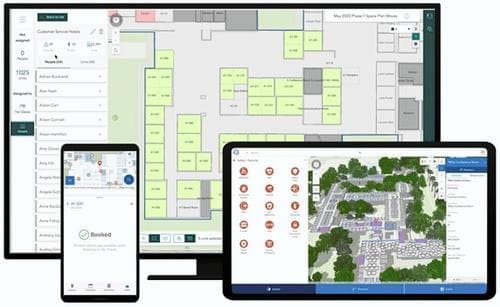
Modernising the criminal justice estate
Critically, a geographic approach provides insight that goes well beyond the buildings themselves. By layering location-enabled data such as potential sites, utilities, staff locations, flood risk, and biodiversity, the justice estate is understood in relation to the communities and environments it operates within:
Maintenance and capital planning. Estate teams can layer asset age, condition data, and budget constraints onto a map to model where investment will have the greatest impact, making decisions faster, more evidenced, and more justifiable.
Space utilisation and capacity management. With a live picture of occupancy across every site, informed decisions can be made from actionable intelligence about where to place people and how to balance demand across a constrained portfolio. For an estate facing projected population growth of 3,000 places per year, this is essential.
Sustainability and net zero planning. A holistic view of the estate makes it possible to understand how habitats and environmental conditions are changing across it, track energy performance building by building, and target retrofit investment where it will have the greatest impact.
Security and safety assessments. Spatial analysis enables teams to model lighting coverage, viewsheds, and access routes, identifying gaps before incidents occur and supporting the evidence-based safety planning that inspectors and regulators expect.
For the justice estate, this means knowing not just where a probation office sits, but whether it is genuinely accessible to the caseload it serves. It means understanding whether a site earmarked for a new prison carries flood or climate risk before capital is committed. It means shifting from estate management as a facilities function to estate strategy as a tool for justice outcomes.
Technology has a critical role to play, not just in digitising processes, but in giving those responsible for the estate the visibility and intelligence they need to make better decisions. Location Intelligence gives the criminal justice estate the clarity it needs to do that.