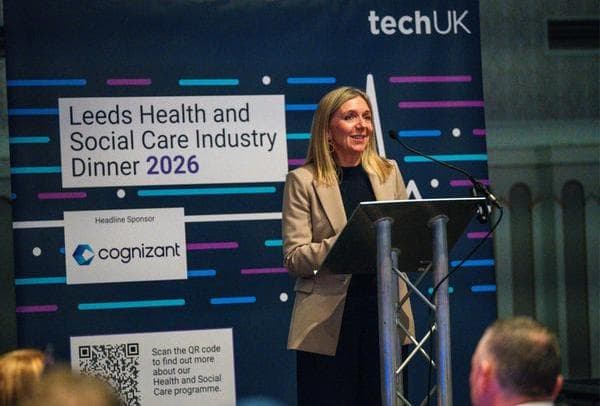
On 30 April, techUK convened senior leaders from across the digital health, life sciences, and social care industry in Leeds for our annual Health and Social Care Industry Dinner.
The evening brought together almost three hundred C-suite leaders alongside senior figures from NHS England (NHSE), Department of Health and Social Care (DHSC), Medicines and Healthcare products Regulatory Agency (MHRA), and Health Data Research Service (HDRS).
The dinner opened with keynote speeches by Dr Melanie Ivarsson OBE, Chief Executive Officer of the Health Data Research Service (HDRS) and Lawrence Tallon, Chief Executive Officer of the Medicines and Healthcare products Regulatory Agency (MHRA). The summaries below set out the key themes and arguments from each keynote.

Dr Melanie Ivarsson OBE, Chief Executive Officer, Health Data Research Service (HDRS)
Melanie opened her remarks with a strong claim: the UK has a once-in-a-generation opportunity to become the best place in the world to conduct medical research, and the Health Data Research Service (HDRS) is the route to realise this ambition.
Drawing on a career that spans neuroscience, pharma, and biotech, she explained that while the UK's combination of richness and diversity in health and care data is unmatched, it is inaccessible today. HDRS has been given the mandate to "put everything on the table": to consolidate the duplicate data pots, access pathways and approval committees that currently fragment the landscape, and to make recommendations on what should stop, change, or scale.
Its first year as an arms-length body will focus on funding the underlying infrastructure: the regional Trusted Research Environments (TREs), the Secure Data Environments (SDEs) network, and the Data Safe Havens. In parallel, a strategy and full business case will be co-developed with industry, academia, and patients, ahead of an autumn submission for the remainder of HDRS's funding.
"We have the most incredible health and care data available to us in this very diverse population. It's inaccessible today, but we want to make it really accessible in the future." - Dr Melanie Ivarsson
Three themes emerge for industry. First, the commercial and access model is being explicitly designed to be fit for purpose for industry. This model must be viable especially for small and medium sized enterprises (SMEs) as big pharmaceutical companies only account for 11% of health data access requests. HDRS aims to unlock investment, double clinical trial volumes, and support data-enabled trials. Second, AI functionalities are being embedded in the operating model from the outset. Third, public trust is treated as a core enabler rather than a downstream concern. Citing a Norwegian counterpart who described public expectation on fair use of health data as the norm, Melanie committed to prioritising the development of public trust.
Lawrence Tallon, Chief Executive Officer, Medicines and Healthcare products Regulatory Agency (MHRA)
"You don't often hear regulation and innovation in the same sentence unless there is a 'but' or some sort of contrary phrase. But I believe we can make regulation good, regulation pro-innovation, a catalyst for innovation." - Lawrence Tallon
Lawrence made the case that good regulation can be the catalyst for innovation rather than a barrier. Given the challenges the NHS faces, the MHRA aims to champion this principle and support the UK health ecosystem to navigate the necessary deep systemic change.
Lawrence reviewed some of the ongoing transformations: the post-market surveillance regime for medical devices introduced last June; the indefinite recognition of CE marking; and a reinvention of UKCA into a genuine first-in-market pathway, particularly for AI as a Medical Device.
Industry is now awaiting the upcoming reporting of the National Commission on the Regulation of AI as a Medical Device, chaired by Professor Alistair Denniston. Lawrence previewed three guiding principles, which closely align with techUK's advocacy on AI regulation in Health.
The principles include:
Weighing the risk of inaction alongside the risk of action
Shifting the centre of gravity from pre-market hurdles to post-market surveillance
Adopting context-specific regulation that accounts for the device, the user, and the institutional setting.
The speech closed on a collaborative note, framing the agenda he set out as one that no single actor can deliver alone. As a community of technology leaders, techUK welcomes the message as an invitation and challenge to meet this openness with the engagement, evidence, and ambition it requires.
"None of us can do this on our own, but working together as a wider collective ecosystem, we can innovate for the improvement of health services." - Lawrence Tallon

Robert Walker
Head of Health & Social Care, techUK
Robert Walker
Head of Health & Social Care, techUK
Robert joined techUK in October 2022, where he is now Programme Manager for Health and Social Care.
Robert previously worked at the Pension Protection Fund, within the policy and public affairs team. Prior to this, he worked at the Scottish Parliament, advising politicians and industry stakeholders on a wide range of issues, including rural crime and health policies.
Robert has a degree in Politics and International Relations (MA Hons) from the University of Aberdeen, with a particular focus on strategic studies and energy security. Outside of work he enjoys activities such as running, rugby, boxing and cooking!
Rachel joined techUK in December 2024, as a Programme Manager in the Health and Social Care team.
Prior to this, Rachel worked at a specialist health and social care public affairs agency, working with a range of organisations and trade bodies across the medical technology, pharmaceutical, digital health and social care sectors. As well as this, Rachel was part of the Secretariat for a number of health and care related All-Party Parliamentary Groups.
Rachel has a Masters in Global Governance and Diplomacy from the University of Leeds, as well as a first-class honours in Politics BA from Newcastle University.
Lewis Stewart
Programme Manager ‑ Health and Social Care, techUK
Lewis Stewart
Programme Manager ‑ Health and Social Care, techUK
Lewis brings a multidisciplinary background spanning health policy, stakeholder engagement, digital innovation, and elite sport. A former Commonwealth Games champion, he draws on the resilience, adaptability, and team-driven mindset gained through years of high-performance competition.
Before joining techUK, Lewis supported a Member of Parliament in the House of Commons, where he led on constituency engagement and produced evidence-based research to inform debates, committee work, and policy advocacy. He has also helped shape youth wellbeing policy through the Youth Sport Trust, collaborating with government, education, and grassroots networks to drive impact.
Lewis has played key roles in health tech and mobility startups, helping to bring innovative solutions to market and improve user experience in complex systems. With a degree in Biochemistry and Pharmacology, he combines analytical thinking with a passion for evidence-led, people-centred change.
Junior Programme Manager, Health and Care Team, techUK
Viola Pastorino
Junior Programme Manager, Health and Care Team, techUK
Viola Pastorino is a policy, governance, and strategic communication specialist.
She joined techUK as the Junior Programme Manager in the Health and Care Team in April 2024.
She has obtained a Bachelor of Sciences in Governance, Economics, and Development from Leiden University, and a Master's programme in Strategic Communications at King's College London. Her academic background, leading up to a dissertation on AI policy influence and hands-on campaign development, is complemented by practical experience in international PR and grassroots project management.
She is skilled in qualitative and quantitative analysis and comfortable communicating findings to varying stakeholders. Above all, she is deeply passionate about the intersection of technology and government, especially how technology and global discourse shape one another, the processes that lead to belief polarisation and radicalisation of communities, and crafting strategic narratives that steer public discourse.
Outside of work she loves reading, live music light operation, and diving.
Health and Social Care Programme activities
techUK is helping its members navigate the complex space of digital health in the UK to ensure our NHS and social care sector is prepared for the challenges of the future. We help validate new ideas and build impactful strategies, ultimately ensuring that members are market-ready. Visit the programme page here.
techUK CareTech Conference 2026
Explore how technology is transforming adult social care, from digital innovation to service delivery at scale. Hear from leaders across the sector on priorities, challenges and practical solutions improving outcomes for people and providers. Join the conversation to understand where caretech is delivering impact and what comes next.
Our members develop strong networks, build meaningful partnerships and grow their businesses as we all work together to create a thriving environment where industry, government and stakeholders come together to realise the positive outcomes tech can deliver.