
03 Jul 2026

Event Roundup - Agents of Change: Generative and Agentic AI in Financial Services 2026

On Wednesday 24 June, techUK hosted a summit to launch its report on Generative and Agentic AI in Financial Services – “Agents of Change: Generative and Agentic AI in Financial Services in 2026”. Innovators, industry and regulators joined to examine where AI deployment stands in 2026, what it means for institutions, regulators and what needs to happen next. 

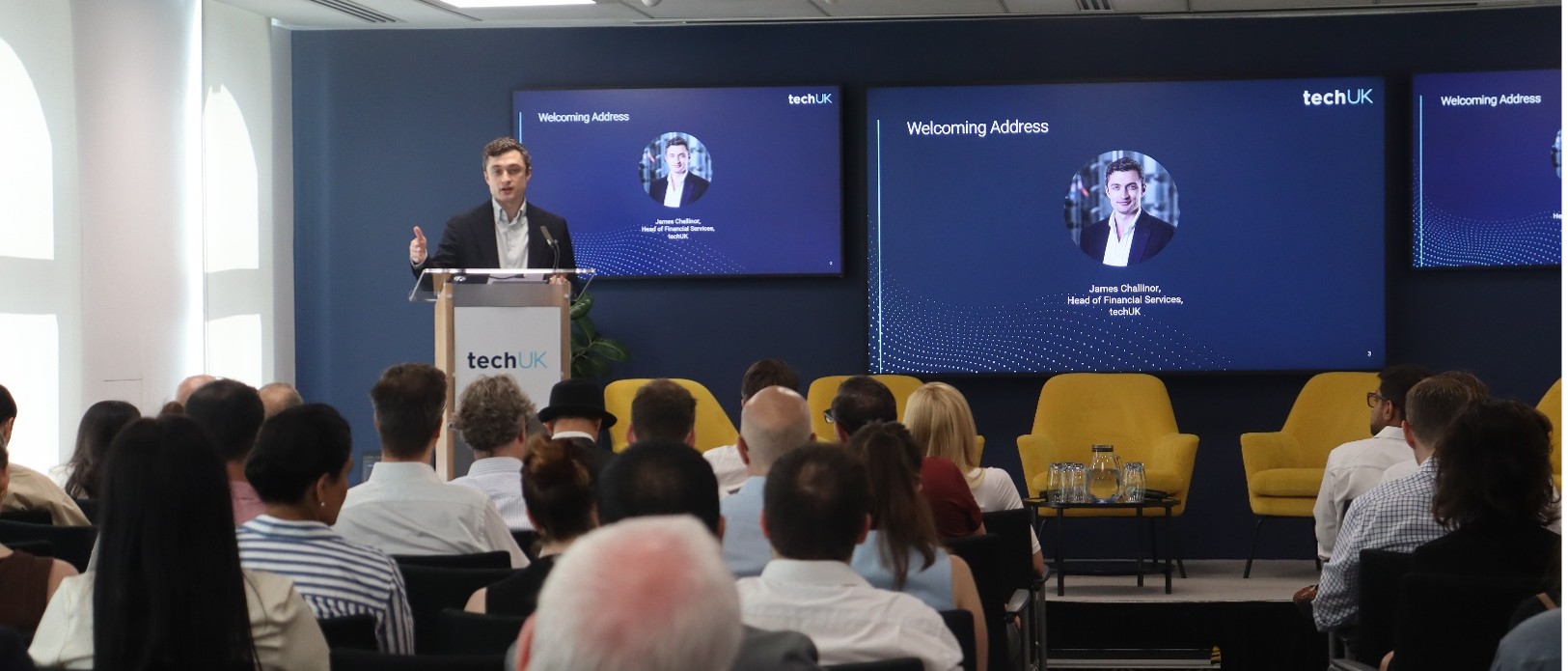
Opening remarks – James Challinor, Head of Financial Services, techUK

Picture1.jpg 41

James opened by framing the discussions around the Agents of Change report. The use cases in the report demonstrate that AI can be operationalised safely at genuine enterprise scale. They are real, live deployments, not experiments.  techUK is actively engaging with the IS-8 industries to drive meaningful and responsible AI adoption in the UK economy, in line with the Chancellor’s ambition for the UK to become the fastest AI adopter in the G7.

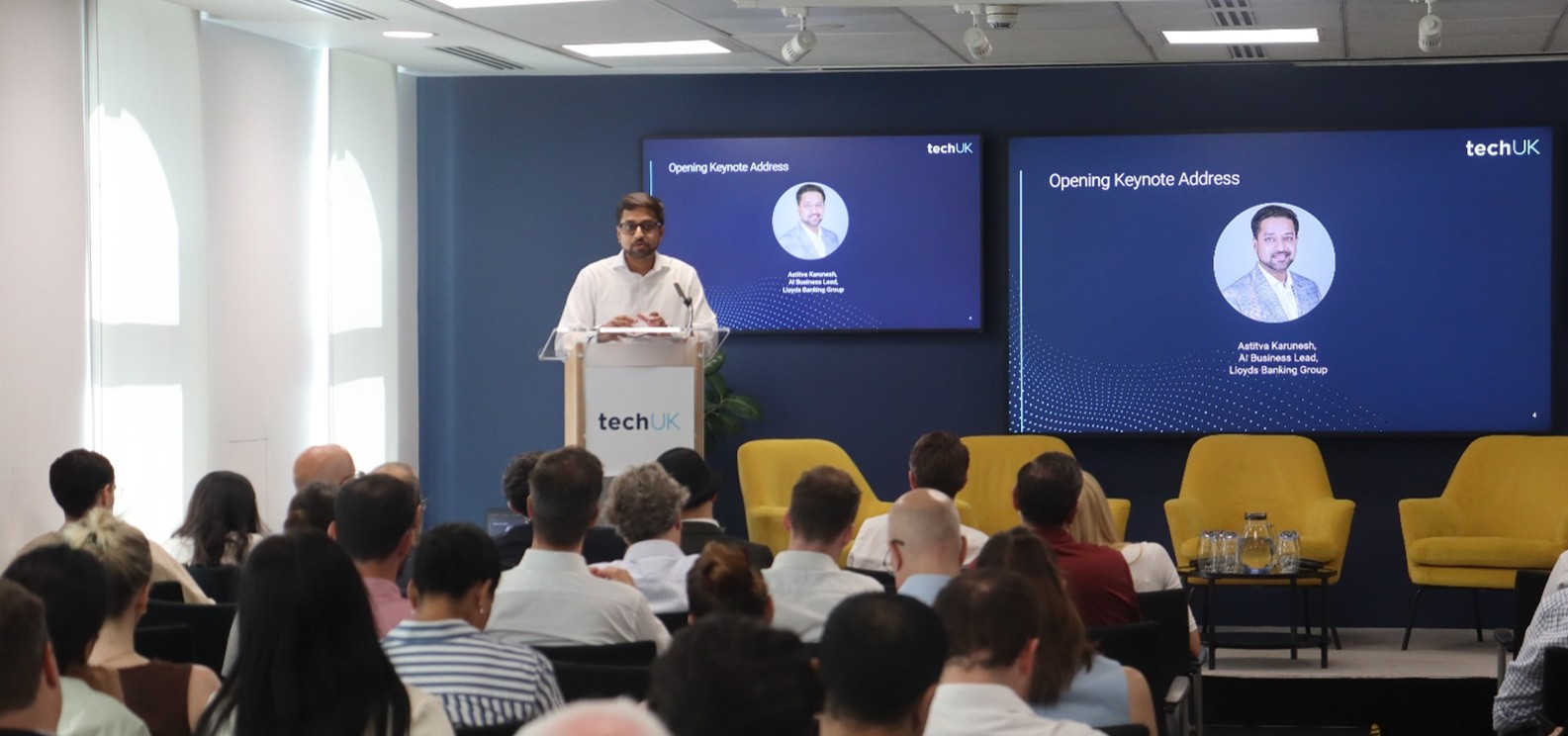
Opening Keynote Address– Astitva Karunesh, AI Business Lead, Lloyds Banking Group

Picture5.jpg 3

Astitva Karunesh affirmed that the conversation to be had is how agentic AI would help us towards customer adoption, fomenting trust and scaling AI in a responsible manner. The technology is here, yet confidence in technology alone won’t lead us to where we want to be. Every major transformation across financial services has required above all, trust. Without trust, there is no adoption. Without adoption, there is no large-scale transformation. Yet, trust isn’t built overnight.

Astitva drew parallels with India’s United Payments Infrastructure and agentic AI adoption, highlighting lessons that can be applied to agentic AI:

  • Trusted infrastructure: Sovereign AI initiatives and moving beyond reliance on hyperscale LLMs may push AI use in the sector. 
  • Economics do matter: Agentic commerce and agentic payments need to sit in a space where the cost is justifiable over the long term. 
  • Familiarity and control: If we unify agents into banking relationship, there will be more likelihood of trusting the technology and eventually adopting it. Giving a sense of control to users and developing guardrails is an important component to trusting AI. 
  • Regulation: The FCA is coming up with multiple initiatives that are allowing organisations to experiment in a safe and responsible way such as sandboxes and commissioning the Mills review paper.

Overall, Astitva feels optimistic of what the tech future in the UK looks like. World leading universities, deep capital markets, a vibrant tech ecosystem and a clear national ambition toward AI are just some of the characteristics that the UK have that are needed to succeed in the widespread of Agentic AI in Financial Services. If we get the balance right for innovation, trust, capability and responsibility, we can achieve our ambitions even before 2035. 

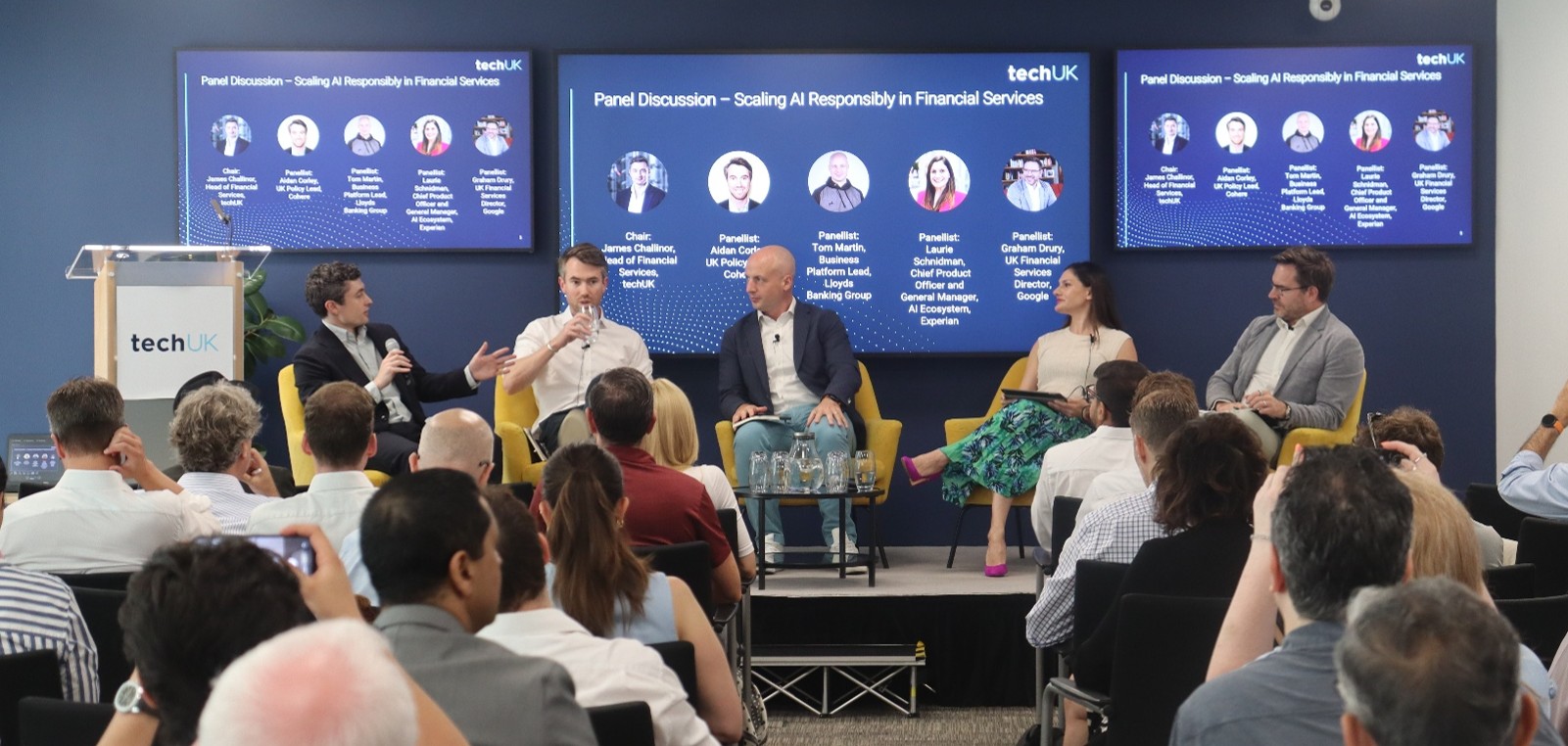
Panel Discussion - Scaling AI Responsibly in Financial Services

Following the keynotes, industry leaders joined the stage for a discussion how to scale AI responsibly in Financial Services. The panellists were:

Moderated by James Challinor, Head of Financial Services, techUK

Picture2.jpg 12

The conversation was divided in three themes: human oversight, sovereignty and the future direction of the ecosystem. Panellists agreed that human oversight remains a non-negotiable as agentic AI scales across financial services, with the need to rethink what oversight means in practice. The gap between appetite and comfort was wide: while more than half of UK consumers already turn to AI for some form of financial advice, only around 2% say they are comfortable with AI making fully autonomous decisions on their behalf. As one panellist put it, AI will only ever scale at the speed of trust. 

The panel discussed how by using agentic AI, they’ve been able to reduce fraud by one third. One example was a bank’s fraud contact centre, where call handling times had fallen to a third of their previous length with no corresponding rise in fraud, and agents were freed up to do the investigative, detective work behind the scenes. Panellists emphasised that at agentic scale, human oversight becomes structurally impossible yet critical. The answer is embedding governance as code: observability frameworks, agent identity management and geographic guardrails built directly into deployment pipelines and highlighted the mindset shift – going from a point in time, to continuous oversight. 

Data quality, vendor complexity and siloed systems are what have been identified as blockers in scaling AI. On sovereignty, panellises were broadly aligned that the UK should chart its own course rather than follow the EU’s model. Sovereignty was the one area where panellists openly disagreed, and for that reason it had deliberately been left out of the report as a standalone chapter, as there was too little consensus on what the term means. For one panellist it was less a technical matter than a question of UK identity, jobs and skills; for another, it was not a new question for banks at all, simply an accelerated one.

One of the panellists framed sovereignty as a question of control. Data, workflows, and the AI models themselves, advocating for on-premises deployment as the most credible path to institutional confidence. There was caution against pursuing sovereignty too far down the technology stack, spreading dependencies across multiple providers and geographies as a more pragmatic route to resilience. Sovereignty must be understood as encompassing and domestic talent pipeline is what is needed to build and sustain these systems over time. 

Finally, the panellists discussed the three recommendations from the Agents of Change report, establishing a dedicated agentic AI workstream as part of an existing public-private initiative, expand shared AI deployment infrastructure and strengthen AI supply chain resilience across the ecosystem. Supply chain resilience was most foundational for panellists. Resilience, rather than the more eye-catching capabilities, was picked out as the single most important of the report’s three recommendations. 

The panel closed on a positive note, the tools exist, deployments are live and the results are exceeding expectations. Harder challenges remain building governance frameworks, supply chain resilience and domestic talent pipeline needed to scale with confidence. The UK has the institutional depth to lead. The task is now execution underpinned by trust. 
 

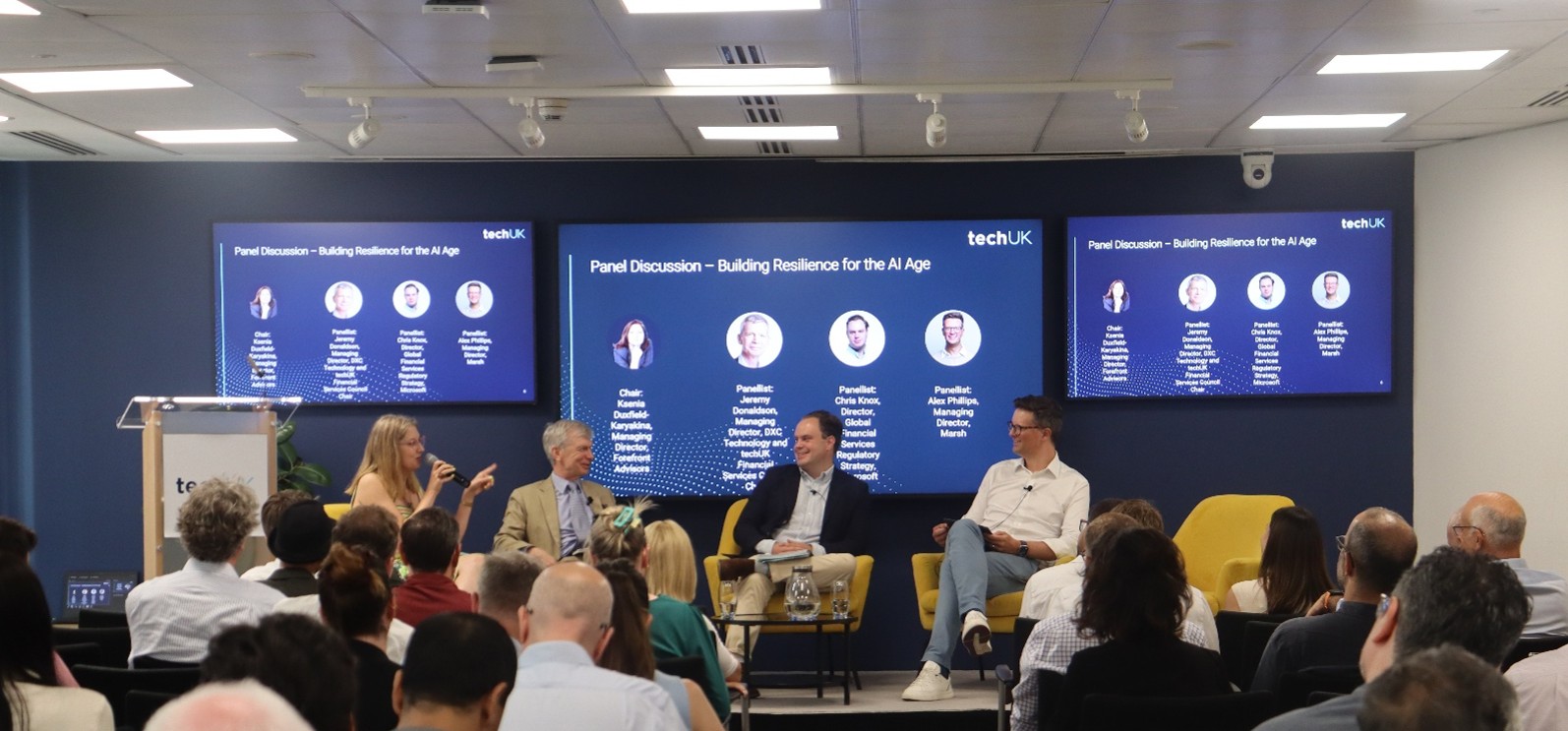
Panel Discussion - Building Resilience for the AI Age

The panellists were:

  • Jeremy Donaldson, Managing Director, DXC Technology and techUK Financial Services Council Chair
  • Chris Knox, Director, Global Financial Services Regulatory Strategy, Microsoft
  • Alex Phillips, Managing Director, Marsh

Moderated by Ksenia Duxfield-Karyakina, Managing Director, Forefront Advisors

Picture3.jpg 11

Firms’ relationship with AI is no longer one of experimentation, rather of critical infrastructure. New models, agents and autonomous capabilities are changing the speed and scale of cyber risk, with regulators beginning to respond. The question now is not whether firms will use AI, rather, how do they remain resilient while doing so. Against this backdrop, panellists discussed how boards and leadership teams are truly across the risks their organisations are running. 

Some organisations have embedded AI governance at the highest level, while others are still relying on management to navigate the space, making board engagement something of a mixed bag. Beneath the headline AI strategy sat a quieter gap, shadow AI, where staff make use of tools the organisation does not know it is running. The organisations with adequate board supervision and the correct guardrails in place will be more resilient. Panellists then discussed the FSB’s consultation on sound AI practices. The consultation highlights more concrete solutions and tangible use cases and is a recognition that AI adoption is now systemic and that governance frameworks within firms must move at the same pace. 

Overall, there is a sentiment that regulators at a global scale now regard AI adoption as systemic and are focusing on harmonization. Proportionality matters and controls should be built based on finality rather than applied uniformly. On resilience, panellists agreed that it cannot be considered at the firm level alone. The entire ecosystem, from technology providers within orchestration, data and infrastructure are integral to firms’ risk profile. This was the thinking behind the FCA’s critical third-party regime, which extends oversight to the key technology suppliers the sector now depends on. Finally, resilience is also a matter of upskilling and managing workforce. Retaining people who can interrogate and use AI effectively when needed is just a s critical to resilience as the technology architecture itself. Part of that challenge sat inside firms, in bridging the gap between early adopters and the mainstream of the workforce, a chasm several panellists felt was as decisive as any technical hurdle. 

Looking at the next 12 months, the panellists identified key questions to solve. Ksenia talked about moving from level governance to global governance, acknowledging that one sector alone cannot address the governance question in isolation. Chris highlighted the real opportunities around the AI not only in financial services but also in different sectors. Alex pinpointed AI as an important driver for growth and a real driver foe the economy. Jeremy closed the panel off showing how AI is an exciting area and the importance of deploying the technology in a controlled environment.

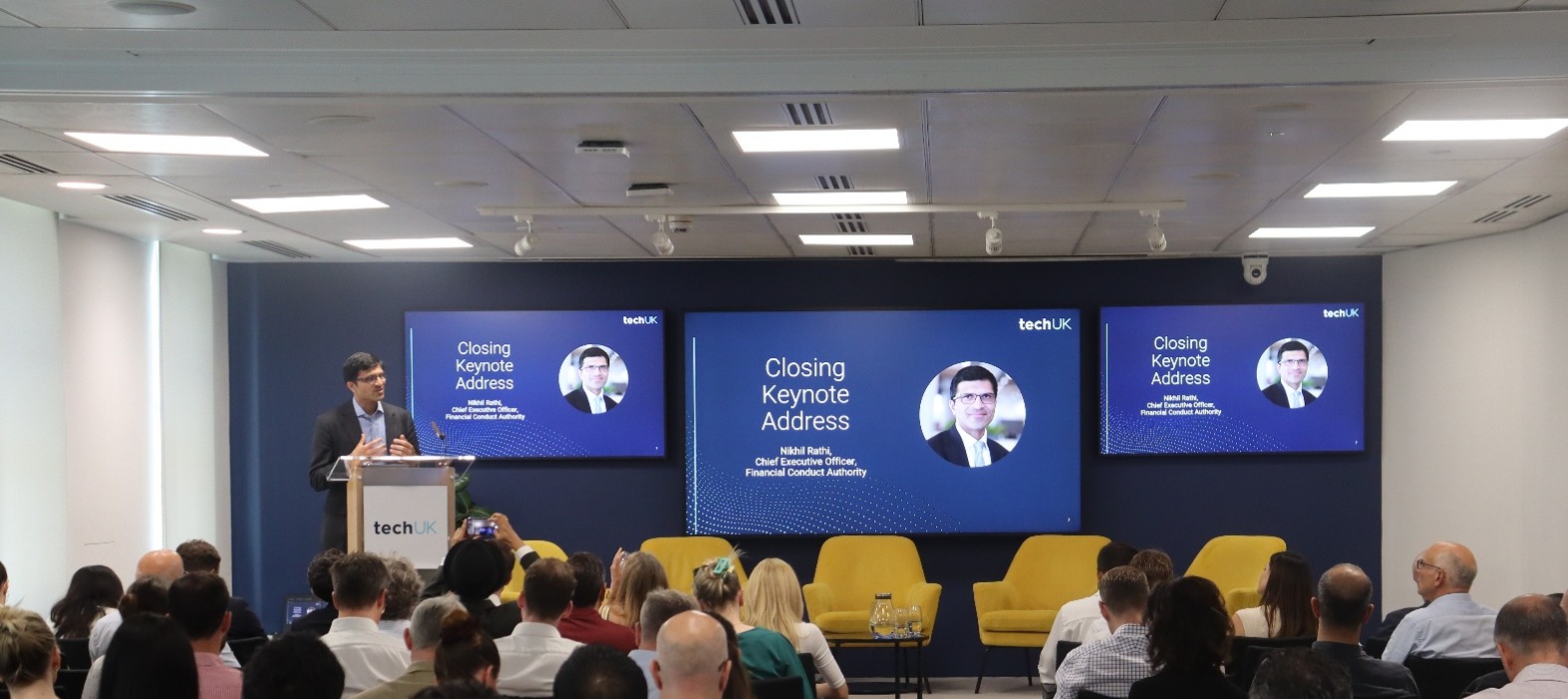
Closing Keynote – Nikhil Rathi, Chief Executive Officer, Financial Conduct Authority

Picture4.jpg 8

Nikhil Rathi, CEO of the FCA, closed the summit by affirming that financial services will be central to making the UK a world-leading AI economy, harnessing our capital, infrastructure and developing the trust needed for AI to scale across the wider economy. Two big scaling opportunities stand out in financial services, Agentic systems and tokenisation.

On agentic systems, Nikhil highlighted their capabilities in not only supporting financial decision but coordinate and transact. In practice, this could mean personalised investment strategies, supporting liquidity management, trading workflows, yet accountability of outcomes must remain clear. Tokenisation has huge potential to lower costs, reduce risks and unlock new services. Through tokenised deposits, friction and fraud risks could be reduced.

The FCA is re-thinking how to be a more effective regulator and how to rebalance risk. Nikhil affirmed FCA’s commitment to work more collaboratively and creatively to understand emerging risks, even acting before legislation catches up. He was candid that legislation will never keep pace with the technology, which is why the FCA is leaning towards principles-based stewardship, using its system-wide powers as a matter of routine rather than exception and stepping in ahead of legislation where it needs to, much as it had done with Buy Now Pay Later.

To support this, he pointed to the regulator’s growing toolkit, the supercharged sandbox, the AI Lab and a new Agentic Academy, and previewed both the forthcoming Mills Review and a publication setting out examples of good and poor AI practice. He also welcomed the three ecosystem recommendations from the Agents of Change report, a dedicated agentic AI governance workstream, shared deployment infrastructure and stronger supply chain resilience.

In conclusion, the question for the UK is whether we are the pace where AI is scaled in a safe, responsible and commercially viable way. Success will be defined by how we harness our talent while making sure that markets are competitive, resilient and making sure regulation is fit for purpose. The FCA is committed to support innovation to ensure the UK seizes the opportunity. 


Financial Services Programme activities

The techUK Financial Services programme connects tech firms, the FS industry, and regulators to ensure innovation and technology can be fully embraced. Through market engagement activities and events, we help to empower decision makers and aid collaboration.


Upcoming events

Latest news and insights 

Learn more and get involved


Financial Services updates

Sign-up to get the latest updates and opportunities from our Financial Services programme.


Here are the five reasons you should join the Financial Services programme.

Learn about the value members get from our work.

Download

Join techUK groups

techUK members can get involved in our work by joining our groups, and stay up to date with the latest meetings and opportunities in the programme.

Learn more


Become a techUK member

Our members develop strong networks, build meaningful partnerships and grow their businesses as we all work together to create a thriving environment where industry, government and stakeholders come together to realise the positive outcomes tech can deliver.

Learn more


Meet the team  

James Challinor

James Challinor

Head of Financial Services, techUK

Lourdes de Miguel

Lourdes de Miguel

Junior Programme Manager - Financial Services & SME Engagement

Lucas Banach

Lucas Banach

Programme Assistant, Data Centres, Climate, Environment and Sustainability, Market Access, techUK


Related topics