Digital twins – the convergence point for AI-enabled personalised healthcare and next-generation deep learning
AI-driven biotech and healthcare signal a new wave of technological convergence that is already rewriting business strategy. The UK, like many European peers, must navigate the complex landscape of funding availability, innovation, and value creation. Here, we examine how the government and industry can seize emerging opportunities in biopharma and healthcare, how these opportunities look, and what the UK can learn from comparable European efforts.
The escalating cost of bringing new therapeutics to market and persistent attrition rates have intensified the search for new R&D* frameworks. These pressures extend into the clinic, where improved patient stratification and therapy matching remain unaddressed1-5. Despite major advances in deep learning/AI, current methods still depend on static analytical architectures and limited live biological feedback1. At the same time, we lack in silico-to-in vitro-to-in vivo continuum for truly effective healthcare solutions – those that personalize care, identify and prevent adverse drug reactions, and optimize treatment strategies1-3. Beyond diagnostics and drug development, therapy and healthcare process management is emerging as a crucial domain requiring specialized monitoring, cross-system integration, and the capacity for continuous self-updating. Its deployment will necessarily be accompanied by rigorous regulatory and ethical oversight.
Addressing these gaps presents both economic opportunities and a need for unconventional approaches capable of capturing dynamic processes across preclinical and clinical domains. Digital twins (DTs) have emerged as the key convergence point for this shift–offering the technological dynamism required for next-generation biopharma and healthcare. They also provide a strategic platform on which the UK can build competitive advantage and deepen high‑value partnerships across Europe (e.g., European Virtual Human Twins (VHT) Initiative and Apply AI Strategy).
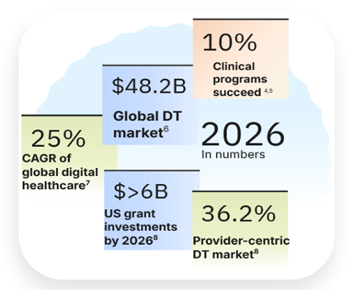
Economic Landscape & Motivation. There is a very clear economic incentive for these new technological advancements6-8(Fig. 1), as the DT market is estimated to reach $48.2B globally in 20266. The global digital healthcare market, which is closely tied to AI and DT-enabled solutions, such as wearables or telemonitoring, was valued at $180.2B in 2023 and is projected to reach $549.7B by 2028, achieving a CAGR* of 25% from 2023 to 20287. These fast developing markets accentuate the need for better healthcare enabling technologies and greater diversity among developers, particularly as the US continues to lead investments in research8. As the UK and Europe’s sectors are underinvested, this creates a widening gap between technological potential and market readiness. Only through bold investment strategies and stronger cross-border collaboration, especially with European initiatives that are already accelerating DT-enabled healthcare (e.g., the EU-funded DTRIP4H project for the development of a decentralized DT ecosystem that enables researchers, innovators and SMEs to devise applications that address specific scientific challenges), can the UK secure a meaningful role in the rapidly expanding global AI and convergent technology market.
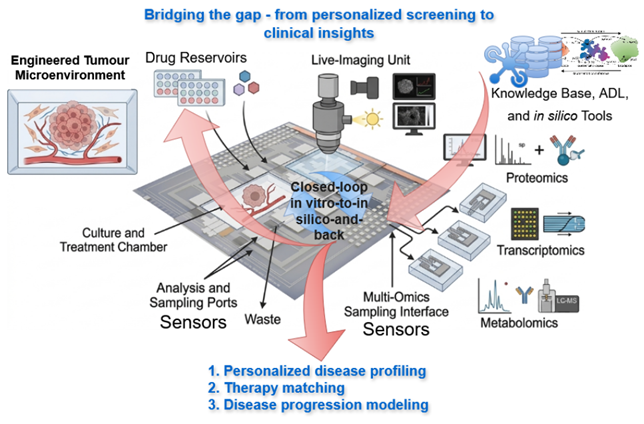
Technology Emergence & Impact Building. The discussed economic drivers and the clearer delineation of current bottlenecks highlight that new solutions are both necessary and achievable. To compete globally, the UK must enter these markets with distinctive, high‑value technological propositions that allow it to capture and shape emerging opportunities. We argue that, for AI‑native R&D and personalized healthcare, this advantage can be built by recognising the role of DTs as catalysts for closed‑circuit systems and the advancement of new deep‑learning methodologies–such as adaptive deep learning (ADL)–alongside integrated screening technologies (e.g., lab‑on‑a‑chip, LOC) that enable continuous dataflow and real‑time predictions¹. Our previous work9-13 has demonstrated that these new types of technologies and the new class of AI–ADL capable of adapting to inputs without pre-set schemas1–captures complex data and patterns inaccessible to conventional models. Importantly, DTs unify these systems for continuous feedback, in silico and in vitro adjustments to extract and analyze omics dataflows (Fig. 2). The UK already has necessary foundations to support these breakthrough technologies through the DT ecosystem, namely DTNet+, CVD-NET, and others.
Figure 3. DT-driven closed-loop framework. LOC-derived imaging, sensing & multi-omics data integrate with ADL & in silico tools to support personalised disease modelling.
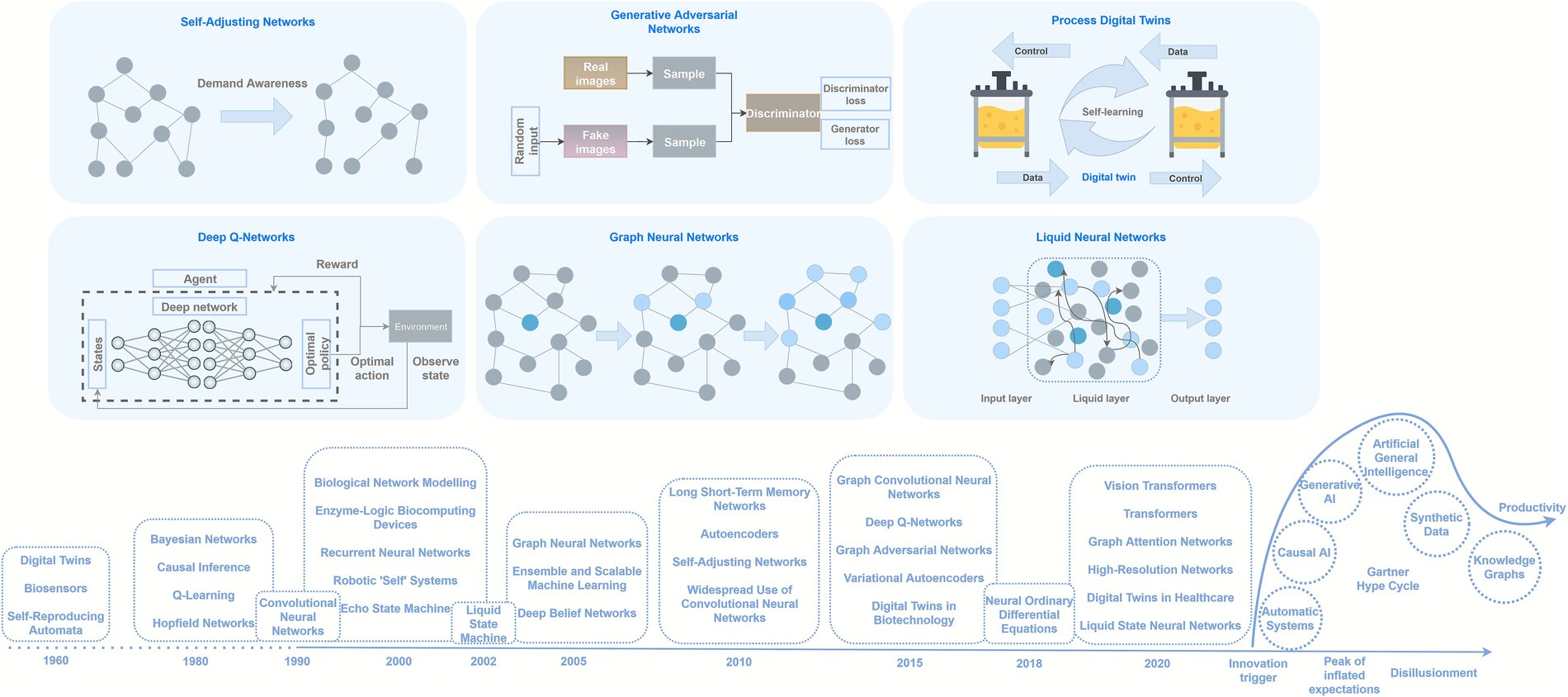
However, the UK ecosystem needs to have a grounded roadmap - currently there are too many competing interests, prioritising institutional needs. We can also learn from European tried-and-tested strategies aiming to unify data and research (e.g., European Health Data Space Regulation; EHDS). Well-established applied solutions are essential for moving beyond the hype cycle (Fig. 3), especially as many AI-driven initiatives have stalled without delivering meaningful progress. This is evident in the trajectory of several AI companies that once promised AI-discovered drugs but have since shifted toward selling platforms that failed to meet their original drug discovery claims. Importantly, countries parallelising technological advancement with regulatory coordination can expect faster entry to market - again valuable lessons offered by the EU with comprehensive initiatives, such as the Data Act, for fair data access, user rights, and the protection of personal data embedded into economic and funding strategies, allowing companies to address any challenges during the development.
For the UK, the stagnation of the R&D sector and lack of national investment coordination underscores the importance of re-establishing strategic partnerships with Europe to build credible, deployable technologies that deliver real clinical and economic value. Such co-development would not only pool expertise and infrastructure but also create shared, interoperable resources capable of competing with the scale and speed of US and Asian ecosystems. By aligning investment, regulation, and technological development, the UK and Europe can jointly accelerate the transition from hype to impact, securing a stronger position in the next generation of biopharma and healthcare markets.
Auste is a seasoned expert working at the intersection of computational science and therapeutic development, with deep expertise in bioinformatics, cheminformatics, and AI-driven solutions for drug discovery. Her portfolio includes projects with tier-one pharma that helped redefine R&D strategies and deep learning approaches through network-centric models and deep learning-based elucidation of complex disease interactomes. She has led the development of large-scale, multidimensional screening platforms – such as DNA-encoded libraries and high-throughput omics characterization – that helped identify novel therapeutic targets and modalities. With a proven track record of driving therapeutic innovation, Auste has steered successful clinical-stage projects and high-impact programs, managing portfolios exceeding $500M. In her advisory roles with leading venture capital firms and government institutions, she has shaped strategic investments in biotech and precision medicine with a focus on translating research into clinical applications.
Prof Andrea Townsend-Nicholson
UCL
Prof Andrea Townsend-Nicholson
UCL
Andrea is a Professor of Biochemistry & Molecular Biology and the Vice-Dean Health in the Faculty of Life Sciences at UCL. Her research focuses on understanding the molecular basis of cell surface receptor function in health and disease using a combination of experimental and computational methodologies. Andrea is particularly interested in facilitating the introduction of personalised medicine into clinical practice and in the development of computational methodologies that converge with experimental findings. Since 2019, she has engaged UK policy makers with digital technologies in her knowledge exchange and public policy roles. Andrea teaches medical and undergraduate bioscience students to use supercomputers as part of their taught university curriculum and has a sustained track record of public engagement. She has been lead and co-lead on a portfolio of grant funding from the UK and Europe that focuses on enhancing engagement of biomedical researchers with computational resources, including the recent award of £19.5M for Charger, a new National Compute Resource within the UK’s Digital Research Infrastructure landscape.
Prof David Wagg
University of Sheffield
Prof David Wagg
University of Sheffield
David Wagg is Professor of Nonlinear Dynamics at the University of Sheffield. His research interests are focused on the dynamics and control of engineering systems including the design and implementation of digital twins for health applications. He leads the Digital Twinning Special Interest Group which is part of the Centre for Machine Intelligence. Since November 2022, David has been part-seconded to the Alan Turing Institute in London where he is developing the AI and data science aspects of digital twins. Prior to his appointment at the University of Sheffield, David was based at the Department of Mechanical Engineering at the University of Bristol (2000-2013). From 2004-2009 he was an EPSRC Advanced Research Fellow. He was awarded his PhD from University College London in 1998.
Dr Shazia C. Hyat
University of Manchester
Dr Shazia C. Hyat
University of Manchester
Shazia is a Senior Lecturer in Molecular Cell Biology at the University of Manchester and founder and CEO of Virtual Scientia, an Accelerate Cambridge venture developing AI-powered digital twins of virtual laboratories, scientific equipment and experimental workflows for life-sciences education, research, industry training and data-connected experimentation. Her academic research spans the molecular mechanisms underlying human disease, embryonic development and extracellular matrix control of cell signalling. Her research identified and characterised two genes with developmental roles. Mutations in the Na-K-Cl cotransporter gene Slc12a2 were shown to cause deafness, while mutations in Fibrillin 2 were linked to abnormal limb development and syndactyly. She also investigated how extracellular matrix proteins regulate growth factors, including the role of Fibrillin 1 in controlling TGF-β1 bioavailability. Shazia has contributed to molecular biology textbooks as an author. Through Virtual Scientia, Shazia leads the development of digital twins, immersive laboratory simulations and interfaces for data-connected experiments. The company has received support from Innovate UK and the European Union, and Shazia was selected as a Women TechEU award winner. She is passionate about equity in education and widening access to practical science for disadvantaged and underrepresented learners.
*CAGR-Compound Annual Growth Rate; R&D*-Research and Development
Technology and Innovation programme activities
techUK bring members, industry stakeholders, and UK Government together to champion emerging technologies as an integral part of the UK economy. We help to create an environment where innovation can flourish, helping our members to build relationships, showcase their technology, and grow their business. Visit the programme page here.
Tech and Innovation Summit 2026
Join us on 3rd November 2026 for techUK's fourth annual Tech and Innovation Summit, which brings together the innovators, investors, policymakers, and researchers shaping what comes next, exploring how the UK's regions, research institutions, and companies of all sizes can work together to turn scientific excellence into scaled, sovereign, commercially successful capability.
Our members develop strong networks, build meaningful partnerships and grow their businesses as we all work together to create a thriving environment where industry, government and stakeholders come together to realise the positive outcomes tech can deliver.
Sue leads techUK's Technology and Innovation work. This includes work programmes on AI, Cloud, Data, Quantum, Semiconductors, Digital ID and Digital ethics as well as emerging and transformative technologies and innovation policy. In 2025, Sue was honoured with an Order of the British Empire (OBE) for services to the Technology Industry in the New Year Honours List. She has also been recognised as one of the most influential people in UK tech by Computer Weekly's UKtech50 Longlist and was inducted into the Computer Weekly Most Influential Women in UK Tech Hall of Fame.
A key influencer in driving forward the tech agenda in the UK, in December 2025 Sue was appointed to the UK Government’s Women in Tech Taskforce by the Technology Secretary of State. She also sits on the UK Government’s Smart Data Council, Satellite Applications Catapult Advisory Group, Bank of England’s AI Consortium and BSI’s Digital Strategic Advisory Group. Previously, Sue was a member of the Independent Future of Compute Review and co-chaired the National Data Strategy Forum. As well as being recognised in the UK's Big Data 100 and the Global Top 100 Data Visionaries in 2020, Sue has been shortlisted for the Milton Keynes Women Leaders Awards and has been a judge for the Loebner Prize in AI, the UK Tech 50 and annual UK Cloud Awards. She is a regular industry speaker on issues including AI ethics, data protection and cyber security.
Prior to joining techUK in January 2015, Sue was responsible for Symantec's Government Relations in the UK and Ireland. Before that, Sue was senior policy advisor at the Confederation of British Industry (CBI). Sue has an BA degree on History and American Studies from Leeds University and a Master’s Degree in International Relations and Diplomacy from the University of Birmingham. Sue is a keen sportswoman and in 2016 achieved a lifelong ambition to swim the English Channel.
Head of Emerging Technology and Innovation, techUK
Rory Daniels
Head of Emerging Technology and Innovation, techUK
Rory joined techUK in June 2023 after three years in the UK Civil Service on its Fast Stream leadership development programme.
During this time, Rory worked on the Government's response to Covid-19 (NHS Test & Trace), school funding strategy (Department for Education) and international climate and nature policy (Cabinet Office). He also tackled the social care crisis on secondment to techUK's Health and Social Care programme in 2022.
Before this, Rory worked in the House of Commons and House of Lords alongside completing degrees in Political Economy and Global Politics.
Today, Rory leads techUK's five-strong Emerging Technology and Innovation team, working with many of the UK's most innovative tech companies to convene experts and decision-makers, showcase best practice, shape government's thinking, and ensure the UK leads on developing and deploying transformative technologies.
The team's main areas of focus are AI Innovation, Quantum, Semiconductors, Robotics, Photonics, Frontier Compute, Innovation Policy, and Technology Convergence.
Rory sits on BIST's expert Robotics Advisory Group, hosts techUK's Meet the Innovators video interview series, and chairs techUK's Emerging Tech Leadership Committee, comprising 36 senior leaders from the UK's most exciting tech companies. He also judges the Global Space Awards, sits on the SXSW Pitch Advisory Board, has hosted London Tech Week's Deep Tech Stage, has completed Stanford University's Tech & Entrepreneurship residency, and has given oral evidence in a House of Lords Select Committee.
In his spare time, Rory enjoys photography, reading non-fiction (tech, architecture, design & geopolitics), and searching for London's best burger.
Senior Programme Manager in Digital Ethics and AI Safety, techUK
Tess Buckley
Senior Programme Manager in Digital Ethics and AI Safety, techUK
Tess is a digital ethicist and musician. After completing a MA in AI and Philosophy, with a focus on ableism in biotechnologies, she worked as an AI Ethics Analyst with a dataset on corporate digital responsibility (paid for by investors that wanted to understand their portfolio risks). Tess then supported the development of a specialised model for sustainability disclosure requests. Currently, at techUK, her north star as programme manager in digital ethics and AI safety is demystifying, and operationalising ethics through assurance mechanisms and standards. Outside of Tess's work, her primary research interests are in AI music systems, AI fluency and tech by/for differently abled folks.
Usman joined techUK in January 2024 as Programme Manager for Artificial Intelligence.
He leads techUK’s AI Adoption programme, supporting members of all sizes and sectors in adopting AI at scale. His work involves identifying barriers to adoption, exploring solutions, and helping to unlock AI’s transformative potential, particularly its benefits for people, the economy, society, and the planet. He is also committed to advancing the UK’s AI sector and ensuring the UK remains a global leader in AI by working closely with techUK members, the UK Government, regulators, and devolved and local authorities.
Since joining techUK, Usman has delivered a regular drumbeat of activity to engage members and advance techUK's AI programme. This has included two campaign weeks, the creation of the AI Adoption Hub (now the AI Hub), the AI Leader's Event Series, the Putting AI into Action webinar series and the Industrial AI sprint campaign.
Before joining techUK, Usman worked as a policy, regulatory and government/public affairs professional in the advertising sector. He has also worked in sales, marketing, and FinTech.
Usman holds an MSc from the London School of Economics and Political Science (LSE), a GDL and LLB from BPP Law School, and a BA from Queen Mary University of London.
When he isn’t working, Usman enjoys spending time with his family and friends. He also has a keen interest in running, reading and travelling.
Elis joined techUK in December 2023 as a Programme Manager for Tech and Innovation, focusing on Semiconductors and Digital ID.
He previously worked at an advocacy group for tech startups, with a regional focus on Wales. This involved policy research on innovation, skills and access to finance.
Elis has a Degree in History, and a Masters in Politics and International Relations from the University of Winchester, with a focus on the digitalisation and gamification of armed conflicts.
Programme Manager ‑ Quantum and Digital Twins, techUK
Sara Duodu
Programme Manager ‑ Quantum and Digital Twins, techUK
Sara joined techUK in October 2025 as Programme Manager for Quantum and Digital Twins.
Before joining techUK, Sara worked at Capital Enterprise as Research Lead, where she focused on policy research related to the UK’s startup ecosystem. During her time there, she co-authored a flagship report unpacking what quantum startups in the UK need to grow and stay in the UK.
Sara holds a Master of Global Affairs (Innovation Policy & Global Security) from the Munk School of Global Affairs & Public Policy, and an MA (History) and a BA (History & Political Science) from the University of Western Ontario.
Outside of work, Sara enjoys reading, playing rugby, and watching any and all sports.
Ella joined techUK in July 2025 as Junior Programme Manager for Emerging Technologies.
In her role, Ella leads the design and delivery of techUK's focus areas, which identify emerging technologies of interest to members and Government. These initiatives seek to showcase industry best practice, champion key UK sectors, and address the challenges and opportunities shaping the development, application, and commercialisation of these technologies. Previous focus areas led by Ella have included photonics, and currently, frontier compute.
Ella also supports the day-to-day running of techUK's Emerging Tech and Innovation Policy activity, working to convene industry experts and policymakers to showcase best practice, shape government thinking, and ensure the UK leads on the development and deployment of transformative technologies.
Before joining techUK, Ella completed an internship at Digital Catapult, supporting across public affairs, policy and the organisation's programmes. She also has experience working in an MP's Parliamentary and Constituency Office.
Ella holds a BSc in Politics and International Relations from the University of Bristol.
Luke is a Junior Programme Manager in techUK’s Emerging Tech and Innovation team. He works on techUK’s robotics programme, collaborating closely with members, policymakers and stakeholders to support the safe development, deployment and adoption of robotics technologies across the UK. Alongside this, he also contributes to the team’s wider work on emerging technologies.
Luke began his career on the DHL Supply Chain graduate scheme, where he worked across large-scale logistics operations and supported transformation initiatives focused on efficiency, automation and process improvement. This gave him first-hand experience of complex industrial environments and the practical application of technology within supply chains.
Following this, Luke worked for Michelle Donelan MP, focusing on policy communications and parliamentary engagement. He supported briefing, stakeholder engagement and cross-sector communications, gaining insight into how legislation and policy are shaped and debated, as well as developing a strong understanding of parliamentary process.
He later worked at the Department for Transport as a Senior Policy Advisor, focusing on digital policy development and leading on data-driven programme delivery within government. This strengthened his understanding of policymaking and the regulatory and digital landscape shaping emerging technologies.
Luke holds a degree in Mechanical Engineering, which provides him with a strong technical foundation and a particular interest in robotics, automation and applied engineering.
Outside of work, Luke enjoys weight training, walking (particularly in Wiltshire and the Cotswolds) and reading non-fiction. He previously spent time at a Shaolin temple in the rural mountains of Shandong province, China, where he studied Kung Fu while living alongside Shaolin monks - an experience that also sparked his appreciation (and slight obsession) for tea.