techUK proud to be joining government and industry-led AI Skills Partnership

Government and industry programme expands to provide 10 million workers with key AI skills by 2030.
During London Tech Week 2025, UK government announced a new government-industry partnership to upskill and train 7.5 million UK workers in essential skills to use AI by 2030, equivalent to around 20% of the UK workforce.
Founding partners of this initiative included techUK members: Accenture, Amazon, Barclays, BT, Google, IBM, Intuit, Microsoft, Sage, SAS, and Salesforce.
Today government is expanding that ambition to take the AI Skills Boost programme to the next level and committing to upskill 10 million workers with AI skills by 2030—a third of the UK workforce, including at least two million people in small and medium-sized businesses.
techUK has joined the partnership alongside the British Chambers of Commerce (BCC), Cisco, Cognizant, Confederation of British Industry (CBI), Department for Education, Department for Work and Pensions, Federation of Small Businesses (FSB), Institute of Directors (IOD), Local Government Association, Multiverse, the NHS, and Pax8.
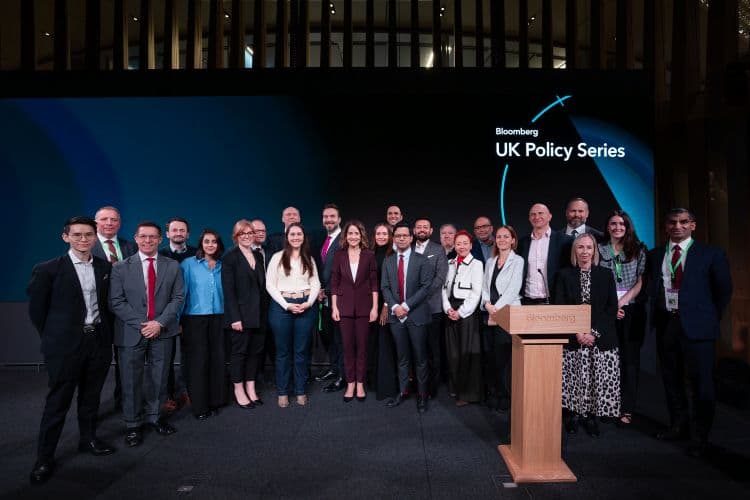
(Above: techUK Deputy CEO, Antony Walker with Secretary of State for Science, Innovation and Technology, Liz Kendall at the launch of the AI Skills Partnership)
At techUK, we have long been at the forefront of examining how AI is reshaping the workforce. We are committed to embedding lifelong learning across our membership and to ensuring that short-term, AI-driven reductions in roles, particularly at entry and graduate level, do not create serious skills shortages in the years ahead.
The organisations in our membership are no longer just experimenting with AI. They are getting their workforces ready for what comes next. We are moving fast from the generative AI moment into the agentic era, where AI, data, applications and people work side by side at the heart of every modern business. One year on since the launch of the AI Opportunities Action Plan and we welcome the continued momentum in building the skills needed for the future.
AI Skills Boost
AI Skills Boost is a national training initiative, with 14 industry-developed AI courses live on the AI Skills Hub, giving people across the UK quick access to free, practical workplace training. The courses have been assessed against Skills England’s benchmark for foundational AI skills, and learners who complete them earn a virtual AI Foundations badge. Users can create a learning profile and follow a tailored learning journey beyond the foundations training.
Open to all UK adults, the online courses can be completed in as little as 20 minutes. They focus on building confidence with everyday AI tools, helping people draft documents, create content and manage routine administrative tasks more efficiently.
One million courses have already been delivered since June.
techUK has welcomed AI Skills Boost as we have consistently called for better use of existing resources and training programs to develop AI skills in the workforce. Businesses already offer a wide variety of online and in-person training, from basic digital skills right through to courses on the latest technological developments. These efforts need to be unified to boost learners’ confidence in investing their time. techUK has long urged the government to build on the successful Skills Toolkit launched in 2020, creating an updated version that helps people across all sectors access digital job opportunities and relevant training. Many techUK members’ courses have been featured, but now the focus must shift from basic digital skills to advanced, stackable qualifications that lead to workplace-ready capabilities.
TechFirst
Building on announcements set out in the Industrial Strategy, also published in June 2025, Government has announced £27 million in funding to launch the TechLocal scheme, part of the wider £187 million TechFirst programme. The initiative will support employers in creating or filling up to 1,000 tech roles in communities across the UK. It will also fund new professional practice courses, graduate traineeships, and AI-focused work experience opportunities.
The first TechLocal competition will allow organisations in every region of England, as well as those in the Devolved Authorities to apply for up to £225,000 in grant funding to deliver a project over six to nine months. The focus of these projects will be to help skilled local people move into local tech jobs through projects such as supporting employer networks, derisking recruitment, and developing innovative recruitment and career pathways. Applications will be assessed based on the number of jobs that will be created, the quality of jobs created, and the number of women supported into jobs.
techUK has hosted roundtables with Department for Science, Innovation and Technology and our members on the key principles that underpin TechFirst and provided input to shape TechLocal.
AI Masters Scholarships
Applications have opened for the Spärck AI Scholarship at nine UK universities. Up to 100 high-potential Master’s students in AI and STEM subjects will receive full funding for tuition and living costs, along with access to industry partnerships, work placements, and mentoring throughout their studies.
AI and the Future of Work Unit
AI and the Future of Work Unit will be created to research and monitor AI’s economic and labour market impacts to provide timely advice on when new policies should be implemented. The Unit will also lead across government on the AI and the Future of Work programme. This programme will prepare the UK for AI-driven labour market transformation. The programme will be guided by the principles of recognising that work is fundamental to human dignity, ensuring people benefit from this once-in-a-generation transformation, prioritising economic growth through AI adoption, supporting workers to update their skills, and establishing a positive, practical vision for the future.
This work builds on the 11 reports of research developed by government’s AI Skills for Life and Work: Rapid Evidence Review which found that only 21% of UK workers currently feel confident using AI at work.
An expert panel of industry, academia, civil society and trade union representatives will support the Unit looking at increasing confidence in AI, providing strategic insight to its work, and supporting external collaboration. Members include Daniel Susskind, Diane Coyle, Abigail Gilbert (Institute for the Future of Work), Naomi Weir (CBI), and Mike Clancy (Prospect Union).
techUK also contributed to the research informing Skills England’s analysis on AI skills for the UK workforce, where we were able to help ensure the resulting tools address practical challenges in developing AI skills across the workforce.
Julian David OBE, CEO of techUK:
“techUK is proud to join this partnership, working with industry and government to help equip 10 million people with the skills needed to use AI confidently and responsibly. Our members bring both the expertise to build these capabilities and the experience to support the delivery of high-quality, industry-backed training across the UK economy.”
Secretary of State for Science, Innovation and Technology, Liz Kendall said:
“We want AI to work for Britain, and that means ensuring Britons can work with AI.
“Change is inevitable, but the consequences of change are not. We will protect people from the risks of AI while ensuring everyone can share in its benefits.
“That starts with giving people the skills and confidence they need to seize the opportunities AI brings, putting the power and control into their hands.”
Full list of industry and public sector partners as of January 2026:
Accenture
AWS
Barclays
British Chambers of Commerce (BCC)
BT
Cisco
Cognizant
Confederation of British Industry (CBI)
Department for Education
Department for Work and Pensions
Federation of Small Businesses (FSB)
Google
IBM
Institute of Directors (IOD)
Intuit
Local Government Association
Microsoft
Multiverse
NHS
Pax8
Sage
Salesforce
SAS
techUK