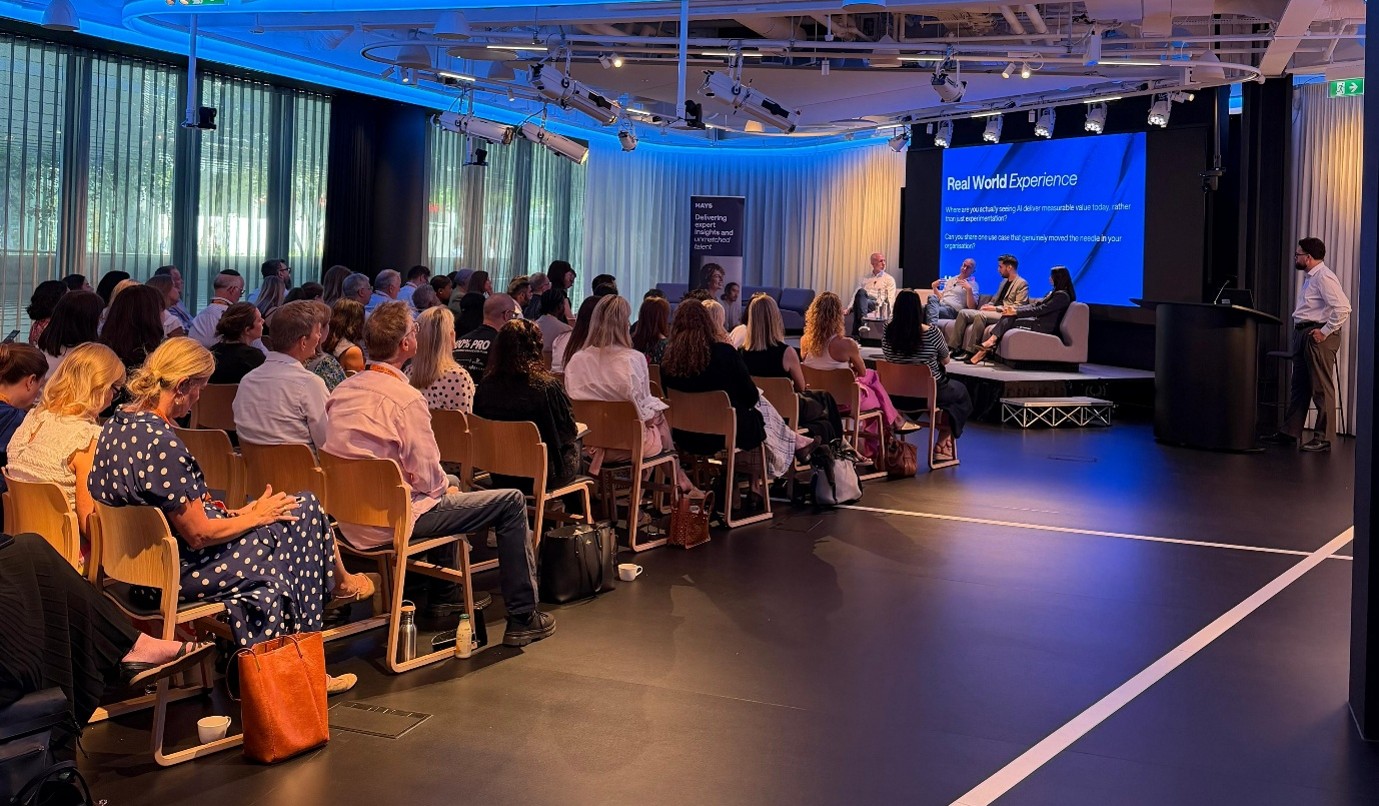
Jacob Bartoli, Business Manager at Hays, recently hosted an AI leadership event at Norton Rose Fulbright in collaboration with BossUp, bringing together industry experts Paul Orchard, Matt Hobby, Rahan Arif and Anu Doll to discuss how organisations can move from AI adoption to genuine AI readiness.
The AI conversation is changing
For the last two years, most conversations about AI have focused on adoption. Organisations have been exploring use cases, investing in new tools and encouraging employees to experiment with emerging technologies.
However, a recent discussion I hosted with leaders from technology, professional services, HR and transformation highlighted a shift in thinking. The organisations seeing the greatest value from AI are no longer focused on adoption alone. Instead, they are focusing on readiness.
This might sound like a subtle distinction, but it has significant implications for businesses planning their next phase of AI investment.
Adoption is not the same as transformation
Many organisations can confidently say they are using AI. Employees have access to tools, pilot programmes are underway and innovation teams are testing new ideas.
The challenge is that AI is often being layered onto existing ways of working rather than fundamentally changing them.
The organisations making meaningful progress are stepping back and asking different questions:
Where does AI create genuine value?
How should work be redesigned around AI?
Which skills will become more important?
How do we prepare our workforce for change?
In other words, they are focusing less on the technology and more on the operating model that sits around it.
Human skills are becoming more valuable
One of the more surprising themes to emerge from the discussion was the growing importance of human capability.
Whilst AI continues to improve at executing tasks, skills such as communication, critical thinking, decision-making and judgement are becoming increasingly valuable.
Rather than replacing people, AI is changing the role people play.
Many professionals are moving away from purely executing work and towards directing, reviewing and improving outputs generated by AI. The ability to ask the right questions, challenge assumptions and make informed decisions is becoming a key differentiator.
For employers, this presents an important challenge. Technical skills remain important, but organisations also need to invest in the softer skills that enable effective collaboration between humans and AI.
The workforce must come along on the journey
Technology is rarely the biggest barrier to AI transformation. More often, it is confidence, capability and culture.
Employees understandably have questions about how AI will affect their roles and future career paths. Organisations that address those concerns openly and invest in workforce development are likely to be better positioned than those focused purely on technology deployment.
AI readiness should not be viewed as a one-off training exercise. It requires ongoing development, curiosity and a willingness to continuously learn as the technology evolves.
Looking ahead
AI is rapidly becoming accessible to every organisation. As access to technology becomes more widespread, competitive advantage is less likely to come from the tools themselves.
Instead, the organisations that stand out will be those that successfully prepare their people, redesign their processes and create environments where humans and AI can work together effectively.
The next phase of AI adoption will not be defined by who adopts the fastest. It will be defined by who becomes ready first.
Jacob Bartoli
Business Manager, Hays Technology
Jacob Bartoli
Business Manager, Hays Technology
Jacob Bartoli is a Business Manager at Hays, partnering with organisations across the UK to support their Technology and Change talent needs at all levels. Alongside delivering recruitment solutions, he is passionate about building communities that bring industry leaders together through roundtables, networking events and panel discussions. These forums provide a space for professionals to exchange ideas, discuss common challenges and learn from one another's successes. Most recently, Jacob hosted an AI leadership event at Norton Rose Fulbright, attracting more than 150 senior professionals to explore the opportunities, challenges and future impact of AI. Following the event, he is producing a comprehensive post-event report to share key insights and ensure the conversation continues beyond the room.
techUK's Skills, Talent and Diversity Programme activities
techUK work with our members to signpost the opportunity of digital jobs and ensure these opportunities are open to people of diverse backgrounds. We strive to help our members attract, recruit, and retain a diverse workforce, whilst showcasing their work on workplace innovation. Visit the programme page here.
Jobs and Skills
To make sure that the UK is a world-leading digital economy that works for everyone, it is crucial that people have the digital skills needed for life and work. Rapid digitalisation is creating surging demand for digital skills across the economy and the current domestic skills pipeline cannot keep up. Digitalisation is also leading to rapid changes in the labour market that means some traditional roles are being displaced. There is an urgent need to better match the demand and supply.
The future of work is changing. Technology is powering a growth in flexible work across the economy, whilst emerging technologies such as robotics and AI are set to become common place. techUK believes the UK must consider the implications of digital transformation in the world of work now, equipping people and businesses across the country with the skills and conditions needed to take advantage of the opportunities presented by the 4IR.
Diversity and inclusion sits at the heart of digital growth. The tech sector understands that innovation thrives from diversity of thought and is continually looking to attract, recruit and retain a diverse workforce. techUK is proud to support a number of initiatives that promote this, from doing outreach work to ensure that people regardless of their background are inspired into tech, to initiatives that help build more inclusive workplaces for those with different accessibility needs.
Returners programmes offer a supported bridge back to work for people who have taken a career break. Providing ways for people to ease back into work after a career break is a vital way to make sure we do not lose out on their talent and experience. The techUK returners hub was created as a one-stop-shop for people looking to return to a career in digital.
Our members develop strong networks, build meaningful partnerships and grow their businesses as we all work together to create a thriving environment where industry, government and stakeholders come together to realise the positive outcomes tech can deliver.