Building a smart estate at Manchester NHS Trust
Guest blog by Duncan Booth, Head of Health & Social Care at Esri UK
Innovation has always been the engine of NHS transformation. But today, as the health service faces unprecedented demand, workforce pressures and ageing estates, the pace of innovation needs to accelerate. At Manchester University NHS Foundation Trust (MFT), we’re seeing that acceleration in action.
Esri UK has been working with MFT to reimagine how an NHS estate can operate and make the hospital more intelligent, in the run-up to the New Hospital Programme (NHP). Together with our partner BIS Consult, we’re helping the Trust make the shift from an analogue to digital approach. The result is England’s first healthcare ‘smart estate’ powered by a digital twin, created with geospatial technology. This repeatable model can help other trusts modernise more quickly and reduce the need to reinvent processes.
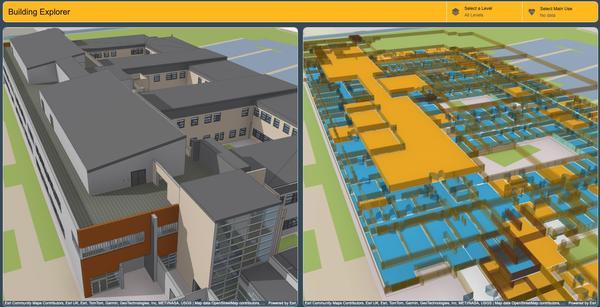
To date, the twin spans six hospitals and 274,000 square metres of internal floor space.
Designed to provide a single source of estates data to support new workflows and better decision making, the 3D model is a major milestone in MFT’s digital transformation to improve operational efficiency and patient safety.
Modernising estates management
Estates and facilities teams are responsible for keeping hospitals safe, efficient and operational. Yet the data they rely on is usually dispersed across legacy systems, paper files and siloed teams.
MFT wanted a ‘single source of truth’ for its data that could answer questions quickly, including:
- Which spaces could be repurposed?
- Where is asbestos and RAAC located and how do we manage risk?
- What are the maintenance priorities?
- What assets are in this room?
Finding these answers used to take days, sometimes weeks, and even then, the picture was often incomplete.
Why location is the missing link
Everything in a healthcare estate happens somewhere. That makes location and geospatial technology the natural common thread to create a single source of estates data.
Using Esri UK’s ArcGIS system, we worked with MFT to build a digital twin, capable of integrating all relevant data. This involved indoor mapping, cloud-based mapping and spatial data management, plus mobile applications for location data collection.
But before a digital twin can exist you need clean, well‑governed data and this is where Esri UK’s partner, BIS Consult, played an essential role. Their work included:
- Designing a robust data strategy
- Integrating data from multiple legacy systems
- Improving data quality and consistency
- Establishing ongoing data governance
Early impact
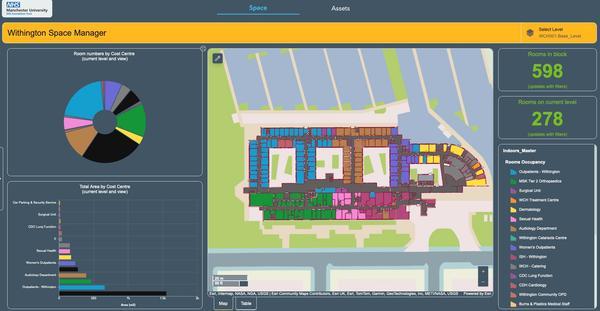
Today, the Trust can visualise buildings, floors, rooms and space in detail, with associated information. The system connects all types of data, from operational to clinical, including CAFM systems, CAD drawings, Compliance, maintenance schedules, asbestos and RAAC information and asset inventories.
The twin is being used in a trial to better understand the use of space, by quickly showing where room usage is not being optimised. Full roll-out will provide all staff with a real-time view of occupancy levels and space requests, while clinicians will be able to examine existing facilities more easily and plan new services.
New applications for RAAC and asbestos management involve performing digital surveys on mobile devices, which feed directly into the digital twin and visualise the different risk levels. By providing more accurate and timely data, the new workflow is driving more effective maintenance regimes to improve safety.
Looking ahead
What MFT has achieved is just the beginning. The Trust is also exploring mapping applications that extend beyond traditional estates management, including indoor navigation, real-time asset tracking and patient contact tracing.
Using RFID tags allows equipment from scanners to wheelchairs to be located more quickly on a map. Real-time tracking improves asset visibility and cuts unnecessary spend on ‘lost’ items, while making life easier for staff.
In a complex building like a hospital, indoor mapping and mobile wayfinding will help reduce missed appointments, save staff time and improve the patient experience.
Patient contact tracing uses the same indoor positioning system. By identifying and notifying individuals who have been in close contact with an infected person, guidance on next steps including testing and self-isolation can be given, helping reduce the spread of disease.
Why geospatial?
Choosing a geospatial approach to developing a digital twin offers significant advantages. It can easily accommodate large, complex estates – even those with buildings dispersed across a city. It doesn’t just visualise the estate itself – it also provides insight into the wider context by integrating other information, including population health data, public transport networks and traffic flows, route-finding, staff locations and information about the surrounding environment, such as biodiversity or flood risks. It then shifts to become a strategic tool to support the planning of new services and inform capital projects including hospital new builds.
A blueprint for the future
As the New Hospital Programme (NHP) moves forward and trusts across the country consider how to modernise their estates, MFT is an emerging example of what’s possible and could be repeated elsewhere. Their digital twin is currently supporting the early-stage project planning for the North Manchester General Hospital (NMGH) NHP. Having all their estates data within one system will allow for strategic decision making about which buildings are refurbished, disposed of or require new build.
The NHS estate is one of the most complex built environments in the UK. But with the right data foundation and geospatial technology, it can in time, also become one of the most intelligent.
A smart estate isn’t simply a digital version of existing buildings. It’s an intelligent hospital that:
- Increases operational efficiency and patient safety
- Unlocks smarter new build planning
- Supports long‑term clinical transformation
MFT’s pioneering work shows what’s possible when trusts embrace digital transformation not as a technology project, but as a strategic shift. Their digital twin is the start of an entirely new way of running an estate – a blueprint for Hospital 2.0 – helping build smarter, more efficient and safer hospitals.
David Bailey, Head of Digital Estates at MFT, who led the project, said: “Integrating all our existing data into a digital twin is driving new opportunities for efficiency gains. Moving from analogue to digital achieves a better understanding of our buildings and assets which helps improve their management and maintenance, as well as improving patient safety.
David Bailey
Head of Digital Estates at MFT
Health and Social Care Programme activities
techUK is helping its members navigate the complex space of digital health in the UK to ensure our NHS and social care sector is prepared for the challenges of the future. We help validate new ideas and build impactful strategies, ultimately ensuring that members are market-ready. Visit the programme page here.
Upcoming events
Latest news and insights
Learn more and get involved
Health and Social Care updates
Sign-up to get the latest updates and opportunities from our Health and Social Care programme.
Authors
Duncan Booth
Head of Digital Estates at MFT, Esri UK