Agentic AI: A Once-in-a-Generation Opportunity to Solve the UK's Productivity Puzzle
Britain's central economic problem is not a shortage of ideas, rather, a shortage of execution.
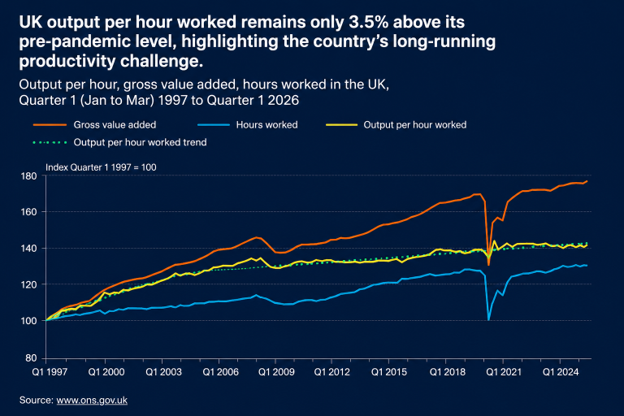
UK productivity growth collapsed after the 2008 financial crisis, averaging roughly 0.3% a year over the following decade against around 2% before it.1
The ONS calls this the "productivity puzzle", and describes the slowdown as the slowest sustained recovery since the Second World War.
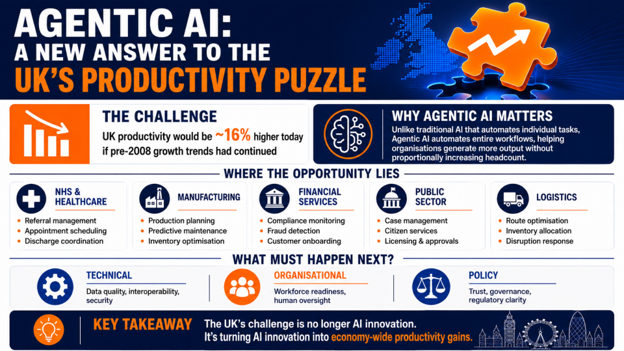
Had the pre-2007 trend held, productivity today would be about 16% higher 2,and with it wages and living standards.
The recovery since the pandemic has not closed the gap. Output per hour worked stood only 3.5% above its 2019 level in the first quarter of 2026.3
With public debt and spending pressures rising across health, pensions and welfare, the UK's path to sustainable growth lies in productivity, not expenditure alone. And productivity, ultimately, depends on how efficiently work is executed across systems and teams daily.
Breaking the Fiscal Deadlock
Much of the government's room to invest in growth has been absorbed by the rising cost of day-to-day commitments. When budgets tighten, capital investment, the spending that raises future capacity, is the first thing cut, because its cost is felt now and its return arrives years later. It is a familiar trap: the country needs to invest to grow, but feels it has no fiscal space to invest.
Agentic AI offers a way out, because it asks for comparatively little public capital. Unlike a new rail line or a rebuilt energy grid, productivity gains from agents draw mostly on systems and data organisations already own, which makes them well suited to going first. The sequence is straightforward: higher productivity raises output, higher output raises GDP, and faster growth both widens the tax base and lowers the debt-to-GDP ratio, creating fiscal headroom. Roughly a third of additional national output reaches the Exchequer over time. Low-capital gains, in other words, can fund the high-capital investment that has stalled.
One caveat keeps the argument honest: productivity gains take years to register in the national figures, and reinvesting the proceeds in infrastructure rather than elsewhere is a political choice, not an economic certainty. But the direction is sound and self-reinforcing. Done well, it turns a vicious circle into a virtuous one.
The Constraint is Deployment, Not Capability
Most technologies improve individual tasks; Agentic AI transforms entire workflows, fundamentally changing how work happens. Instead of helping one person draft one email more quickly, an agent can coordinate a process end to end: reading from several systems, taking a sequence of actions, and escalating to a human where judgement is required.
That distinction is the whole opportunity.
Back in 2017, PwC predicted that AI could contribute up to £232 billion to the UK economy by 2030, equivalent to a 10.3% boost to GDP. 4 With the current advancements, the economic gains are likely to be higher. But to realise this potential, what's needed is deployment at scale, not increasingly sophisticated AI models.
Where the Gains are Largest
In the NHS, clinicians lose substantial time to administration and coordination that never touches patient care. Agents can manage referrals, scheduling, discharge and patient communication across disconnected systems, recovering thousands of clinical hours a week. 5
In manufacturing, which produced roughly $279 billion of UK output in 2024, 6 agents can coordinate production schedules, optimize inventory and orchestrate predictive maintenance, lifting output and resilience without a proportional rise in labour cost.
In financial services, which contributed more than £208.2 billion to the UK economy, accounting for 8.8% of total economic output, 7 much of the operating cost sits in compliance, risk and fraud detection: evidence-heavy, rules-bound work that agents handle well, escalating anomalies to the people whose judgement matters.
Across the public sector, case management, planning, licensing and procurement are coordination problems before they are anything else, where agentic AI could provide significant support.
The pattern is the same in each. The value is not in replacing the expert. It is in clearing the operational debris that keeps the expert from doing expert work.
Why Most of this will Fail, and What Separates the Exceptions
Honesty about the obstacles is what gives optimism its credibility. A widely cited Harvard Business Review Analytic Services research found that while 94% of organisations recognise connected data, processes and applications as essential for AI success, only 27% have achieved such integration.8 That single statistic explains most of the failed pilots already accumulating across British industry.
An agent is only as capable as the systems it can reach and the data it can trust. Data quality, interoperability and integration are not chores to be rushed before the interesting work begins. They are the work, alongside the monitoring, security and auditability that make an autonomous system trustworthy. The organisational requirements are just as real: the firms that succeed treat agents as augmentation rather than replacement, build AI literacy across the workforce, and keep humans in the loop on decisions affecting patients, customers and citizens.
A Narrow Window
The UK's opportunity lies not in building smarter AI, but in deploying Agentic AI responsibly to boost productivity.
The economies that move fastest from experimentation to operational transformation will define the next decade of competitiveness. Britain can be one of them. The work is not glamorous and it is not theoretical. It is the patient business of connecting systems, cleaning data and rebuilding workflows so that capable technology can finally do what it has long promised. That is the puzzle. It is also, at last, solvable.
The UK is a global leader in AI innovation, development and adoption.
AI has the potential to boost UK GDP by £550 billion by 2035, making adoption an urgent economic priority. techUK and our members are committed to working with the Government to turn the AI Opportunities Action Plan into reality. Together we can ensure the UK seizes the opportunities presented by AI technology and continues to be a world leader in AI development.
Get involved: techUK runs a busy calendar of activities including events, reports, and insights to demonstrate some of the most significant AI opportunities for the UK. Our AI Hub is where you will find details of all upcoming activity. We also send a monthly AI newsletter which you can subscribe to here.
On 16 September 2026, EU Commission President Ursula von der Leyen delivered her State of the EU address. This annual speech, first introduced in 2010, is delivered before the European Parliament and is meant to ensure transparency in the EU's political life while highlighting the EU Commission's key priorities.
In this article, Sara Belhay, Head of Policy and Public Affairs, EY Foundation explores the potential of AI for social mobility and discusses their AI and Social Mobility Challenge Prize.
Sign-up to our monthly newsletter to get the latest updates and opportunities from our AI and Data Analytics Programme straight to your inbox.
Contact the team
Kir Nuthi
Head of AI and Data, techUK
Kir Nuthi
Head of AI and Data, techUK
Kir Nuthi is the Head of AI and Data at techUK.
She holds over seven years of Government Affairs and Tech Policy experience in the US and UK. Kir previously headed up the regulatory portfolio at a UK advocacy group for tech startups and held various public affairs in US tech policy. All involved policy research and campaigns on competition, artificial intelligence, access to data, and pro-innovation regulation.
Kir has an MSc in International Public Policy from University College London and a BA in both Political Science (International Relations) and Economics from the University of California San Diego.
Outside of techUK, you are likely to find her attempting studies at art galleries, attempting an elusive headstand at yoga, mending and binding books, or chasing her dog Maya around South London's many parks.
Usman joined techUK in January 2024 as Programme Manager for Artificial Intelligence.
He leads techUK’s AI Adoption programme, supporting members of all sizes and sectors in adopting AI at scale. His work involves identifying barriers to adoption, exploring solutions, and helping to unlock AI’s transformative potential, particularly its benefits for people, the economy, society, and the planet. He is also committed to advancing the UK’s AI sector and ensuring the UK remains a global leader in AI by working closely with techUK members, the UK Government, regulators, and devolved and local authorities.
Since joining techUK, Usman has delivered a regular drumbeat of activity to engage members and advance techUK's AI programme. This has included two campaign weeks, the creation of the AI Adoption Hub (now the AI Hub), the AI Leader's Event Series, the Putting AI into Action webinar series and the Industrial AI sprint campaign.
Before joining techUK, Usman worked as a policy, regulatory and government/public affairs professional in the advertising sector. He has also worked in sales, marketing, and FinTech.
Usman holds an MSc from the London School of Economics and Political Science (LSE), a GDL and LLB from BPP Law School, and a BA from Queen Mary University of London.
When he isn’t working, Usman enjoys spending time with his family and friends. He also has a keen interest in running, reading and travelling.
Sue leads techUK's Technology and Innovation work. This includes work programmes on AI, Cloud, Data, Quantum, Semiconductors, Digital ID and Digital ethics as well as emerging and transformative technologies and innovation policy. In 2025, Sue was honoured with an Order of the British Empire (OBE) for services to the Technology Industry in the New Year Honours List. She has also been recognised as one of the most influential people in UK tech by Computer Weekly's UKtech50 Longlist and was inducted into the Computer Weekly Most Influential Women in UK Tech Hall of Fame.
A key influencer in driving forward the tech agenda in the UK, in December 2025 Sue was appointed to the UK Government’s Women in Tech Taskforce by the Technology Secretary of State. She also sits on the UK Government’s Smart Data Council, Satellite Applications Catapult Advisory Group, Bank of England’s AI Consortium and BSI’s Digital Strategic Advisory Group. Previously, Sue was a member of the Independent Future of Compute Review and co-chaired the National Data Strategy Forum. As well as being recognised in the UK's Big Data 100 and the Global Top 100 Data Visionaries in 2020, Sue has been shortlisted for the Milton Keynes Women Leaders Awards and has been a judge for the Loebner Prize in AI, the UK Tech 50 and annual UK Cloud Awards. She is a regular industry speaker on issues including AI ethics, data protection and cyber security.
Prior to joining techUK in January 2015, Sue was responsible for Symantec's Government Relations in the UK and Ireland. Before that, Sue was senior policy advisor at the Confederation of British Industry (CBI). Sue has an BA degree on History and American Studies from Leeds University and a Master’s Degree in International Relations and Diplomacy from the University of Birmingham. Sue is a keen sportswoman and in 2016 achieved a lifelong ambition to swim the English Channel.
Visit our AI Hub - the home of all our AI content:
Enquire about membership:
Become a techUK member
Our members develop strong networks, build meaningful partnerships and grow their businesses as we all work together to create a thriving environment where industry, government and stakeholders come together to realise the positive outcomes tech can deliver.