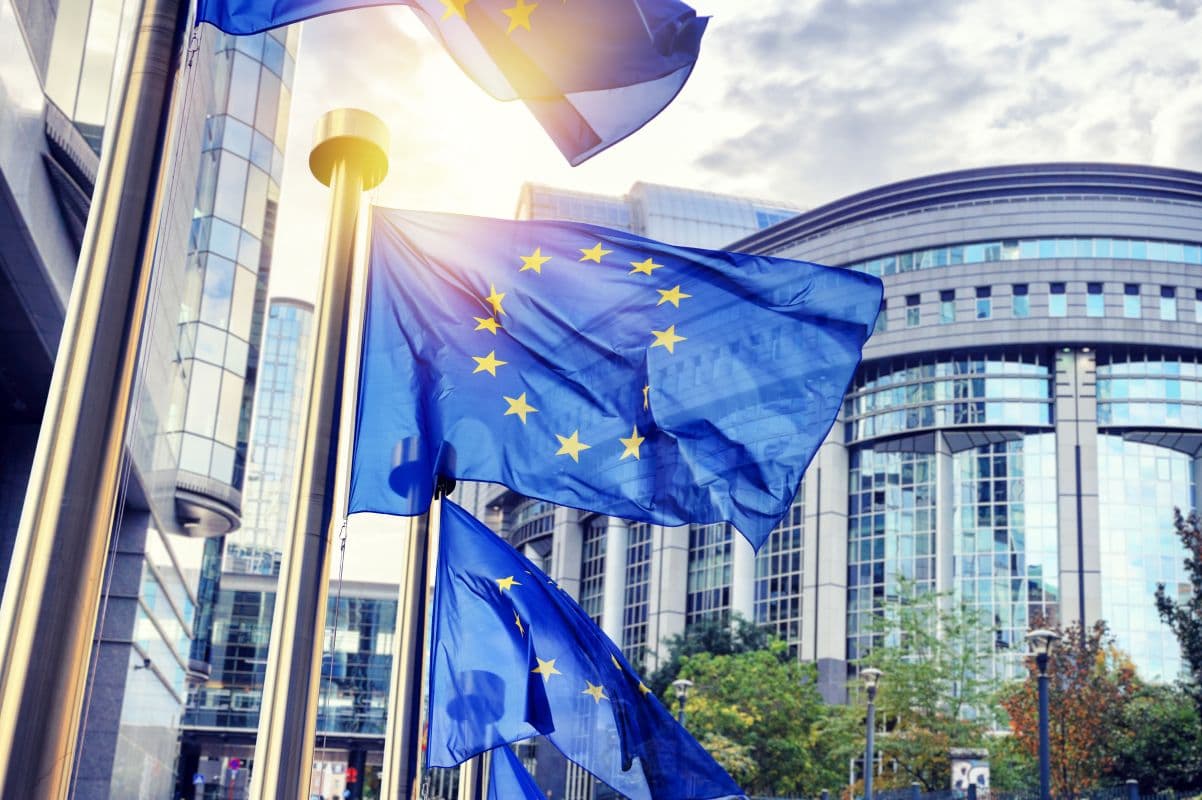
On 16 September 2026, EU Commission President Ursula von der Leyen delivered her State of the EU address. This annual speech, first introduced in 2010, is delivered before the European Parliament and is meant to ensure transparency in the EU's political life while highlighting the EU Commission's key priorities.
Today, on 16 September 2026, EU Commission President Ursula von der Leyen delivered her State of the EU address. This annual speech, first introduced in 2010, is delivered before the European Parliament and is meant to ensure transparency in the EU's political life while highlighting the EU Commission's key priorities. This year's address was of particular importance as it was attended by Canadian Prime Minister Mark Carney and saw the proposal to open the door to Canada becoming the first associate member of the European Union.
Tech and digital announcements
AI and sovereignty
One of the more important passages of the address was the Commission President's acknowledgement that models in development could enable hacking on an unprecedented scale and would soon be in the hands of adversaries. The call by CEOs of frontier labs to "pace the frontier" was highlighted as something the EU should take seriously. It is for these reasons that the EU Commission announced it would seek to work with partners like Canada and the UK on model evaluation, verification, early warning and AI security, and that frontier AI labs would be invited to discuss industry efforts to pace the frontier.
The need for the EU to have its own sovereign AI capabilities (especially for national security) was highlighted, with the EU saying it would set out plans to massively boost computing capacity in a "clean and efficient" way.
While von der Leyen argued that Europe did not necessarily need to develop frontier models outright to capture the value of AI, she stressed that the focus should be on applying AI in factories, hospitals, farming, grids, autonomous driving and defence, using Europe's high-quality industrial data.
Online platforms: EU Kids Act
Child online safety was another prominent aspect of the speech. President von der Leyen confirmed that the Commission will present an EU Kids Act on 17 September. She described a tiered, age-based approach:
No social media access for children under 13
Parent-supervised accounts with limited features and a one-hour daily limit for those aged 13 to 15
A safe-by-design obligation on platforms for users aged 15 to 18
The Digital Fairness Act (meant to tackle issues such as addictive design and dark patterns) was confirmed for proposal this autumn and would address addictive design for all users (not just children).
Was the UK mentioned?
As noted above, the UK was mentioned in relation to working together on frontier AI evaluation, verification and security, but, quite importantly, it was also mentioned a second time during the speech.
Indeed, von der Leyen was eager to highlight the need for stronger partnerships on security and announced she wanted to turn these security discussions with like-minded partners into a "European Security Council", involving partners including the UK. The scale of the risks being faced has made this urgent, and the EU Commission will be setting out ideas on how to make it a reality.
What does Canada’s Associate EU Membership involve?
The biggest announcement of the speech was arguably von der Leyen's offer to open the door to Canada becoming the first associate member of the EU. The move is part of the EU's reimagining of its international partnerships in what she described as a complex age of great possibilities and great perils. Within that context, she announced that the EU and Canada would move from CETA to an "alliance for the future", creating a "common prosperity and economic security space" covering a tech alliance, cybersecurity, intelligent manufacturing, the integration of defence industrial bases and a "flagship joint project" on the Arctic. Full details of what associate membership would involve are yet to be announced.
Canadian Prime Minister Mark Carney, who was present for the speech, will address the European Parliament on 17 September. Canada and the EU will hold a summit in Montreal at the end of October to further define their cooperation.
As the UK continues to build on the work begun at last year's UK-EU summit, and ahead of the next UK-EU summit due to take place before the end of the year, the UK now has a clearer indication of the levels of partnership and association that could be possible with the EU, given the right level of ambition.
Should you have any questions about these announcements do not hesitate to get in touch with the techUK team:

Theophile Maiziere
Policy Manager - EU, techUK
Theophile Maiziere
Policy Manager - EU, techUK
Theo joined techUK in 2024 as EU Policy Manager. Based in Brussels, he works on our EU policy and engagement.
Theo is an experienced policy adviser who has helped connect EU and non-EU decision makers.
Prior to techUK, Theo worked at the EU delegation to Australia, the Israeli trade mission to the EU, and the City of London Corporation’s Brussels office. In his role, Theo ensures that techUK members are well-informed about EU policy, its origins, and its implications, while also facilitating valuable input to Brussels-based decision-makers.
Theo holds and LLM in International and European law, and an MA in European Studies, both from the University of Amsterdam.
Sabina Ciofu is International Policy and Strategy Lead at techUK, where she heads the International Policy and Trade Programme. Based in Brussels, she shapes global tech policy, digital trade, and regulatory cooperation across the EU, US, Canada, Asia-Pacific, and the Gulf region. She drives strategy, advocacy, and market opportunities for UK tech companies worldwide, ensuring their voice is heard in international policy debates.
With nearly a decade of previous experience as a Policy Advisor in the European Parliament, Sabina brings deep expertise in tech regulation, trade policy, and EU–US relations. Her work focuses on navigating and influencing the global digital economy to deliver real impact for members.
A passionate community-builder, Sabina co-founded Young Professionals in Digital Policy (800+ members) and now runs Old Professionals in Digital Policy (more experience, better wine, earlier nights). She is also the founder of the Gentlewomen’s Club, a network of 500+ women supporting each other with kindness.
She holds advisory roles with the UCL European Institute, Café Transatlantique (a network of women in transatlantic tech policy), and The Nine, Brussels’ first members-only club for women.
Recognised by ComputerWeekly as one of the most influential women in UK tech, Sabina is also a sought-after public speaker on tech, trade and diversity.
Sabina holds an MA in War Studies from King’s College London and a BA in Classics from the University of Cambridge.
Archie Breare joined techUK in September 2022 as the Telecoms Programme intern, and moved into the Policy and Public Affairs team in February 2023.
Before starting at techUK, Archie was a student at the University of Cambridge, completing an undergraduate degree in History and a master's degree in Modern British History.
In his spare time, he likes to read, discuss current affairs, and to try and persuade himself to cycle more.
Programme Assistant, Policy and Public Affairs, techUK
Ammal Kamran
Programme Assistant, Policy and Public Affairs, techUK
techUK International Policy and Trade Programme activities
techUK supports members with their international trade plans and aspirations. We help members to understand market opportunities, tackle market access barriers, and build partnerships in their target market. Visit the programme page here.
techUK Cyber Resilience Delegation to Brussels 2026
Join us from 8 – 9 September in Brussels to deepen your understanding of the EU cyber policy landscape, connect with key European decision-makers, and shape your organisation's strategy for engaging with EU institutions on cyber resilience.
Our members develop strong networks, build meaningful partnerships and grow their businesses as we all work together to create a thriving environment where industry, government and stakeholders come together to realise the positive outcomes tech can deliver.
Sabina Ciofu is International Policy and Strategy Lead at techUK, where she heads the International Policy and Trade Programme. Based in Brussels, she shapes global tech policy, digital trade, and regulatory cooperation across the EU, US, Canada, Asia-Pacific, and the Gulf region. She drives strategy, advocacy, and market opportunities for UK tech companies worldwide, ensuring their voice is heard in international policy debates.
With nearly a decade of previous experience as a Policy Advisor in the European Parliament, Sabina brings deep expertise in tech regulation, trade policy, and EU–US relations. Her work focuses on navigating and influencing the global digital economy to deliver real impact for members.
A passionate community-builder, Sabina co-founded Young Professionals in Digital Policy (800+ members) and now runs Old Professionals in Digital Policy (more experience, better wine, earlier nights). She is also the founder of the Gentlewomen’s Club, a network of 500+ women supporting each other with kindness.
She holds advisory roles with the UCL European Institute, Café Transatlantique (a network of women in transatlantic tech policy), and The Nine, Brussels’ first members-only club for women.
Recognised by ComputerWeekly as one of the most influential women in UK tech, Sabina is also a sought-after public speaker on tech, trade and diversity.
Sabina holds an MA in War Studies from King’s College London and a BA in Classics from the University of Cambridge.
Theo joined techUK in 2024 as EU Policy Manager. Based in Brussels, he works on our EU policy and engagement.
Theo is an experienced policy adviser who has helped connect EU and non-EU decision makers.
Prior to techUK, Theo worked at the EU delegation to Australia, the Israeli trade mission to the EU, and the City of London Corporation’s Brussels office. In his role, Theo ensures that techUK members are well-informed about EU policy, its origins, and its implications, while also facilitating valuable input to Brussels-based decision-makers.
Theo holds and LLM in International and European law, and an MA in European Studies, both from the University of Amsterdam.
Archie Breare joined techUK in September 2022 as the Telecoms Programme intern, and moved into the Policy and Public Affairs team in February 2023.
Before starting at techUK, Archie was a student at the University of Cambridge, completing an undergraduate degree in History and a master's degree in Modern British History.
In his spare time, he likes to read, discuss current affairs, and to try and persuade himself to cycle more.
Theo joined techUK in 2024 as EU Policy Manager. Based in Brussels, he works on our EU policy and engagement.
Theo is an experienced policy adviser who has helped connect EU and non-EU decision makers.
Prior to techUK, Theo worked at the EU delegation to Australia, the Israeli trade mission to the EU, and the City of London Corporation’s Brussels office. In his role, Theo ensures that techUK members are well-informed about EU policy, its origins, and its implications, while also facilitating valuable input to Brussels-based decision-makers.
Theo holds and LLM in International and European law, and an MA in European Studies, both from the University of Amsterdam.
This morning, the Department for Science, Innovation and Technology’s (DSIT) Secretary of State, the Rt Hon Peter Kyle, announced the publication of two new Responsible Technology Adoption Unit (RTA) products at the Financial Times Future of AI Summit.
AI is transforming business, but governance is lagging. Shoosmiths’ Technology & AI Partners, Alex Kirkhope and Sarah Reynolds, explore why embedding compliance into strategy is critical for resilience and growth.
This is an informative insight about artificial intelligence system impact assessments (AI-SIAs) which are documented processes for identifying individuals and groups impacted by an AI system. Common-use impact assessments are already found in the context of business, the environment, finance, human rights, IT, privacy, personally identifiable information and security. As part of a growing list of governance and policy assets available to those deploying and providing AI systems, AI-SIAs can provide analytical frameworks and approaches to SIAs supported through technical rigor.
Chatham House has released a collection of essays that examines innovative approaches to AI regulation and governance. It presents and evaluates proposals and mechanisms for ensuring responsible AI, from EU-style regulations to open-source governance, from treaties to CERN-like research facilities and publicly owned corporations. You can read the essays here. Drawing on perspectives from around the world, the collection underscores the need to protect openness, ensure inclusivity and fairness in AI, and establish clear ethical frameworks and lines of cooperation between states and technology companies.
As AI continues to transform industries across the globe, the need for professionals who can operationalise its ethical implementation has never been more critical. Whether you're looking to join the field or are already working as a responsible AI practitioner, these resources from techUK will help you navigate this evolving profession.