

Shaping solutions before procurement: what the Supplier Summit has achieved, and where it goes next
Over three editions, techUK and GDS have used the Supplier Summit to do something a procurement pipeline rarely allows: surface unsolved challenges early and openly, so that the public sector and industry can work on them together. Each edition has moved the conversation forward, from setting the strategic direction to focusing on delivery to engaging upstream of procurement while there is still room to shape the outcome.
The through-line from government speakers is consistent: it cannot deliver digital transformation alone and needs the support of industry partners. With three summits behind us, it feels like the right moment to take stock of what the series has been about, what it has achieved, and how it is going. And, as the government and the wider digital landscape keep shifting, ask how we need to evolve to keep pace.
Why the Summit exists
The Supplier Summit was conceived in late 2024 during a conversation between techUK Public Services Board (PSB) members and the then Minister for AI and Digital Government Feryal Clark. In a wide-ranging discussion, the conversation kept returning to one reflection: government and industry must find better ways to engage with one another, earlier in the process.
The premise is simple. If both sides are more open with each other, and earlier, they can make real progress together on shared challenges, whether that means collaboration between departments, between government and industry, or getting into the conversation before procurement while there is still room to shape the outcome.
That is why the Summit’s format is built the way it is. Each session starts with context setting from key digital leaders from across government. Then specific departments set out challenges that they hope digital approaches can help. The Summits are intentionally designed to be "learn while doing" sessions, and are not a platform for sales pitches. Everyone is expected to contribute, listen, and work through the challenges together. It reflects a conviction the Public Services Board holds strongly: that no single person or organisation has the answers to challenges of this scale, and that the right outcomes only emerge by working together.
That conviction sits at the heart of techUK's Public Services Board. PSB has three core aims:
- To improve engagement between government and industry;
- To provide leadership on the policy issues around public services transformation;
- To champion the better use of technology to drive efficiency and better outcomes for citizens.
The Summit is one of the clearest expressions of these aims in action.
The series so far: three summits, nine challenges
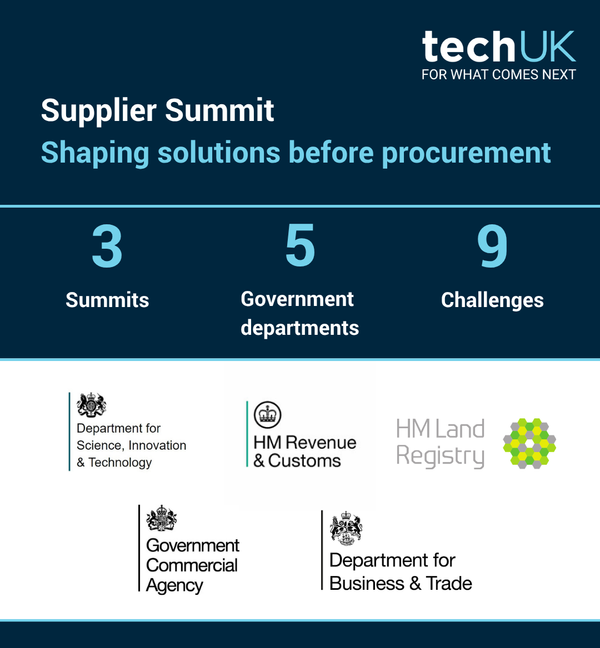
Across three editions, there have been nine live challenges, alongside and several impactful keynote addresses from public sector digital leaders.
Summit one, Summer 2025. The founding session set the strategic frame. Then Government CTO David Knott gave a candid assessment, drawing on the State of Digital Government report and the Blueprint for a Modern Digital Government, arguing that success too often relied on "heroic effort" rather than being consistent by design. The Digital Commercial Centre of Excellence (DCCoE) was introduced as a more intelligent client for the government's tech spend, and Secure-by-Design was set out as a cross-government mandate. Three challenges were put to the room: the National Digital Exchange (NDX), validating customer application data at HM Land Registry, and unlocking government data through the GDS Data Directorate.
Summit two, Winter 2025. With strategic direction established, the conversation shifted decisively toward delivery. David Knott reflected on progress at the end of 2025, pointing ahead to the Digital and AI Roadmap and to translating Spending Review investment into delivery. The DCCoE (Dr Philip Orumwense) and the Commercial Innovation Hub (Toni Peters) showed how the Procurement Act's flexibilities are being used to procure innovation and to tackle the "valley of death" facing innovative suppliers. Three delivery challenges followed: Digital Licensing (led by the Department for Business and Trade), Legacy Remediation (DSIT), and Digital Engineering (GDS).
Summit three, Summer 2026. In the latest session, the focus moved upstream of procurement. Interim Government CTO Sonia Patel made the case for moving "from digital government to intelligent government" on the right foundations; Aimee Smith, the government's Chief Data Officer, argued you cannot "AI your way out of poor data"; and GDS Local's Jenny McEneaney brought the local-government dimension into view. Two departmental challenges were tabled: HMRC's assurance for agentic AI and GDS/DSIT's challenge of using AI to meet accessibility requirements.
The impact so far
The clearest evidence of impact is the arc of the series itself. In three editions, the conversation has matured from what needs to change, to how we deliver it, to how we shape it together before requirements are fixed — a progression that mirrors government's own journey from the State of Digital Government diagnosis to a delivery-focused reform programme.
A handful of themes have recurred and deepened rather than being replaced: legacy remediation, data sharing and discovery, procurement reform, and assurance questions raised by AI and agentic systems. The consistency of messages across different speakers and editions suggests the Summit reflects a settled direction of travel, not a series of one-off set pieces.
The Summit's reach across central government has been wide, with engagement from DSIT, HMRC, HM Land Registry and DBT, alongside central functions such as the Government CTO's office, the DCCoE, the Commercial Innovation Hub, the GDS Data Directorate and GDS Local. Some of the vehicles introduced at the Summit - the DCCoE, the NDX challenge model, the Commercial Innovation Hub - have been positioned as shared, ongoing assets rather than procurement channels, and the range of departments willing to bring live challenges to the room has broadened across the three editions.
Where we go from here
The series has earned its place, and the opportunity now is to build on it. Its defining strength has been keeping the focus upstream: exploring challenges while they are still genuinely open, before requirements are fixed and while there is still room to shape the outcome together. This aspect of the Summit needs to be protected. As the format has matured, the most recent editions have at times felt more polished and closer to procurement than the early, open-ended sessions that defined it. That is a natural pull for any maturing series, and worth calling out. However, the prize in protecting the Summit's distinctive value is that it keeps drawing challenges to the room while they are still active and ongoing, and to make the follow-up after each session as substantial as the ambition around it.
It also means widening the circle. The departments that have engaged so far have set a strong example; the opportunity is to draw in others who have live, cross-cutting challenges and the same willingness to explore them openly. And it means continuing to develop the format itself, edition on edition, so that both sides leave with something they could not have got through business as usual.
That evolution is already upon us. In July 2026 the government abolished DSIT - one of the Summit's co-conveners - and distributed its responsibilities across Whitehall, with digital transformation moving to a strengthened Department for Culture, Media and Sport (DCMS), science and innovation folding into the renamed Department for Business, Innovation, Science and Trade, and AI adoption drawn into the Cabinet Office. For a series built around a single, identifiable digital centre, that dispersal makes the convening role more valuable still: the people who own these challenges now sit further apart, and a room that still brings them together is worth more, not less.
techUK intends to continue convening this engagement and to ensure it delivers for members and government alike. Government, and the challenges it brings to the room, will keep changing and the series evolve with them.
Get involved
The real work of the Summit starts after the day itself. If your organisation can contribute evidence, examples or ideas on any of the live challenges, or if you would like to know more about how techUK's Central government programme convenes this kind of engagement, please get in touch with the programme team.

Heather Cover-Kus
Heather Cover-Kus
Heather is Associate Director, Central Government and Education at techUK, working to represent the tech supplier community to Central Government.
She started as Head of Central Government at techUK in April 2022 and was promoted to Associate Director in August 2025 supporting both the Central Government and Education programmes.
Prior to joining techUK in April 2022, Heather worked in the Economic Policy and Small States Section at the Commonwealth Secretariat. She led the organisation’s FinTech programme and worked to create an enabling environment for developing countries to take advantage of the socio-economic benefits of FinTech.
Before moving to the UK, Heather worked at the Office of the Prime Minister of The Bahamas and the Central Bank of The Bahamas.
Heather holds a Graduate Diploma in Law from BPP, a Masters in Public Administration (MPA) from LSE, and a BA in Economics and Sociology from Macalester College.
- Email:
- [email protected]
- LinkedIn:
- https://www.linkedin.com/in/heather-cover-kus-ba636538

Ellie Huckle
Ellie Huckle
Ellie joined techUK in March 2018 as a Programme Assistant to the Public Sector team and now works as a Programme Manager for the Central Government Programme.
The programme represents the supplier community of technology products and services in Central Government – in summary working to make Government a more informed buyer, increasing supplier visibility in order to improve their chances of supplying to Government Departments, and fostering better engagement between the public sector and industry. To find out more about what we do, how we do this and how you can get involved – make sure to get in touch!
Prior to joining techUK, Ellie completed Sixth Form in June 2015 and went on to work in Waitrose, moved on swiftly to walking dogs and finally, got an office job working for a small local business in North London, where she lives with her family and their two Bengal cats Kai and Nova.
When she isn’t working Ellie likes to spend time with her family and friends, her cats, and enjoys volunteering for diabetes charities. She has a keen interest in writing, escaping with a good book and expanding her knowledge watching far too many quiz shows!
- Email:
- [email protected]
- Phone:
- 020 7331 2015
- Twitter:
- @techUK,@techUK
- Website:
- www.techuk.org,www.techuk.org
- LinkedIn:
- https://bit.ly/3mtQ7Jx,https://bit.ly/3mtQ7Jx

Charles Bauman
Charles Bauman
Charles Bauman is a Junior Programme Manager in the Central Government Programme at techUK.
He supports the programme’s mission to represent the technology supplier community to the UK government and advocate for digital innovation to address public sector challenges. Charles helps facilitate market engagement, foster partnerships, and ensure that tech suppliers and the government work collaboratively to improve outcomes, deliver value for money, and enhance public services for citizens.
Before joining techUK, Charles gained significant experience in research, analysis, and strategic advisory roles. At H/Advisors Cicero, he specialised in public affairs and corporate communications, while at Verdantix, he supported sustainability research and advisory projects, focusing on regulatory and environmental challenges.
Charles holds an MSc in Theory and History of International Relations from the London School of Economics and Political Science (LSE) and an MA in Medieval History from King’s College London.
Charles enjoys volunteering with a think tank, reading, hiking, and spending time with his dog and family outside of work.
- Email:
- [email protected]
- Website:
- www.techuk.org
- LinkedIn:
- https://www.linkedin.com/in/charles-bauman-75712016b/
techUK - Transforming Public Services

techUK members are transforming public services in the UK. Our community help to shape a smarter, digitally empowered public sector.
techUK drives public sector digital transformation by uniting the public sector and tech industry. Through early market engagement, efficient procurement, and innovative technology adoption, we help to modernise legacy IT, and enable efficient, secure, and personalised services.
Get involved: We run a busy calendar of activity including events, reports, and insights that demonstrate some of the most significant digital transformation opportunities for the sector. Our Transforming Public Services Hub is where you will find details of all upcoming activities. We also send a monthly public services newsletter to which you can subscribe here.
Upcoming 'Transforming Public Services' events

GCA Transport Technology RM6347 market engagement events
Online and techUK Industry Briefing
GPA Shared Network (Enterprise LAN) market engagement event
London Industry Briefing
GPA ServiceNow Development and Managed Services Partner: market engagement event
Online WebinarLatest news and insights
More resources