Rethinking Pathways into Tech for the Next Generation

Jessie joined Samsung in November 2010 and is responsible for Samsung’s Corporate Social Responsibility strategy and programmes in the UK that ultimately aim to help build trust and love for the brand. Her primary role is to help identify, design and implement programmes that best deploy Samsung’s resources across people, expertise, products and services to help improve people’s lives and the communities they live in. She is passionate about working with young people in particular and leads the company’s Solve for Tomorrow tech for good education initiative and idea competition. She also leads on Samsung’s online safety programmes for young people, parents and teachers. She is also responsible for Samsung’s employee volunteering and fundraising activities in the UK.
Young people may be digital natives, but many still feel unprepared for digital careers. Despite using technology daily, 96% say barriers prevent them from entering tech, and 65% worry their background will limit their opportunities1. This comes as 76% of UK employers report difficulty hiring for digital roles2, signalling a disconnect between young people’s potential and the pathways available to them.

Closing this gap is no longer only about technical competency. As AI accelerates automation, the skills that will define tomorrow’s workforce are uniquely human: creativity, empathy, collaboration and critical thinking - the abilities that allow people to design solutions technology alone cannot produce. Young people already show these instincts when encouraged to solve real‑world problems.
Unequal Pathways Into Tech
Despite the UK’s thriving tech sector, access remains uneven. Many young people still lack early exposure to tech careers, visible role models or clear routes into the industry. Misconceptions persist too: some believe tech is “only for maths or science experts”, while others feel the sector is “too competitive” to enter. Representation gaps deepen the divide, with women holding just 26% of IT roles 3 and only 9% of tech professionals coming from lower socio‑economic backgrounds 4.

These barriers are not about talent; they are about structure. Industry, education and society must work earlier and more intentionally to ensure young people see tech as a space where they belong. Collaborative initiatives across the sector, such as ours with Tech She Can, demonstrate how collective action can widen participation long before career‑shaping decisions are made.
Purpose‑Led Learning
For meaningful change, industry‑education partnerships must move beyond technical training and create environments where young people can build the capabilities that technology cannot replicate. As automation reshapes roles, creativity, collaboration, empathy and complex problem-solving will define the next generation of innovators.
Programmes across the sector are beginning to reflect this shift. Samsung’s Solve for Tomorrow initiative, for example, shows what becomes possible when young people learn through real‑world problem solving.

One student created My Bear, an app‑connected device designed to help children explore cultural differences through play.

Another developed a vibration‑based device to support Bell’s Palsy recovery, shaped through research, prototyping and user feedback.
Together, these projects show that young people already have the empathy and creative instinct needed for innovation; the missing piece is access to structured settings where those capabilities can grow. Since 2020, Samsung Solve for Tomorrow has provided more than 9,300 learning hours, supported by 460 volunteers and reached 326,655 young people – sparking over 6,646 tech‑for‑good ideas. In 2025, students reported increases in critical thinking (96%), confidence (94%) and industry insight (84%), highlighting why human‑centred, hybrid skills must sit at the heart of how we prepare future talent.
Inclusive Design: A Core Competency for the Future Workforce
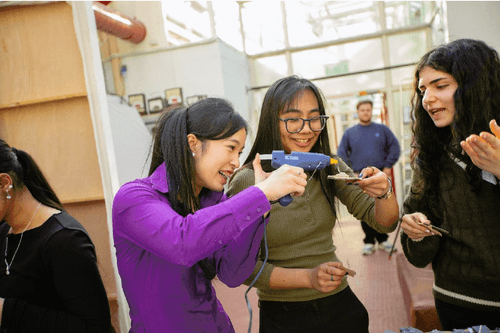
As AI, connected devices and digital public services become integrated into everyday life, design decisions increasingly shape who can participate fully in society. Without diverse perspectives, products risk embedding blind spots that affect real people. This makes inclusive design not a specialist niche but a core future skill.
Embedding principles such as understanding lived experience, designing with empathy and iterating based on real feedback enables young people to build technologies that are not only innovative but equitable.
The Role of Industry
To ensure all young people have access to meaningful tech pathways, industry can step in earlier by providing:
Relatable role models
Structured mentoring
CPD for teachers
Real‑world briefs that reflect modern tech challenges
Visibility of diverse, inclusive career routes
Where We Go From Here
Young people are ready to shape the future of technology; they simply need the tools and the belief that they can. If we want an innovative and inclusive future workforce, we must collectively design the pathways into the tech sector with the same intentionality and empathy we use to design the technologies themselves.
References:
Samsung UK Newsroom – Northern Ireland Named as the UK’s Future Silicon Valley
Experis UK – Closing the Digital Skills Gap: The 2025 Talent Shortage
AIPRM – Gender Diversity in the Tech Sector Report 2025.
UK Government – Diversity in UK Tech
About the campaign
In our pursuit to shape a more equitable future, our March TechTogether campaign will focus on supporting the next generation by joining the National Careers Week campaign, empowering women in tech, advancing equity by design, and evolving the landscape of online safety.