Government publishes the Land Use Framework – and technology is central

Defra’s new Land Use Framework (LUF), published in March 2026, marks a significant step forward in how government approaches one of the country’s most constrained and contested resources: land.
England's land has never been under more pressure. There is acute demand for new homes and infrastructure – including ambitious targets for clean energy and significant investment in digital infrastructure – while being one of the most nature-depleted countries in the world threatens our national security and resilience as we face a changing climate, reshaping physical risk across the country.
Despite this, the UK government has assessed that there is enough land to deliver on all of these objectives. For the first time, the government is attempting to link these competing priorities and outline — for developers, farmers, local authorities and the public — a vision of how the country can use land in a more efficient and multifunctional way. Rather than proscribing how land should be used, it aims to better inform decision-making at national, regional and local levels, backed by "the most advanced spatial analysis ever undertaken in this country”, a process which relies fundamentally on the better use of data and large-scale digital transformation.
The framework follows on from the Environmental Improvement Plan, published in late 2025, which established a “roadmap” for environmental restoration until 2030 and includes a complex map of interrelated commitments on nature, environmental quality (including air and water), circularity and how we environmental improvement relates to national security. All the commitments fundamentally intersect with the LUF, in that the framework is key to delivering on these objectives but is also more strategically focused.
Below techUK break down the key aspects of the LUF, including points to note for infrastructure providers and opportunities for the digital tech sector to participate in the transformation.
Managing competing demands through a systems approach
Developed based on feedback from 2025’s “conversation” on land use, the LUF responds to growing pressure on land, from increasing need for housing and infrastructure, to food security, to environmental restoration and climate adaptation. Historically addressed in isolation, resulting in fragmentation, slower decision-making and, in some cases, avoidable trade-offs, the new framework attempts to change this by adopting a more systemic approach which balances and optimises usage, reflecting a broader shift in policymaking across government towards integrated approaches.
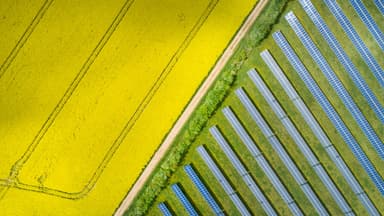
This is demonstrated through the emphasis on multifunctional land use, one of the four key “principles” of the framework. Rather than assigning land to a single purpose, the Framework encourages approaches that enable land to deliver multiple benefits at once, whether that is installing solar panels above crops, investing in habitat restoration to enhance biodiversity (in turn improving food production), or integrating flood management with wider land stewardship. Delivering multifunctionality at scale requires a detailed understanding of how different uses interact across locations and over time, and how those interactions can be optimised. The other principles encourage planners and developers to consider how land use aligns with local contexts; whether it takes account of the most up-to-date evidence to anticipate climate change impacts; and whether it is ‘adaptive by design’, able to flexibly respond to emerging challenges.
These present an inherent data and modelling challenge, depending on the ability to bring together environmental, economic and spatial information, and to translate that into practical decisions for land managers, planners and policymakers.
Making land digital
Significantly, the Framework acknowledges that incomplete, fragmented and inaccessible land data has directly held back housebuilding, infrastructure delivery and environmental management, and proposes digital transformation of how land information is collected and used as integral to addressing this.
Notably, the soon-to-be-established Land Use Unit (overseen by Defra) will publish a dynamic, publicly accessible online map integrating spatial priorities across food, nature, climate, water, housing and energy. This is a significant new data infrastructure undertaking and it will sit alongside a new streamlined digital planning service that planners and developers will be able to use to assess land suitability rapidly.
The government also intends to improve "combined mapping platforms" so that decision-makers can overlay priorities from multiple sectors in a single view. This points towards significant procurement and co-design opportunities for geospatial data firms, GIS platform providers, cloud infrastructure suppliers and data analytics companies.
Further, by 2029 Defra promises to publish a baseline assessment of natural assets by 2029, which could have significant implications for quantifying nature restoration, and the nature markets.
Supporting a long-term land use transition
Alongside the national map, the LUF signals a broader push toward open data flows between national and local government. This reflects a lesson learnt from the consultation process in that national strategies have oftentimes failed to translate into action at the local level precisely because the data pipelines connecting the two did not exist.
The framework explicitly links the transition to digital land data with the Government's ambition to attract private investment into nature markets. Environmental Delivery Plans (EDPs), Biodiversity Net Gain (BNG) requirements and the broader 30by30 commitment all depend on credible data about habitat condition and change. Without robust monitoring and reporting, private capital will be reluctant to flow into these markets at scale. To enable this change, technology and the wider digital infrastructure landscape is fundamental.
In terms of resilience, there is also a strong focus on the role of nature-based solutions to support mitigation and adaptation to large-scale climate impacts. The government notes that it intends for restoration to increasingly be funded by private investment.
A cross-government delivery challenge
Although led by Defra, the LUF sits at the junction of multiple policy areas and responsibilities, including planning, infrastructure, energy and digital policy. Its success will depend on effective coordination across these areas, as well as between national and local levels. This complexity reinforces the importance of shared data, common standards and interoperable systems. It also highlights the role of enabling infrastructure, particularly connectivity, in supporting more data-driven approaches to land use. Without this digital foundation, the ambition to make land use more strategic and multifunctional will be harder to deliver on the ground.
What’s next
The publication of the LUF is the beginning of a long implementation journey, not the end of a policy process. Several key milestones are already signalled that will create concrete engagement points for the technology sector over the next few years.
An updated National Planning Policy Framework will be published this year (2026), shaping the digital planning environment and determine how spatial data from the Land Use Unit feeds into local plan-making.
A national map aggregating data from Local Nature Recovery Strategies (LNRS) will be published in 2026. This will be the first integrated spatial view of what England's LNRSs propose for nature recovery.
The newly established Land Use Unit in Defra will develop and begin publishing the single, dynamic national spatial map. This is a significant public data infrastructure project that will push forward this workstream for years to come.
In 2027, government will publish an updated 10-Year Infrastructure Strategy, coordinated by NISTA, which will further set out national spatial priorities for infrastructure investment. This will be a defining moment for how infrastructure, housing, energy and environmental priorities are spatially coordinated.
In Autumn 2027, the Strategic Spatial Energy Plan will be published. This will spatially optimise the energy infrastructure needed for generation and storage across Great Britain, identifying demands on land and considering societal and environmental factors.
The government has signalled it will develop long-term climate change impact assessments for land use under 2°C and 4°C scenarios, feeding into the Fourth National Adaptation Programme, due in 2028.
The LUF will be updated every five years with the first update due in 2031.
If you’re interested in exploring more how we are engaging with the government’s land and nature priorities, get in touch with Josh or Elisabeth - or sign up to attend our upcoming Tech and Nature Summit. Additionally, keep an eye out for an upcoming webinar looking at key insights from the Land Use Framework and Environmental Improvement Plan.