Event roundup: Tech and the City - How can Britain Build the Next Tech Giants? The Role of Capital Markets

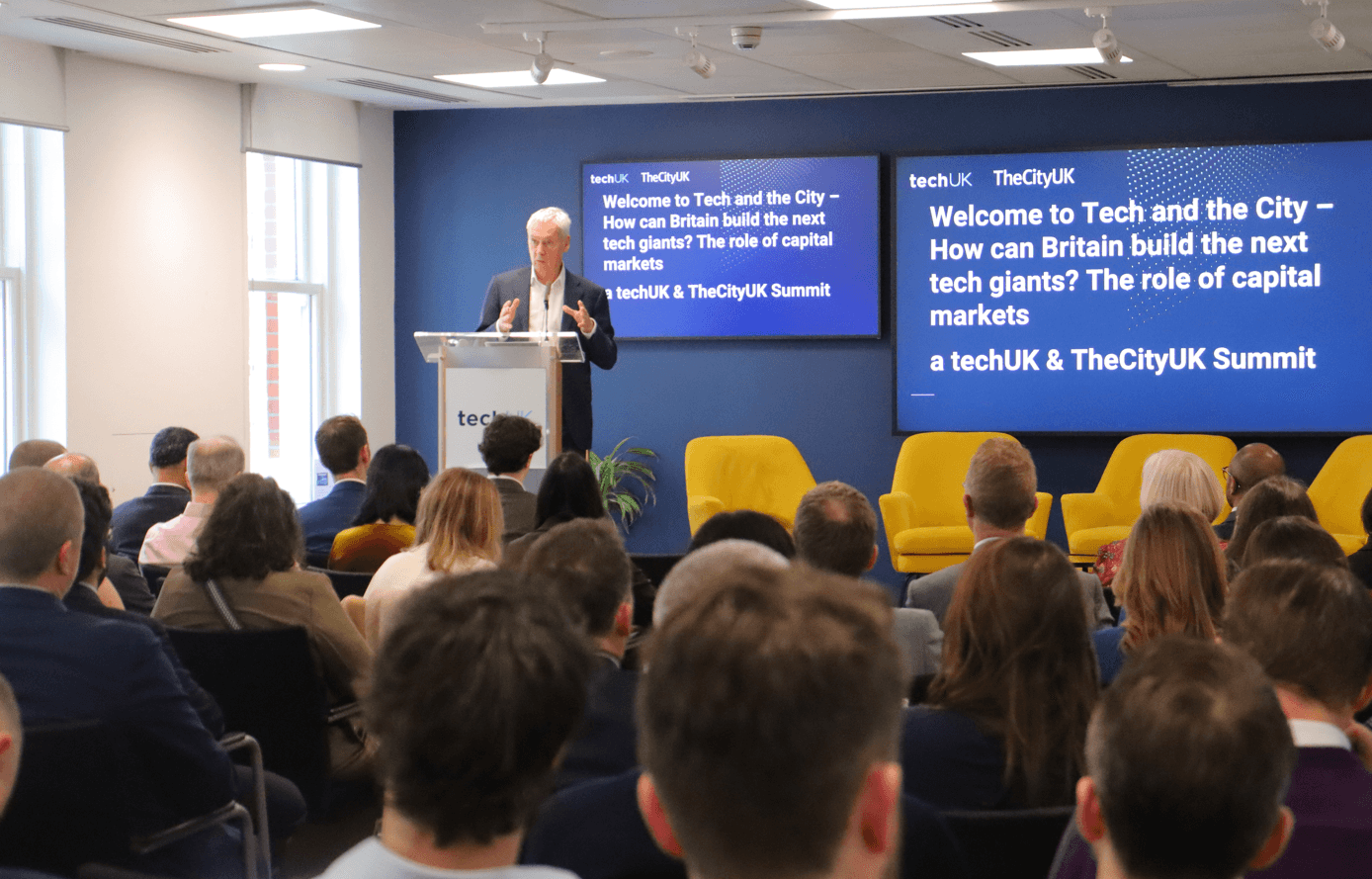
On Tuesday 24 February 2026, techUK partnered with TheCityUK to host leading voices across technology, financial services, and government for Tech and the City – How can Britain build the next tech giants? The role of capital markets.
The summit convened tech leaders, finance experts, and government ministers to discuss how Britain can build its first trillion-dollar tech company, identify the structural barriers regarding access to finance for high-growth tech firms, and determine how UK capital markets can better support the tech sector’s growth mission.
Opening remarks – Julian David OBE, CEO, techUK & John Godfrey, Managing Director – Policy, Public Affairs & Research, TheCityUK
Julian David opened the summit by outlining a clear mission: building Britain’s first trillion-dollar tech business. This summit marks the launch of a wider body of work by techUK designed to support a pipeline of firms as they move from start-up to scale-up and eventually toward listing—a strategy dubbed ‘Start. Scale. Stay.’
John Godfrey affirmed that this is a pivotal moment for the UK economy, noting that when tech and finance move in unison, economic growth inevitably follows. He referenced TheCityUK’s landmark ‘No Time to Lose’ report, which interviewed over 300 industry leaders; the importance of the tech sector was a recurring theme in almost every conversation, underscoring its role as the engine of the modern British economy.
Panel Discussion 1 – Enhancing Access to Capital Markets for UK Tech Businesses
This panel discussed the challenges within the UK’s financing environment, including government funding schemes, tax incentives, and the regulatory reforms necessary to improve private equity and VC investment.
Chair: John Godfrey, Managing Director, TheCityUK
Karan Jain, Founder & CEO, Nayaone
Virginia Khoo, COO EMEA - ECM, BNP Paribas
James Roe, Partner, A&O Shearman
Matthew Harris, CFO, Kao Data

Panellists agreed that while the Mansion House Reforms are a vital step forward, the UK must move beyond the announcement phase. The opportunity in allocating UK pension capital to fund high-growth tech companies is immense, but the industry must now track how much capital is actually being deployed in this way to ensure these reforms bear fruit. While existing schemes like UK R&I grants, R&D tax credits, and the Enterprise Investment Scheme (EIS) have been helpful, panellists suggested that the UK must look toward deeper taxation reform—not just for competitiveness, but for clarity and simplification—to truly stimulate the growth the government needs.
The discussion also highlighted the importance of viewing public and private markets as a single, supportive ecosystem. For capital-intensive sectors like data centres, the UK often struggles during the ‘blitz scaling’ phase, where firms need aggressive growth capital before becoming cash-flow positive. Panellists noted that while London has significant funding strengths, it has historically lacked the risk appetite for this specific stage compared to the US. To combat this, the UK could look to international models such as France, where state-backed investment vehicles help anchor IPO demand and support domestic technology champions listing on home exchanges.
Beyond large-scale institutional shifts, the panel emphasised that the founder experience must be streamlined through better regulatory guidance and "onboarding" pathways. From a founder’s perspective, a hybrid approach to funding—taking smaller amounts of capital to prove a business model before scaling—is often the most sustainable route, yet it requires a clearer single point of contact for navigating options. The FCA’s innovation programs were cited as a massive asset here, as they provide early-stage firms with essential regulatory guardrails while simultaneously putting them in front of potential buyers. This culture of sandboxes and innovation pathways creates a level of stability and trust that can become a unique competitive advantage for the UK.
Ministerial Keynote Address – Lucy Rigby KC MP, Economic Secretary to the Treasury

Lucy Rigby’s keynote address focused on the government’s 10-year vision for the UK economy, envisioning British-founded tech companies leading the world in AI, drug discovery, and cyber security. She noted that the UK holds a distinct advantage with more unicorns in London than Paris and Berlin combined but emphasised that capital markets must become as digital and dynamic as the firms that list on them.
To achieve this, the government is delivering a package of reforms including the FCA’s new listing rules, which allow founders more flexibility through dual-class share structures. Additionally, the new "listings relief" will exempt company shares from stamp duty for the first three years after listing. Rigby reasserted the government’s commitment to making the UK the best jurisdiction in the world to raise capital, noting that the 2036 vision is within reach provided government continues to closely consult industry through techUK and TheCityUK.
Panel Discussion 2 – UK’s Potential for High-Tech, High-Growth Companies
This panel explored the UK’s technology clusters and infrastructure strengths, alongside the specific opportunities for investment in high-growth tech startups.
Chair: Julian David OBE, CEO, techUK
Richard Price, CTO, Pragmatic
Claire Suddens-Spiers, Partner, Rothschild
Dr Jaymin Patel, Co-Founder & COO, Hexarad

The panel debated whether seeking a trillion-dollar company is the right ambition, concluding that a trillion-dollar phoenix will only emerge from a healthy ecosystem of unicorns and decacorns. A major British strength identified was the UK's regional diversity; by treating the country as a unified cluster—combining Cambridge’s research, the North East’s manufacturing, and London’s finance—the UK can lower operating costs while maintaining high innovation. However, in sectors like health-tech, procurement remains a barrier. Despite the NHS being a world-leading asset, long and unpredictable sales cycles often drive British AI firms to the US, suggesting that further procurement reform is a prerequisite for domestic growth.
A recurring theme was the need for a cultural shift toward risk and household investment. While the UK has enough scale capital to build world-leading firms, it lags the US in risk culture and the depth of sectoral expertise among investors. One panellist noted that they chose a Swiss investment firm over British options simply because the Swiss firm had a deeper understanding of health-tech. To bridge the funding gap, the UK must encourage more household investment; if only 25% of household assets were moved into equities, it would create over £700bn of additional financing capacity. Ultimately, alignment across technology, finance, and government is the missing link to ensuring UK capital is reinvested back into the home market.
The conversation further detailed how sector-specific challenges, such as those in semiconductor manufacturing, require a long-term investment mindset that the UK is only beginning to cultivate. Semiconductor cycles can last five years before equipment is even deployed, necessitating patient capital that understands the fundamental importance of hardware to national competitiveness. Panellists pointed out that while initiatives like the National Wealth Fund and the Mansion House Accord are excellent progress, the UK still suffers from a lack of investment professionals with deep, early-stage growth experience. Addressing this skills gap in the investment community is just as critical as the availability of capital itself to ensure the best British firms don't have to look overseas for ‘smart’ money.
Closing Keynote Address - Charlie Walker, Deputy CEO, London Stock Exchange
Charlie Walker closed the summit by arguing that focusing solely on the number of tech IPOs is the wrong starting point. Instead, the UK must focus on how the jurisdiction can ‘start, scale, and stay’ — ensuring that IP, tax revenue, and leadership remain within the country as companies go global.
He noted that while listing rules and prospectus regimes have been modernised, the trend of domestic investment must be reversed. Twenty-five years ago, 50% of UK pension and equity investment was domestic; today, that figure has plummeted to 3%. As other jurisdictions prioritise their own domestic markets to drive growth, Walker stressed that the UK must do the same. With the world’s third-highest pool of capital and world-class universities, the UK is perfectly positioned to lead—provided that everyone ‘leans in’ to support the next generation of British tech.

In conclusion
This summit highlights a defining moment for British competitiveness. UK success in the 21st century economy depends on our capital markets evolving into an engine room for domestic innovation. The discussions made clear the UK has world-leading tech clusters alongside deep pools of capital, but a strategic shift is required to bridge the ‘blitz scaling’ gap, simplify taxation/procurement landscapes, and activate domestic institutional and household investment. By fostering an ecosystem where tech and finance move in unison – supported by sector specific expertise and a bolder risk appetite – we can ensure promising British tech firms become UK anchored global champions. This mission is a central pillar of techUK’s Financial Services Programme, led by James Challinor, and if the themes of this conference interest you and you’d like to learn more please contact james.challinor@techuk.org.