

Promoting citizen-centred outcomes across public product and service landscapes

David Singer
Last year UK’s Cabinet Office and Policy Profession published the Public Design Evidence Review (PDER). It validates the benefits of public design (service design and sibling research and design practices) when delivering citizen-centred outcomes across whole policy lifecycles in UK public sector settings. Through extensive literature reviews, subject matter expert research and case study evidence, the PDER shows that:
“Public design is an iterative process of generating, legitimising, and achieving policy intent whilst de-risking operational delivery. It involves a range of practical, creative and collaborative approaches grounded in citizens’ day-to-day experiences of, and relations to, people, objects, organisations, communities and places.”
(PDER - Public Design in the UK Government: A review of the Landscape and its Future Development, 2025)
Through this piece I’ll move through Transform’s five layers of product and service landscapes, describing how service design holds citizens’ desirable futures and needs at the centre of change, whilst also setting the conditions for public sector transformations to thrive. I’ll show how through participatory ways of working, service design builds enabling relationships across complex policy and organisational contexts and helps to develop feasible and viable transformation architectures with multi-disciplinary colleagues and stakeholders. I’ve used examples from the PDER case study bank to help bring the thinking to life.
The five layers of product and service landscapes
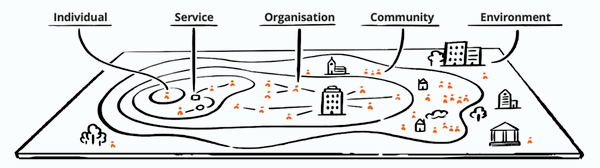
Transform’s product and service landscape model
At the individual layer, service design helps to understand people in the round, not just as service users, but as carers, workers, neighbours - people navigating their lives impacted by policy intent. Service design moves questioning on from the immediate "what do users need from a service?" by extending thinking to "what are people's lives actually like?" considering not only their problems and challenges in hand, but bringing their contexts and strengths into focus. DWP's work on supporting unpaid carers to remain in work surfaced a default journey in which people didn't yet see themselves as carers and were making highly consequential decisions early on, often without the information or support they needed. Their approach helped stakeholders understand a so far undefined group of people, ‘potential carers’ to consider a broader system of support that could act earlier and ultimately help people stay in work.
At the service layer, service design is the central facilitator of co-creating service (and so policy) interactions between citizens with lived experience and policy leads (and many of the system actors in between). Service design champions the prototyping of end-to-end design concepts with all actors who use, manage and lead services and policies, iterating on the strength of their reactions and reflections, rather than the hypotheses and ideas held by the louder centres of power. On our (Transform’s) work with HMCTS re-designing the immigration and asylum appeals service, whole-service simulations brought every actor along the journey into the same room to test service end-to-end prototypes in a single day. This helped highlight gaps in delivery and supported everyone in the service journey (service users, administrators, decision makers and policy leads) connect as a community of design and to spot enabling design compromises.
At the organisation layer, service design acts as a sense-maker and satellite view, helping highlight citizen needs and goals, whilst also helping facilitate organisational re-design. It unpacks and shows how clunky operating model machinery can be transformed into lighter ways of working that produce efficiencies for administrators, the public purse and better service citizens. To help shift organisational designs in favour of citizen outcomes, service designers can find, enable and help grow civil servant intrapreneurs who have a bounce in their step, are less risk averse and often the biggest advocates of citizen-centric futures. DfE's work reimagining education services from the perspective of frontline workers shows how a systems-thinking approach to teacher recruitment and retention led DfE teams to restructure themselves to reflect the teacher service lines. “The team replaced a complex journey split across three organisations and instead created a joined-up service, designed to inspire, attract and support potential teachers”.
At the community layer, service design is a furious networker. It maps systems of communities and their assets, bringing them into design processes to seed their ideas and resources within future state thinking and helping them consider how to guide citizens through new policies and services. DWP’s supporting unpaid carers to remain in work shows how 45 experts and organisations from across government, charities, academia, the private sector and unpaid carers themselves were brought together as a working community, mapping the citizen's information landscape from the citizen's perspective and, in doing so, catalysing new local partnerships.
At the environment layer, service designers are citizen advocates with policy, funding, legislation and infrastructure leads. Here the strengths of designers’ visual communication and story-telling skills come into their own. They help show through relatable, human stories how enacted policies impact citizens and help consider how budgets are best spent. Service design helps policy-makers see the human consequence of their decisions through energising and immersive design experiences like whole-system simulations and speculative future consequence role-playing. In HMRC Policy Lab's work on the Plastic Packaging Tax, field studies and product personas surfaced unintended consequences in medical settings where plastic use cannot be avoided. Workshops with policy and industry stakeholders helped map customer journeys end-to-end, influencing the tax design before implementation rather than retrofitted afterwards.
Service design, a steward of participatory, citizen-centred practice
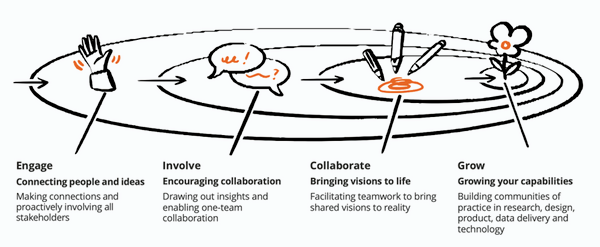
Transform’s participatory practice model
Service design holds the five layers of product and service systems together in positive tension through participatory practice. Collaborative ways of working which are cohesive and that nurture collective imagination and action. Service design is at the epicentre of this orchestration bringing citizens, frontline workers, operational leaders and policy-makers into the same rooms (physical or virtual) to design mutually beneficial futures together. Our participatory model as shown here shows how we can meet citizens and stakeholders where they are and support them to adopt new ways of working that PDER celebrates. On the immigration and asylum appeals service, our co-design sessions had judges, operational staff, managers, policy-makers, Home Office colleagues and third sector organisations playing the roles of researchers and designers, building empathy across the ecosystem and surfacing quick decisions in the room rather than through rounds of additional meetings.
Participatory design activates the middle ground, the centre of system tensions where positive debate has to happen to tackle the knottiest, wicked problems.
Service design is far from just the blueprint artefacts of today’s delivery or possible futures. It’s a relational practice that holds citizen futures in view for a whole system to grapple with and spot their role in enabling and delivering. Service design works across the five layers I’ve discussed, facilitating safe and inclusive spaces for citizens’ complex and sometimes vulnerable lives to be deeply understood and meaningfully harnessed as part of public service transformation. And where possible, for those same citizens to be active participants in a design process.
We’re super proud to have been included as one of 13 exemplars in the PDER, a landmark document that helps demonstrate how service design is a key enabler of citizen-centred, system-aware public service transformation.
Find out more about Transform.
techUK - Transforming Public Services

techUK members are transforming public services in the UK. Our community help to shape a smarter, digitally empowered public sector.
techUK drives public sector digital transformation by uniting the public sector and tech industry. Through early market engagement, efficient procurement, and innovative technology adoption, we help to modernise legacy IT, and enable efficient, secure, and personalised services.
Get involved: We run a busy calendar of activity including events, reports, and insights that demonstrate some of the most significant digital transformation opportunities for the sector. Our Transforming Public Services Hub is where you will find details of all upcoming activities. We also send a monthly public services newsletter to which you can subscribe here.
Upcoming 'Transforming Public Services' events


HMRC Border Services Delivery: Customs and Excise pre-market engagement webinar
Online Webinar
Latest news and insights

More resources
Authors