

Digital excellence in 2026: what it really means for a smarter state?

Laura Larwood
In 2026, digital public services operate in a world increasingly shaped by rapid AI adoption, persistent cyber and geopolitical threats, and heightened scrutiny around sovereignty and data governance. At the same time, many organisations remain dependent on complex legacy estates underpinning critical public outcomes, from revenue collection and welfare payments to border security and emergency response.
Policy ambition is high, and rightly so. But digital excellence is increasingly judged not by vision alone, but by whether government can translate that ambition into safe, reliable and accountable delivery at scale. The challenge facing the state is therefore clear: how does government adopt AI and digital innovation at speed, without losing control, trust, or resilience?
As Head of Central Government at SCC, I have spent two decades helping organisations overcome this tension between innovation and resilience, enabling organisations to adopt new digital capability while maintaining continuity of critical services.
SCC as an organisation has supported the UK public sector for over 50 years and today works with more than 600 public sector organisations where secure, scalable infrastructure is an operational requirement. As a British‑owned, privately held and family‑owned organisation within the Rigby Group, we are able to take a long‑term view, investing in capability and outcomes that serve public services, not shareholder cycles.
What does digital excellence mean in 2026?
Digital excellence is often mistaken for digitisation. More platforms, more automation, more tooling. But a smarter state is not defined by how much technology it deploys. It is defined by how confidently it can operate, govern and evolve its digital estate over time.
In our experience, digitally excellent public sector organisations share four characteristics:
- Control: real‑time visibility across digital estates, with clear ownership of cost, risk and performance
- Resilience: the ability to operate through disruption, whether cyber incidents, supplier failure or geopolitical shock
- Adaptability: improving continuously, rather than relying on infrequent, high‑risk transformation programmes
- Trust: transparent, ethical and accountable use of data and AI that maintains public confidence
These characteristics matter because digital systems are no longer just enablers of services. They are core national infrastructure, spanning applications, data, identity, and the enterprise and networking fabric that connects users, sites and partners.
In that context, excellence depends as much on the fundamentals of enterprise architecture and connectivity as it does on visible digital products. If networks are fragile, integrations are ad hoc, or ownership is unclear, even well-designed services and AI initiatives will be hard to scale, assure, or recover under pressure.
The Smarter State operating model
Delivering digital excellence at scale requires more than individual programmes or technologies. It requires an operating model that connects mission outcomes to day‑to‑day digital operations.
In practice, we see this as four interconnected layers:
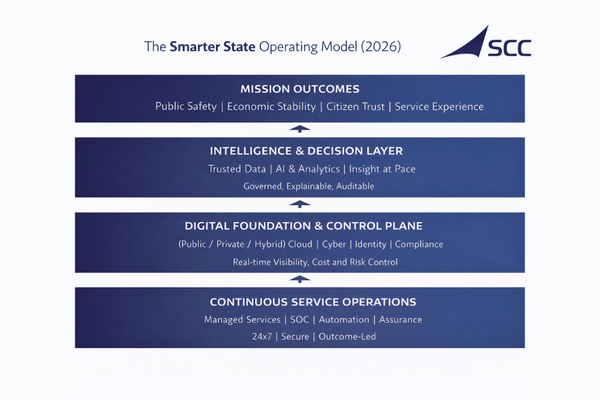
At the top sit mission outcomes: public safety, economic stability, citizen trust and frictionless service experience. These outcomes are where digital success or failure is ultimately felt.
Beneath that is the intelligence and decision layer, where trusted data, AI and analytics enable insight at pace. Crucially, this layer must be governed, explainable and auditable if it is to support confident decision‑making.
Those capabilities depend on strong digital foundations and a control plane: Public, private and hybrid cloud, cyber security, identity and compliance, enterprise architecture and integration, and the networking layer (connectivity, segmentation and performance) that binds the estate together. Done well, this provides real‑time visibility and control over cost, risk and service health across increasingly complex environments.
Finally, all of this must be sustained through continuous service operations: secure, outcome‑led services operating 24×7, with assurance built in rather than bolted on.
For many critical services, this also needs to be underpinned by sovereign capability in practical terms: clear jurisdictional control of data and operations, assured supply chains, cryptographic and access controls that stand up to audit, and credible exit and portability plans. Sovereignty is not a slogan; it is the ability to sustain essential services even when dependencies are under stress.
The key principle is simple but often overlooked: digital excellence is achieved through integration and governance, not fragmented tools or suppliers.
AI raises the stakes for delivery confidence
AI is now embedded across public service delivery, from operational decision‑making to citizen interaction. Used well, it offers real opportunities to improve productivity and insight. Used poorly, it magnifies existing weaknesses in data quality, governance and accountability.
What we see repeatedly is that AI success is constrained less by algorithmic capability and more by the strength of the foundations underneath it. Without trusted data, resilient infrastructure and clear governance, AI introduces risk faster than it delivers value.
This is why digital excellence in 2026 is inseparable from delivery confidence. The question is no longer whether organisations can adopt AI, but whether they can do so safely, responsibly and at scale, without undermining trust or operational resilience.
Why this matters now
Several trends are converging at once. AI is increasingly demanded for everyday public service delivery. Cyber resilience is inseparable from national resilience. Sovereignty is scrutinised not just in policy, but in operational reality. And public trust increasingly depends on how digital systems are governed, not how quickly they are deployed.
At the same time, heritage technology estates continue to underpin essential public services. Transformation cannot come at the expense of continuity. For many organisations, the challenge is not choosing between innovation and stability, but delivering both at once.
It is also worth being clear about what has driven progress to date. Public cloud adoption has often been a rational, enabling choice: faster access to modern security capabilities, scalable platforms, improved developer tooling, and a route to reduce time-to-delivery when internal capacity is constrained. In many cases it has helped organisations standardise, modernise and ship services sooner.
However, public cloud is not a universal answer. Some workloads demand higher assurance, tighter operational control, predictable cost models, specific connectivity patterns, or reduced dependency concentration. Private and sovereign digital initiatives (including modernised on‑premise, sovereign hosting, and managed platforms) can be the right fit where resilience, jurisdiction, or mission criticality require a different balance of risk and control.
The smarter state is therefore defined not by speed or scale alone, but by confidence that the digital estate—including its enterprise integration and networks—can place workloads in the right environments and adapt to AI acceleration and geopolitical uncertainty without slowing down or destabilising public services.
That leads to a fundamental question for public sector leaders:
How confident are we today that our digital estate can safely adapt to AI acceleration and geopolitical uncertainty, without losing control, trust, or resilience?
If you want an objective view of where you are today (and what needs to change) SCC Pathfinder offers a free, no‑cost consultation designed for public sector leaders to help you understand your current capability, clarify the direction you need to take, and define the practical steps required to deliver your long‑term digital strategy with confidence.
Start here: SCC Pathfinders - SCC UK
techUK - Transforming Public Services

techUK members are transforming public services in the UK. Our community help to shape a smarter, digitally empowered public sector.
techUK drives public sector digital transformation by uniting the public sector and tech industry. Through early market engagement, efficient procurement, and innovative technology adoption, we help to modernise legacy IT, and enable efficient, secure, and personalised services.
Get involved: We run a busy calendar of activity including events, reports, and insights that demonstrate some of the most significant digital transformation opportunities for the sector. Our Transforming Public Services Hub is where you will find details of all upcoming activities. We also send a monthly public services newsletter to which you can subscribe here.
Upcoming 'Transforming Public Services' events

HMRC Border Services Delivery: Customs and Excise pre-market engagement webinar
Online Webinar

Latest news and insights


More resources
Authors