Data Centre Programme - What we achieved in 2025

Programme overview
2025 marked a step change in the policy, regulatory and public profile of the UK data centres sector.
Following the Government’s decision in late 2024 to designate data centres and third-party cloud services as Critical National Infrastructure (CNI), engagement throughout 2025 increasingly focused on resilience, cyber security, incident response and dependencies on the energy system. The creation of the Government’s Data Infrastructure Forum also formalised a more structured relationship between industry and Government.

Our report Foundations for the Future - How Data Centres Can Supercharge UK Economic Growth provided an evidence base for much of this engagement. It quantified the sector’s gross value added at £4.7 billion and set out how targeted policy interventions could accelerate growth. The report also highlighted the role of data centres in regional economic development, drawing on case studies from West London and Slough, Greater Manchester, and Cardiff and Newport.
Across the year, techUK’s Data Centres Programme focused on sustained policy engagement, evidence-based advocacy and convening industry, policymakers and regulators around the shared recognition that data centres are foundational infrastructure for the UK economy, public services and AI deployment.
Sector overview and investment signals
The UK remains Europe’s largest data centre market. London accounts for around 80 percent of operational capacity and continues to lead Europe on take-up and interconnection density, although growth is increasingly evident in other hubs, including Greater Manchester and Wales.
The operating environment remains challenging. While demand continues to grow, driven by cloud adoption, connectivity and AI workloads, delivery is increasingly constrained by electricity pricing, grid capacity, planning complexity and environmental scrutiny. techUK’s focus throughout 2025 has been on ensuring that policy ambition translates into practical, investable outcomes.
Investment signals during 2025 reinforced long-term confidence in the UK market, but also demonstrated a shift towards fewer, larger and more power-led projects. There are many estimates, including £45bn of private investment committed since July 2024 (as stated by government), however, the UK data centre pipeline was worth approximately £36.4bn in planned projects as of August 2025, covering nearly 100 data centre developments across the country.
According to network operator SSEN Distribution data on connection applications, the data centre pipeline seeking grid connection in the UK grew to around 2.2 GW (from 1.3 GW previously) by early 2025, reflecting substantial new capacity in development. National Gas has indicated that five proposed sites alone could account for around 2.5GW of demand. These figures underline both the opportunity and the urgency of reforming energy infrastructure and connection processes.
Key Achievements
In 2025, techUK established itself as a trusted and credible partner as well as the first port of call for Government and regulatory agencies for the data centres sector, such as the UK Government directly citing our report within their UK Infrastructure: A 10 Year Strategy. And this has been particularly salient for energy and grid connection.
Energy and grid connection
Energy policy dominated the operating context for data centres in 2025. Grid access, connection timelines and electricity pricing now shape investment decisions as much as planning or customer demand.
techUK advocated for the sector across engagement with Ofgem, the National Energy System Operator (NESO), the Department for Energy Security and Net Zero, the Department for Science, Innovation and Technology, and HM Treasury, ensuring that large-scale digital demand is reflected in national energy reform. In techUK’s response to the Modern Industrial Strategy “Industrial Strategy 2025: What it means for Energy and Digital Tech”, we warned that delivery would fail without dramatic reform of energy infrastructure and a readiness-based grid connection queue.
techUK had a decisive impact on a number of areas, including grid connection reform – by leading sustained engagement with Ofgem, NESO, DESNZ, DSIT and HM Treasury on queue management, capacity visibility and end-to-end connections reform. techUK also co-signed two major cross-industry letters in 2025: one to Ofgem on grid capacity visibility and queue management, and one to the Treasury Select Committee on energy levies calling for an inquiry to examine how the Treasury’s new framework to scrutinise new policy costs can succeed. techUK also appeared before the House of Lords Industry and Regulators Committee to discuss queue management, planning and the implications of prolonged connection delays for energy intensive demand users.
Climate Change Agreements
A central outcome for the sector was the conclusion of negotiations on the new Climate Change Agreement (CCA) for the data centre sector. Following extensive negotiations led by techUK, a sector-specific energy efficiency target of 14.5% improvement relative to a 2022 baseline by the end of 2030 was confirmed for Target Periods 7-9 (2026 - 2030).
Cyber Security and Resilience Bill
The Cyber Security and Resilience Bill progressed during 2025, with data centres identified as potential future essential services under the NIS framework. A Government factsheet published in November confirmed DSIT as policy lead and Ofcom as operational regulator.
While this signals growing recognition of the sector’s importance, substantial detail is expected to follow through secondary legislation. techUK continues to engage with Government and regulators to press for clarity and proportionality in the emerging regime.
Planning reform and NSIP
techUK has long campaigned for planning reform to support data centres development and to ease some of the historic planning challenges faced by the sector. Some positive movement came in the form of the inclusion of the sector under the Nationally Significant Infrastructure Projects (NSIP) regime. techUK supported this development while emphasising the need for a clear National Policy Statement to define thresholds, environmental parameters and community engagement expectations.
Sustainability, water and heat
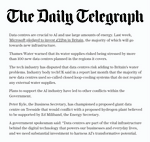
techUK published Understanding Data Centre Water Use in England, developed with the Environment Agency, demonstrating that most UK data centres use minimal water and that many have adopted waterless or closed-loop cooling. The report was reported in the national press such as The Daily Telegraph. The report is a positive first step in collating industry data and opened the door to future collaborations.

Complementary work on heat reuse and district heating highlighted both the potential benefits and practical constraints of heat export, cautioning against mandatory requirements that risk delaying or deterring investment where conditions are not viable.
On this, techUK provided formal evidence to the London Assembly as part of its scrutiny of heat networks, planning policy, and the role of data centres in London’s energy system.
2026 - The year ahead
Throughout 2025, techUK’s role has been to ensure that policy ambition is grounded in evidence and practical deliverability.
In 2026, we will build on this momentum by:
shaping government policy development, including through the Cyber Security and Resilience Bill
challenging constraining approaches on AIGZs, planning, grid access and energy costs
pressing for a more competitive business environment for digital infrastructure
convening industry and stakeholders to build consensus on issues such as CNI, permitting and regulation
continuing to improve understanding of the sector among policymakers, media and the wider public
Our focus will remain on enabling sustainable growth of the sector in the UK.

Announcing the new techUK Data Centres Council 2026/2028
Kicking off 2026, we have announced the outcome of the techUK Data Centres Council elections.
The Council will guide priorities for 2026, ensuring policy engagement reflects member needs and operational realities. Providing a forum for thought leadership and collaboration, they will work closely with Government departments, regulators and the wider tech sector to support the continued transformation of the data centres industry.