We Scored Every FTSE 350 Modern Slavery Statement. Technology Companies Should Be Concerned.

Every year, thousands of UK companies publish a Modern Slavery Statement. Most treat it as a compliance exercise: draft it, get board sign-off, post it to the website, move on.
We wanted to know: what are these statements actually saying? And more importantly, what are they failing to prove?
So, we built a tool – Anti-Slavery Intelligence (ASI) – and scored FTSE 350 statements available as of March 2025 against criteria aligned to the Home Office's 2025 statutory guidance and the investor benchmarks used by a coalition of 70 institutional investors managing £19.3 trillion in assets.
The findings are stark. And for technology companies, they should be a wake-up call.
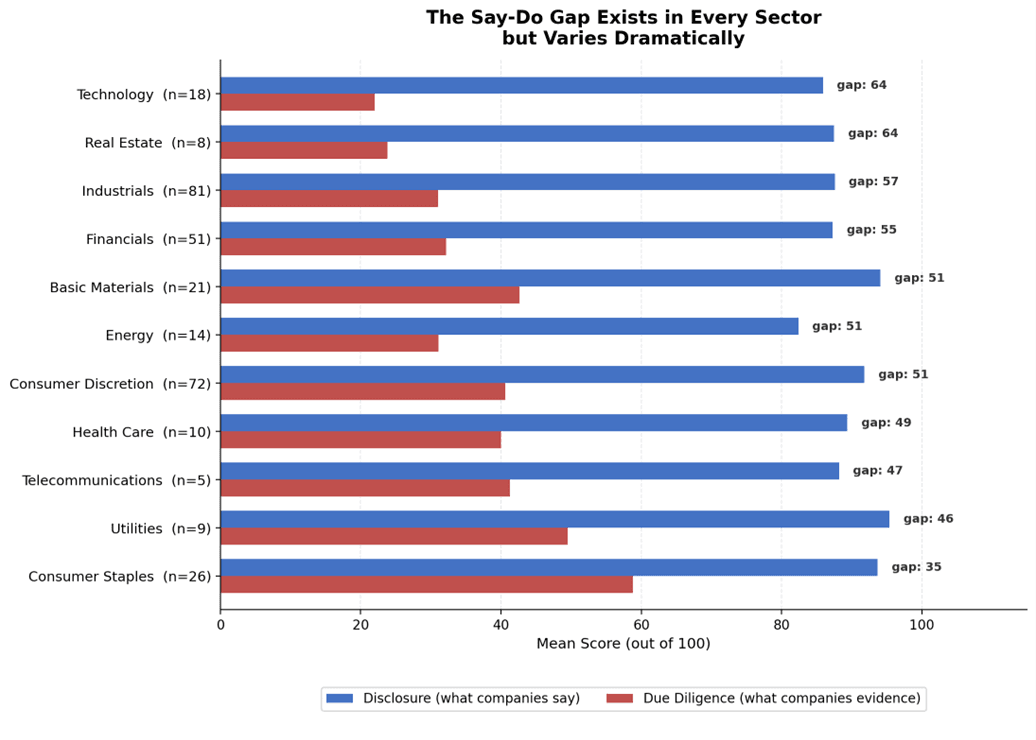
The 53-point gap: saying the right things vs proving them
Across the FTSE 350, we found a consistent pattern. Companies are good at disclosure: describing their policies, governance structures, and commitments. On this dimension, the average score was almost 90%.
But when we scored the same statements on due diligence (the evidence of implementation, outcomes, and remediation), the average dropped to 37%.
That is a 53-point gap. It means the majority of the UK's largest companies are writing statements that read well but fail to demonstrate that their policies translate into action.
This is the say-do gap. And it is exactly what investors, regulators, and procurement teams are now looking for.
The pattern holds across almost every sector, but the gap varies enormously. Consumer Staples, the sector facing the most sustained investor scrutiny, has the narrowest gap (35 points). Technology sits at the opposite extreme, with a 64-point gap.
Why technology companies should pay attention
When we broke the results down by sector, technology ranked last on due diligence.
Despite maintaining high formal compliance (the statements exist, they are signed, they cover the expected topics), technology companies scored a mean of just 22% on due diligence evidence. That is 15 points below the already-weak FTSE 350 average, and nearly three times lower than Consumer Staples (59%), the sector subject to the most sustained scrutiny.
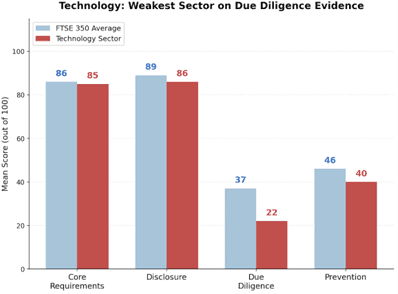
Around three-quarters of FTSE 350 technology companies pair high disclosure scores with due diligence below 40%. Of the 18 technology companies in the FTSE 350, only one scores above 40% on due diligence.
This matters because the gap between what tech companies say and what they can prove is now visible and potentially consequential. The Home Office's updated statutory guidance, published in March 2025, introduces a clear Level 1 (good practice) and Level 2 (best practice) framework. Level 2 specifically asks for evidence of effectiveness: outcome metrics, remediation actions, monitoring results.
Why this matters now
Three forces are converging to make Modern Slavery Statements consequential in ways they were not years ago.
The regulatory direction is clear. In its October 2025 response to the Joint Committee on Human Rights, the Government confirmed it is actively considering legislative options to strengthen Section 54: including penalties for non-compliance, mandatory human rights due diligence, and a "failure to prevent" civil liability where the burden falls on the corporation to prove adequate procedures were in place.1 The question is no longer whether expectations will increase, but when.
Investors are scoring them. The CCLA's "Find it, Fix it, Prevent it" coalition (70 institutional investors managing £19.3 trillion in assets) publicly benchmarks large companies on their modern slavery performance. Weak scores trigger engagement and reputational friction in ESG conversations.
Procurement teams are screening them. Under the Procurement Act 2023, modern slavery offences are mandatory grounds for exclusion from public contracts. Even evidence of modern slavery without a conviction can trigger discretionary exclusion. For companies competing for public sector work (a market worth over £300 billion annually) your Modern Slavery Statement is used as evidence in supplier due diligence, and a weak one fails to demonstrate the systems procurement teams are looking for.
Your Modern Slavery Statement is no longer compliance paperwork. It is a public, comparable, scoreable disclosure, and it is being read.
What technology companies should do
The good news is that the path from Level 1 to Level 2 is clear. The Home Office guidance specifies what "good" and "best" practice look like across every reporting area. The gap, for most companies, is not that they lack policies; it is that their statement does not evidence implementation. Companies are frequently doing more than their statement reflects. The statement just has not been updated to prove it. That is not to say the statement alone is sufficient, but ensuring it accurately reflects the work being done is the essential first step.
Score your statement
ASI is available now. Register for a free assessment at www.antislaveryintelligence.co.uk and see exactly where your statement stands against the 2025 guidance and what it would take to reach Level 2.
ASI is a Lancaster University Management School project, supported by UKRI funding.