Strengthening Digital and Data: Unlocking the Power of Government Information


Christopher Douglas
Central Government Engineering Lead, CACI
Introduction
The UK government holds vast amounts of data across its various departments and agencies—data that has the potential to drive policy decisions, improve public services, and strengthen national resilience. However, due to privacy concerns, security risks, and technological barriers, much of this data remains under-utilised.
Industry has a crucial role to play in helping the government unlock the true value of its data assets while maintaining strict security and privacy protocols. By implementing the right tools, techniques, and expertise, industry can enable the responsible use of data, leading to better decision-making, enhanced cyber-resilience, and improved access to valuable insights.
This blog explores how industry can support the government in strengthening and extending digital and data infrastructure, focusing on privacy-conscious intelligence extraction, secure data sharing, and technical resilience.
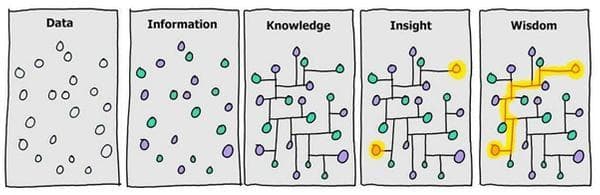
David Somerville – illustration showing the journey from data to informed decision making
Challenge: Data-Rich, Intelligence-Poor
The UK government collects and stores enormous volumes of data, ranging from health records to transport patterns, economic trends, and public service usage statistics. However, these datasets are often siloed, inaccessible, or restricted due to privacy concerns and security risks. While ensuring data protection is paramount, the inability to harness actionable intelligence from existing datasets leads to inefficiencies in governance and policymaking.
Key reasons for under-utilisation include:
Privacy Regulations & Legal Constraints – Strict compliance requirements restrict access to sensitive data.
Security Concerns – Fear of cyber threats discourages data sharing and integration.
Fragmentation & Legacy Systems – Government data is stored in disconnected systems, making surfacing and consolidation difficult.
Lack of Advanced Analytics & AI Integration – The absence of modern tools prevents deeper insights from raw data, especially at operational pace.
Lack of Capacity & Expertise – Without specialist knowledge to enrich the data and form meaningful connections, the data offers limited benefits.
To transition from data hoarding to intelligent decision-making, industry support is essential in applying the right data processing techniques, analytics, and security frameworks to unlock insights safely and efficiently.
Solution: Industry Support for Secure Intelligence Extraction
Industry expertise in data science, cloud computing, AI, and cybersecurity can help the government harness its existing datasets without compromising security/privacy. Using innovative methods tailored to governmental needs, industry can support responsible data utilisation, ensuring better access and more informed policymaking.
1. Privacy-Preserving Analytics
One of the most effective solutions is the adoption of privacy-enhancing technologies (PETs), which allow the government to analyse sensitive data without exposing individual information.
Industry can support the government by integrating:
Federated Learning – Enables machine learning models to train on data without centralising sensitive datasets, preserving privacy while improving intelligence.
Differential Privacy – Adds noise to datasets, ensuring that personal information cannot be reverse-engineered while allowing trend analysis.
Secure Multi-Party Computation – Allows multiple agencies to collaborate on data insights without revealing raw data.
By deploying PETs, the government can unlock insights without violating privacy regulations.
2. Secure Data Sharing & Access Frameworks
A key factor in improving intelligence extraction is responsible data sharing across departments, while maintaining cybersecurity best practices.
Industry can help the government by:
Implementing Secure Cloud Infrastructure – Moving datasets to encrypted, access-controlled cloud environments allows efficient collaboration while enabling access to modern best practice cyber protections.
Creating Data Trusts & Governance Models – Industry can develop transparent policies for data usage, ensuring ethical access.
Enabling API-Driven Data Exchanges – Establishing secure APIs ensures discoverable, controlled, real-time access to necessary insights without exposing raw data.
Providing data expertise to support departments working with data they don’t understand – Industry partners can provide links across government departments to better understand the various sources of data available, helping form links between the information available to drive greater insights.
Securely connecting datasets across departments will help eliminate silos and unlock deeper intelligence for decision-making.
3. AI & Advanced Analytics for Intelligence Extraction
Government agencies often lack the tools and expertise required to turn raw data into actionable intelligence. Industry can support this by providing AI-driven analytics, data science expertise, and automation technologies to ensure insights are accurate, secure, and contextually relevant.
Ways industry can enhance data-driven intelligence include:
Predictive Analytics – AI can forecast trends and potential risks, supporting proactive policy decisions.
Natural Language Processing (NLP) – Helps extract key information from unstructured text data, such as reports and feedback surveys.
Automated Data Cleaning & Processing – Industry-led data engineering techniques ensure quality and usability of datasets.
By incorporating AI-driven analysis, the government can transform existing datasets into intelligence for evidence-based policymaking.
4. Strengthening Cyber & Technical Resilience
While leveraging existing data, cybersecurity remains a top priority. Industry can work alongside the government to strengthen resilience against cyber threats while ensuring safe and effective data access.
Key industry contributions include:
Zero Trust Security Models – Ensure continuous verification of access permissions, reducing risk of breaches.
Threat Intelligence & Incident Response – Industry can provide real-time monitoring, risk assessment and AI Automation to detect and respond to potential vulnerabilities.
Advanced Encryption & Identity Management – Using secure cryptographic techniques to protect data integrity.
Secure by Design adoption – industry experts bring new insights, practices, tools, and techniques from across public and private sector government to support the adoption of Secure by Design, improving cyber security.
By fortifying cyber defenses, the government can safely extract intelligence from its data while protecting public trust.
Conclusion
The UK government holds vast untapped potential in its existing datasets, but privacy concerns and security risks hinder its ability to extract meaningful intelligence. By collaborating with industry experts, the government can overcome these challenges by implementing privacy-enhancing technologies, secure data sharing frameworks, AI-driven analytics, and cyber resilience strategies.
This partnership will enable more informed decision-making, improved public services, and stronger national security, ensuring the UK remains at the forefront of data-driven governance.
Industry must step up as a strategic partner, offering the tools, expertise, and technical solutions that allow the UK government to become not just data-rich, but intelligence-rich.