The next bank heist will sound like someone you trust
AI can now imitate voices, messages and trusted relationships. Defending against it means proving identity and authority for every action, not just checking another credential.
Professor Ben Varcoe, Co-Founder and Chief Cryptographer, Cavero Secure
Reuters reported that fraudsters used an apparent WhatsApp message and an AI-replicated voice to impersonate trusted senior figures and induce Fideuram, the private-banking arm of Intesa Sanpaolo, to transfer €95 million. About €53 million was recovered; roughly €36 million remained missing at the time of reporting. There was no disclosed malware, no network intrusion. The attack succeeded because the request appeared to come from people the recipient already trusted. AML Intelligence has since reported Italian authorities investigating similar AI impersonation scams at two more banks. This is becoming a repeatable pattern, not an isolated case.
Historically, attackers compromised systems and stole the credentials that controlled them. AI now lets them target the trusted identities behind those systems instead — voices, messages, even autonomous agents acting on an organisation’s behalf. The pattern is the same whether the impersonated party is a human executive or an AI agent:
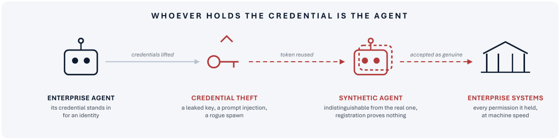
Figure 1: Whoever holds the credential is the agent
Most security architectures treat possession of a credential as proof of legitimacy. But a credential can be copied, an account compromised, a voice cloned. It proves control of something issued once. It does not prove continuity — that this is still the same trusted party the relationship was built with. Identity needs to be a continuously verifiable history, not a token presented at the door.
A second assumption compounds the problem: once authenticated, an identity often keeps its authority across an entire session or role, long after the purpose that justified it has passed. An AI agent, in particular, can reuse that standing authority to act again and again, at machine speed, with nobody watching. Identity should remain continuous. Authority should not — it should be computed fresh for each action, granted at the point of need, and removed the moment the task is done.
That is the model we have built into CaveroCTX™:
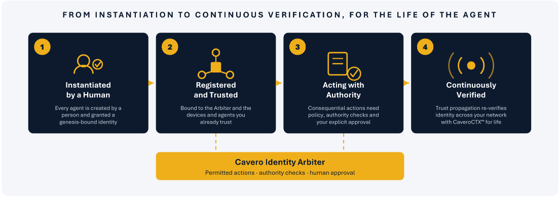
Figure 2: From instantiation to continuous verification, for the life of the agent
Every identity is bound at the moment it is created and re-verified for its entire life. A clone may copy an agent’s state, but not its history, so it exposes itself the first time it tries to act. Consequential actions still need explicit policy checks and human approval. And if an identity’s history ever fails to verify, authority can be withdrawn from that one entity — not from the whole system.
The question for any leader deploying agentic AI, or simply trusting a voice on the phone, is no longer whether it can be imitated. It’s whether your systems can tell imitation from continuity before they grant authority.
To discuss a CaveroCTX™ pilot, visit caverosecure.com.
Cavero Secure Ltd · Nexus, University of Leeds · caverosecure.com
Cyber Resilience Programme activities
techUK brings together key players across the cyber security sector to promote leading-edge UK capabilities, build networks and grow the sector. techUK members have the opportunity to network, share ideas and collaborate, enabling the industry as a whole to address common challenges and opportunities together. Visit the programme page here.
Upcoming events
Latest news and insights
Learn more and get involved
Cyber Resilience updates
Sign-up to get the latest updates and opportunities from our Cyber Resilience programme.
Meet the team

Jill Broom
Head of Cyber Resilience, techUK
Jill leads the techUK Cyber Resilience programme, having originally joined techUK in October 2020 as a Programme Manager for the Cyber and Central Government programmes. She is responsible for managing techUK's work across the cyber security ecosystem, bringing industry together with key stakeholders across the public and private sectors. Jill also provides the industry secretariat for the Cyber Growth Partnership, the industry and government conduit for supporting the growth of the sector. A key focus of her work is to strengthen the public–private partnership across cyber to support further development of UK cyber security and resilience policy.
Before joining techUK, Jill worked as a Senior Caseworker for an MP, advocating for local communities, businesses and individuals, so she is particularly committed to techUK’s vision of harnessing the power of technology to improve people’s lives. Jill is also an experienced editorial professional and has delivered copyediting and writing services for public-body and SME clients as well as publishers.
- Email:
- [email protected]
- Website:
- www.techuk.org/
- LinkedIn:
- https://www.linkedin.com/in/jill-broom-19aa824
Read lessmore

Annie Collings
Senior Programme Manager, Cyber Resilience, techUK
Annie is the Programme Manager for Cyber Resilience at techUK. She first joined as the Programme Manager for Cyber Security and Central Government in September 2023.
In her role, Annie supports the Cyber Security SME Forum, engaging regularly with key government and industry stakeholders to advance the growth and development of SMEs in the cyber sector. Annie also coordinates events, engages with policy makers and represents techUK at a number of cyber security events.
Before joining techUK, Annie was an Account Manager at a specialist healthcare agency, where she provided public affairs support to a wide range of medical technology clients. She also gained experience as an intern in both an MP’s constituency office and with the Association of Independent Professionals and the Self-Employed. Annie holds a degree in International Relations from Nottingham Trent University.
- Email:
- [email protected]
- Twitter:
- anniecollings24
- LinkedIn:
- https://www.linkedin.com/in/annie-collings-270150158/
Read lessmore

Olivia Staples
Junior Programme Manager - Cyber Resilience, techUK
Olivia Staples joined techUK in May 2025 as a Junior Programme Manager in the Cyber Resilience team.
She supports the programs mission to promote cyber resilience by engaging key commercial and government stakeholders to shape the cyber resilience policy towards increased security and industry growth. Olivia assists in member engagement, event facilitation and communications support.
Before joining techUK, Olivia gained experience in research, advocacy, and strategic communications across several international organisations. At the Munich Security Conference, she supported stakeholder engagement and contributed to strategic communications. She also worked closely with local and national government stakeholders in Spain and Italy, where she was involved in policy monitoring and advocacy for both public and private sector clients.
Olivia holds an MSc in Political Science (Comparative Politics and Conflict Studies) from the London School of Economics (LSE) and a BA in Spanish and Latin American Studies from University College London (UCL).
Outside of tech, Olivia enjoys volunteering with local charities and learning Norwegian.
- Email:
- [email protected]
Read lessmore
Authors
Professor Ben Varcoe
Co-Founder and Chief Cryptographer, Cavero Secure