AI in a Modern Org

AI isn't another discrete technology project. It's a new intelligence layer that will sit across every meaningful business process, and the organisations that benefit most will be those that treat it as a strategic capability rather than a portfolio of tools.
That depends on foundational readiness: modern cloud architecture, well-governed data, mature identity, security and compliance controls, and the platform engineering discipline that makes AI services safe to consume. If you've already invested in an enterprise cloud landing zone, extend it rather than bypass it.
Why AI changes the enterprise landscape
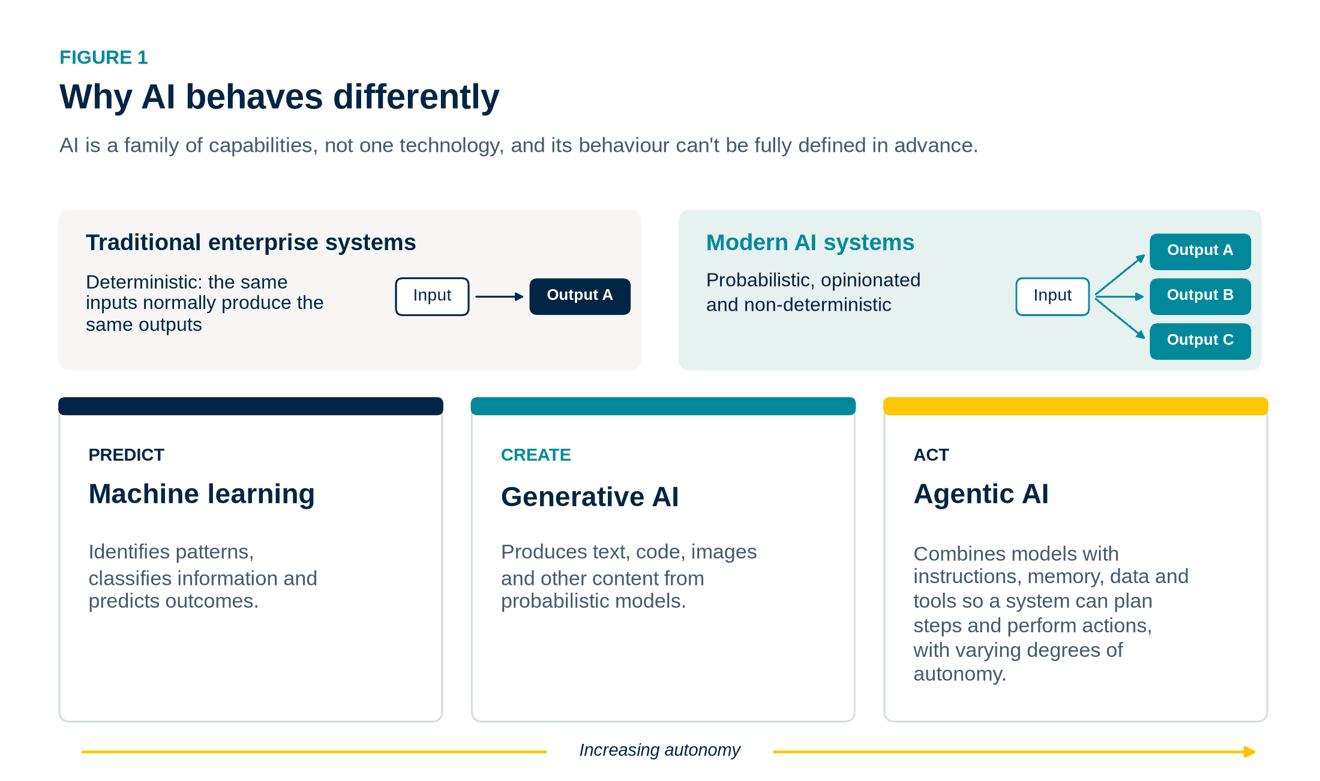
Plenty of technology waves have been called transformational. AI is different because its behaviour can't be fully defined in advance. Traditional enterprise systems are largely deterministic: the same inputs normally produce the same outputs. Modern AI is probabilistic, opinionated and non-deterministic, and that changes how it has to be architected, governed and operated. It's also a family of capabilities rather than one technology (Figure 1).
It's evolving faster than enterprise technology cycles, too. Employees meet AI in consumer products and expect the same at work. Where approved services don't arrive quickly enough, people adopt their own, and data protection and governance risks follow.
A capability, not a collection of tools
Business, data and AI strategy must be connected. Business strategy defines what the organisation wants to achieve; data strategy, what it must know and evidence to get there; AI strategy, where automation, prediction and generation can reduce effort, improve decisions or create new value. Developed in isolation, AI programmes create activity without outcomes, and many organisations still lack a formal plan to convert AI investment into revenue or measurable service improvement.
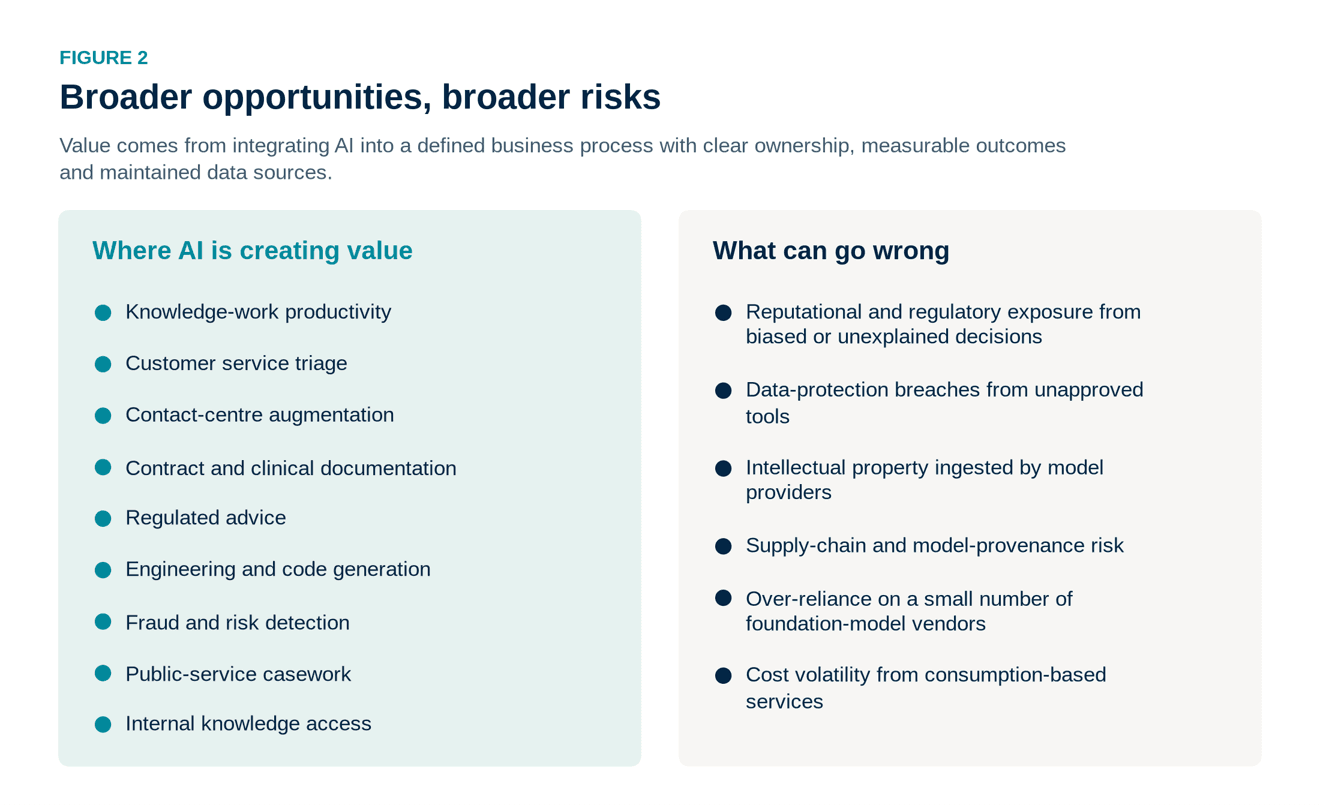
The opportunities are broader than most assume, and so are the risks (Figure 2). What separates business value from AI experimentation is integration into a defined business process, with clear ownership, measurable outcomes and maintained data sources.
So accountability can't sit with technology teams alone. The business owner stays accountable for AI outcomes; technology leadership owns the platform and control environment; data leadership owns data quality and governance. Model risk and Responsible AI run through established risk frameworks, with the executive setting risk appetite. Every use case needs a named business owner, not just a technical sponsor.
Five foundations for enterprise AI
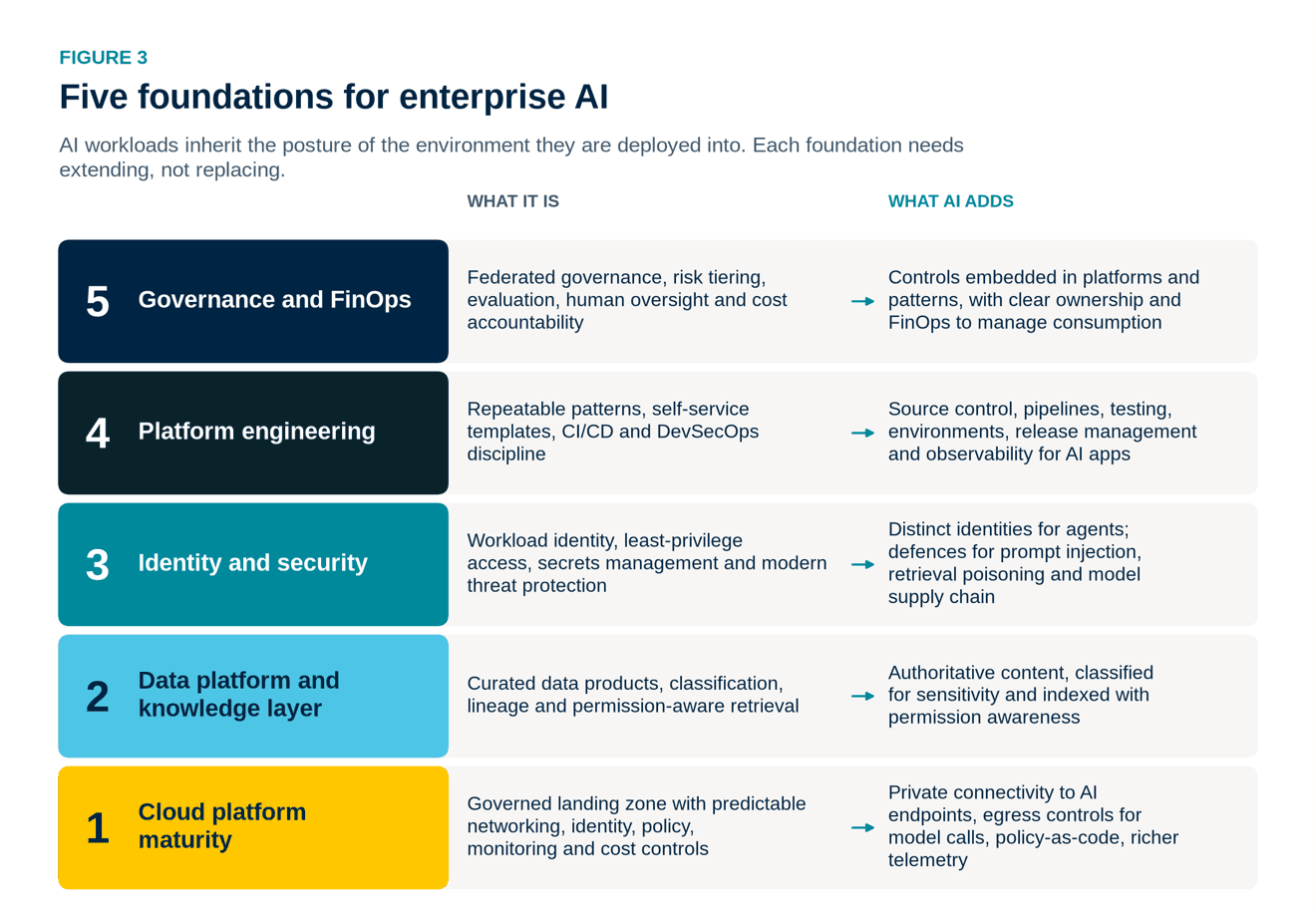
Enterprise AI rests on five foundations (Figure 3). AI workloads inherit the network, identity, policy and monitoring posture of the environment they're deployed into, so gaps there become AI gaps. Two areas deserve particular attention.
One of the most important investments is a governed knowledge layer: authoritative content, classified for sensitivity, indexed with permission awareness, and served through retrieval that respects the same access controls users have in the source systems.
And AI introduces new principals (agents, orchestrators, evaluators), new secrets (model and retrieval keys) and new attack surfaces (prompt injection, model supply-chain risk, retrieval poisoning). AI components need their own workload identities, and the security operating model has to cover AI-specific threats alongside conventional ones.
Extend the landing zone, don't route around it
Many organisations already have an Enterprise Landing Zone standardising how workloads are deployed to : subscription structure, hub-and-spoke networking, centralised identity, policy as code, logging and cost management. A separate AI platform built to accelerate a pilot risks shadow IT at platform scale and losing the controls already in place.
We define an AI Landing Zone as a governed extension of the enterprise cloud platform that provides approved environments, services, controls and delivery patterns for building and operating AI products at scale. That's more than placing an AI service in an existing subscription. It's a coherent layer of additional subscriptions, platform services, policies, guardrails, blueprints and operating processes on top of the existing foundation (Figure 4), with clear ownership, blast radius and cost boundaries.
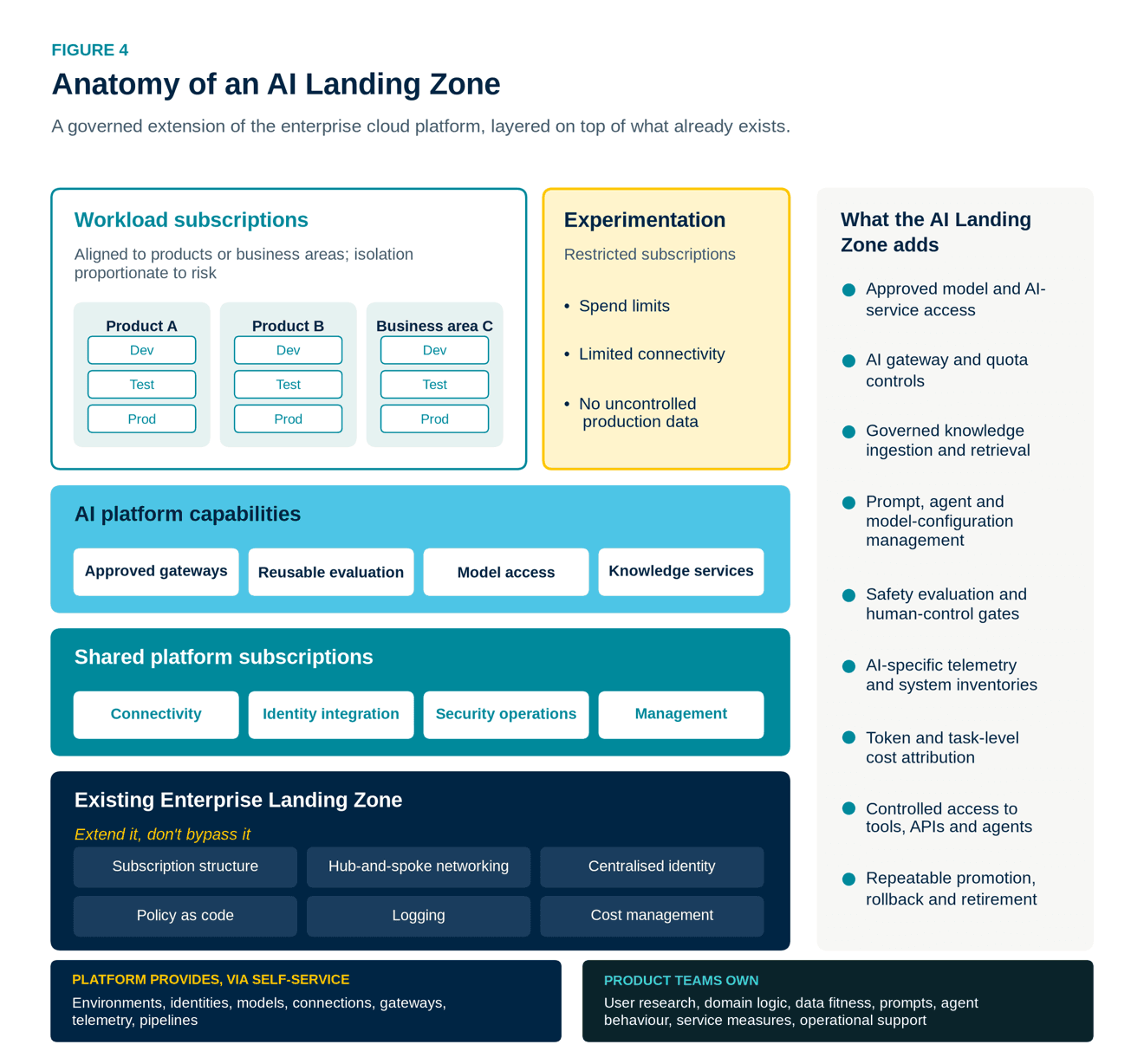
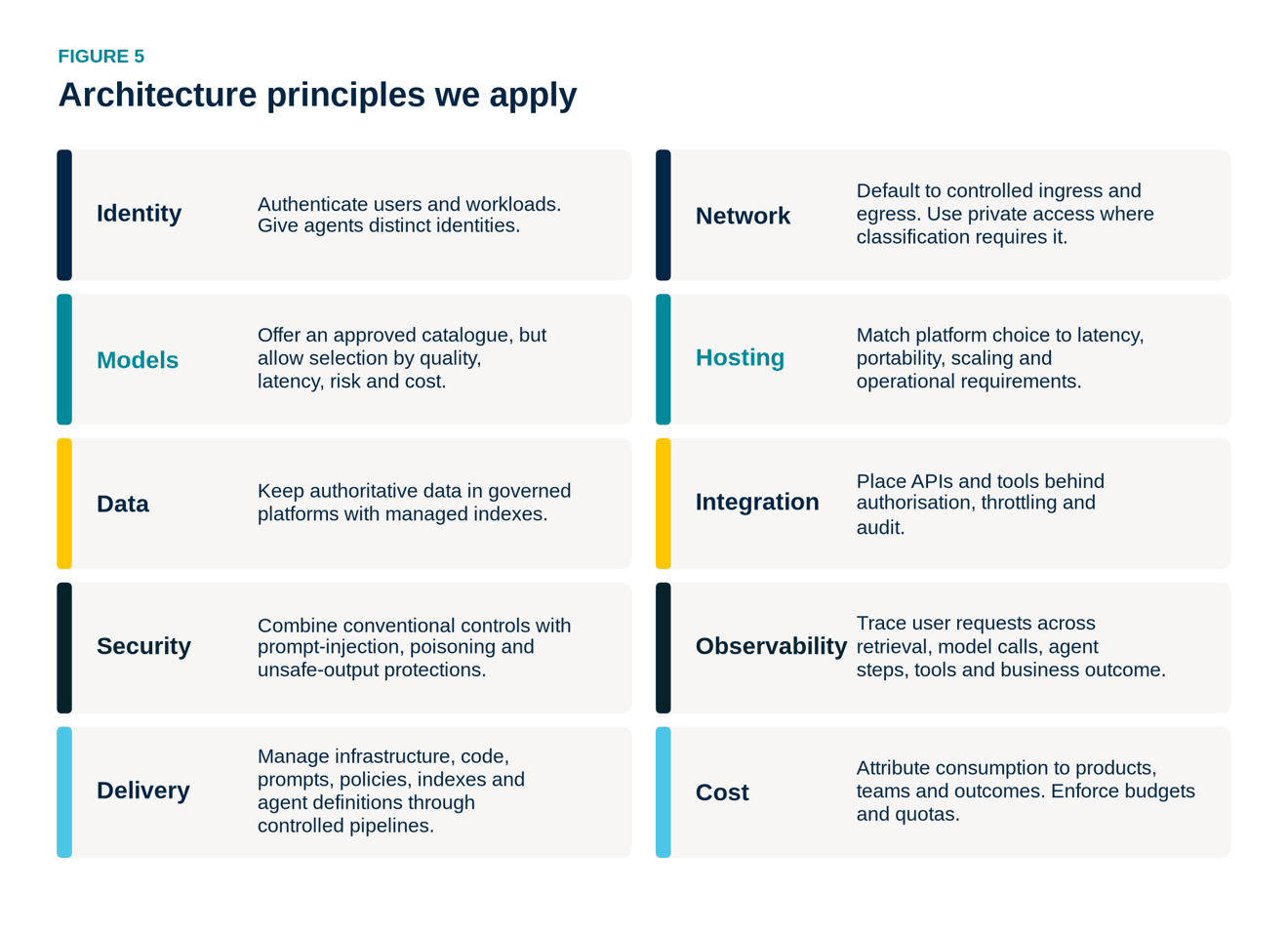
Done well, product teams self-serve what they need within visible, enforceable boundaries, while owning what only they can do. Microsoft's current landing-zone architecture draws the same line: shared networking, identity and policy are platform responsibilities, while AI applications stay within workload-owned boundaries. Figure 5 sets out the architecture principles we apply.
What we see, and what we'd do
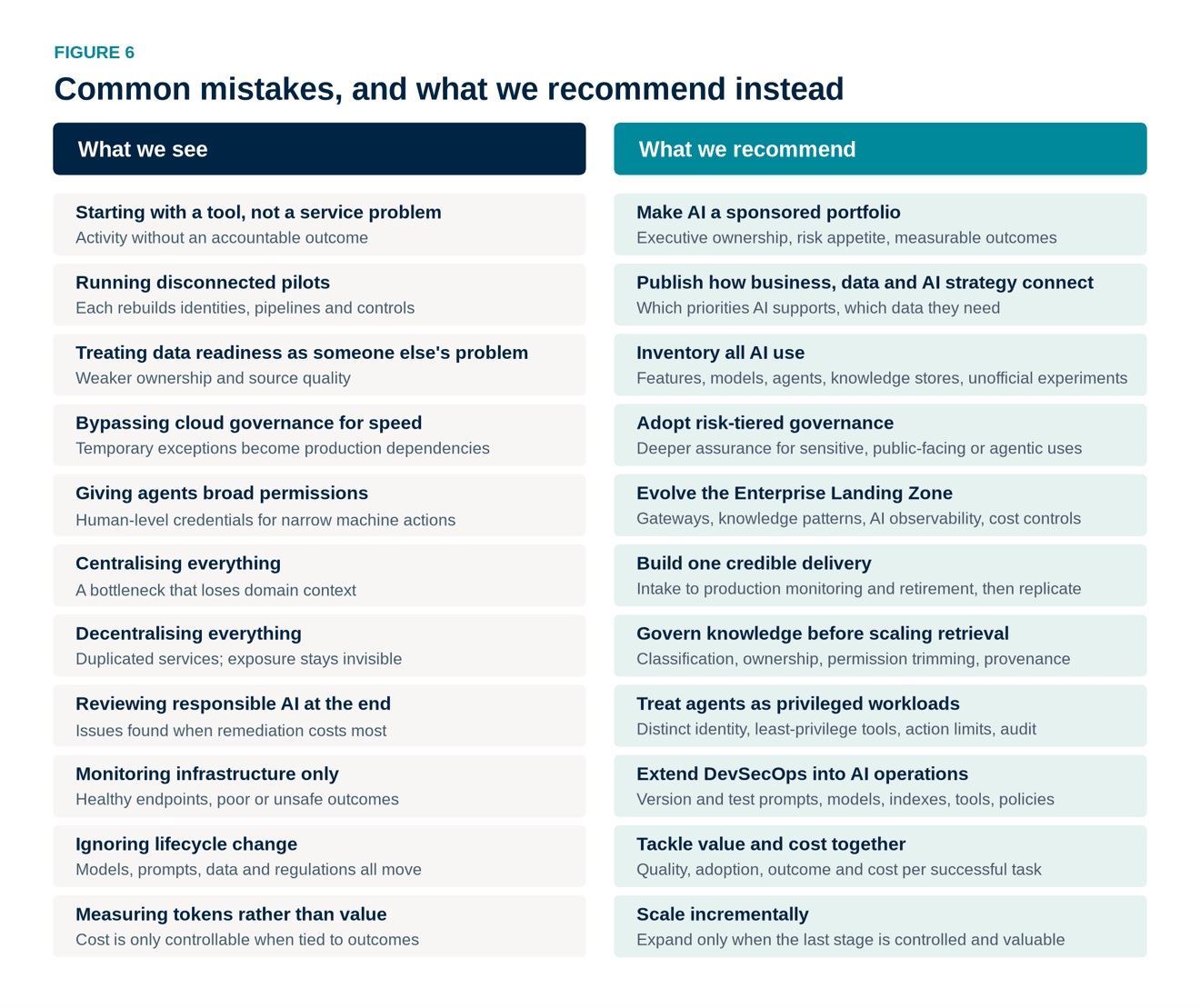
The mistakes are remarkably consistent: starting with a tool rather than a service problem, disconnected pilots that each rebuild identities and controls, bypassing governance until temporary exceptions become production dependencies, giving agents human-level credentials, and measuring tokens rather than value. Centralise everything and you create a bottleneck; decentralise everything and exposure becomes invisible.
Our recommendations (Figure 6) come down to discipline. Make AI a sponsored transformation portfolio with executive ownership. Inventory all AI use. Govern knowledge before scaling retrieval. Treat agents as privileged workloads. Prove one complete pattern, from use-case intake through production monitoring and retirement, then replicate it, and scale only when the evidence shows the previous stage is controlled and valuable.