How AI is Remaking the Internet

The AI economy is built on staggering numbers. Amazon spent $172.2 billion on property and equipment through September 2026. Meta spent $85.8 billion including finance-lease principal payments. Their full-year forecasts are $220 billion and $135–145 billion respectively. These totals extend beyond AI. The question I wanted to understand is how this investment changes the cost of providing services and who controls where the work runs.
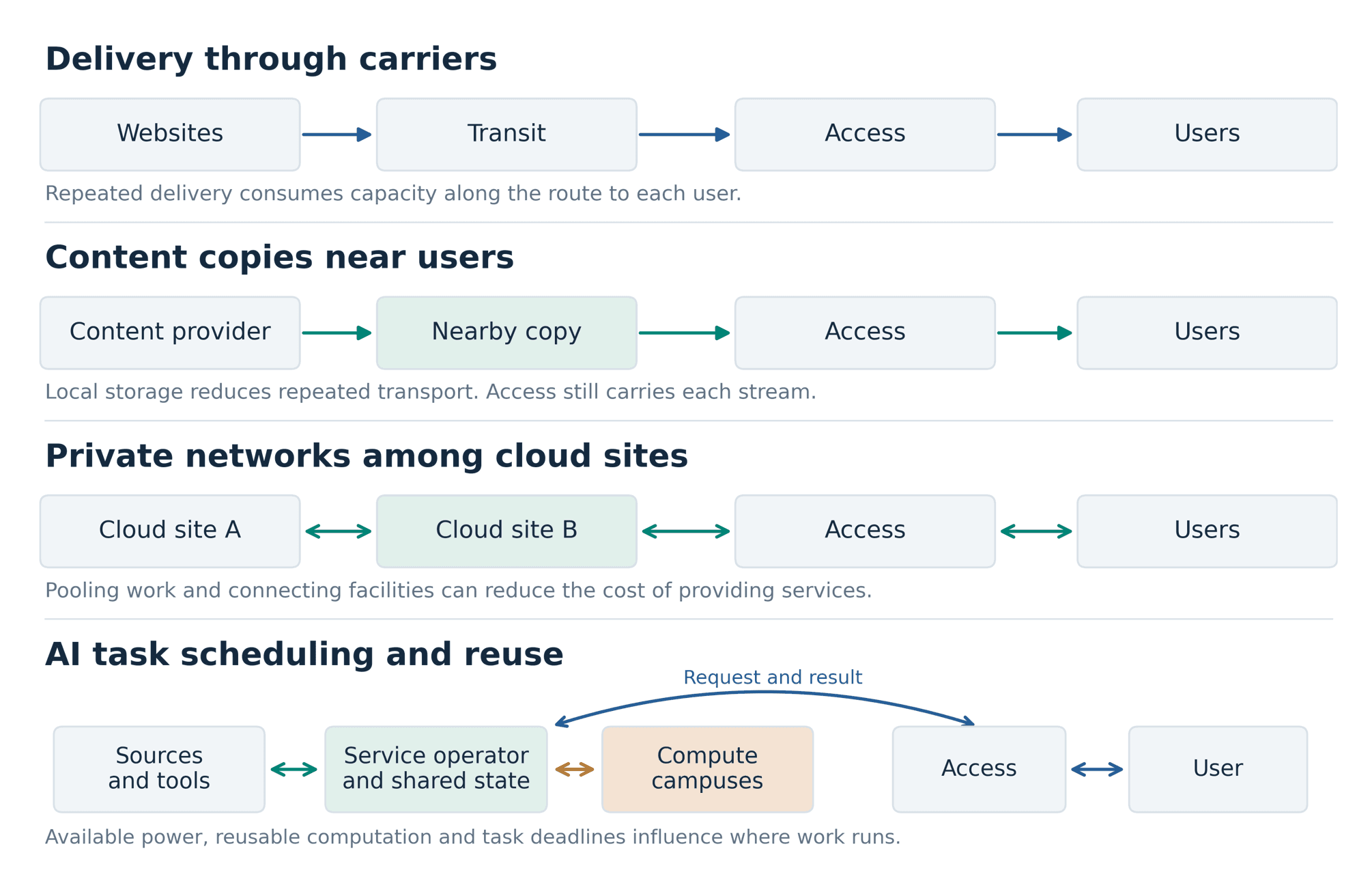
The internet has co-evolved with the services it was asked to deliver. Content companies reduced delivery costs by storing copies of popular files near users. Cloud operators pooled computing and connected their facilities privately. Together, these decisions reduced reliance on transit carriers and created more direct connections around content and computing providers, as Figure 1 shows. Routing records for CoreWeave, a specialist GPU cloud provider, suggest that AI providers are extending this pattern. On paths towards its network, RIPE routing data showed five neighbouring networks in January 2023 and more than 60 in October 2026.
For agent services, the cost of an answer depends on how much new computation it requires and when it must run. Reusing valid results and filling off-peak hours can make research and monitoring affordable for more customers. Those customers can then delegate more work. The engine that runs the internet is provider incentives to invest in the software and connections that make their existing equipment more productive, alongside buying additional machines.
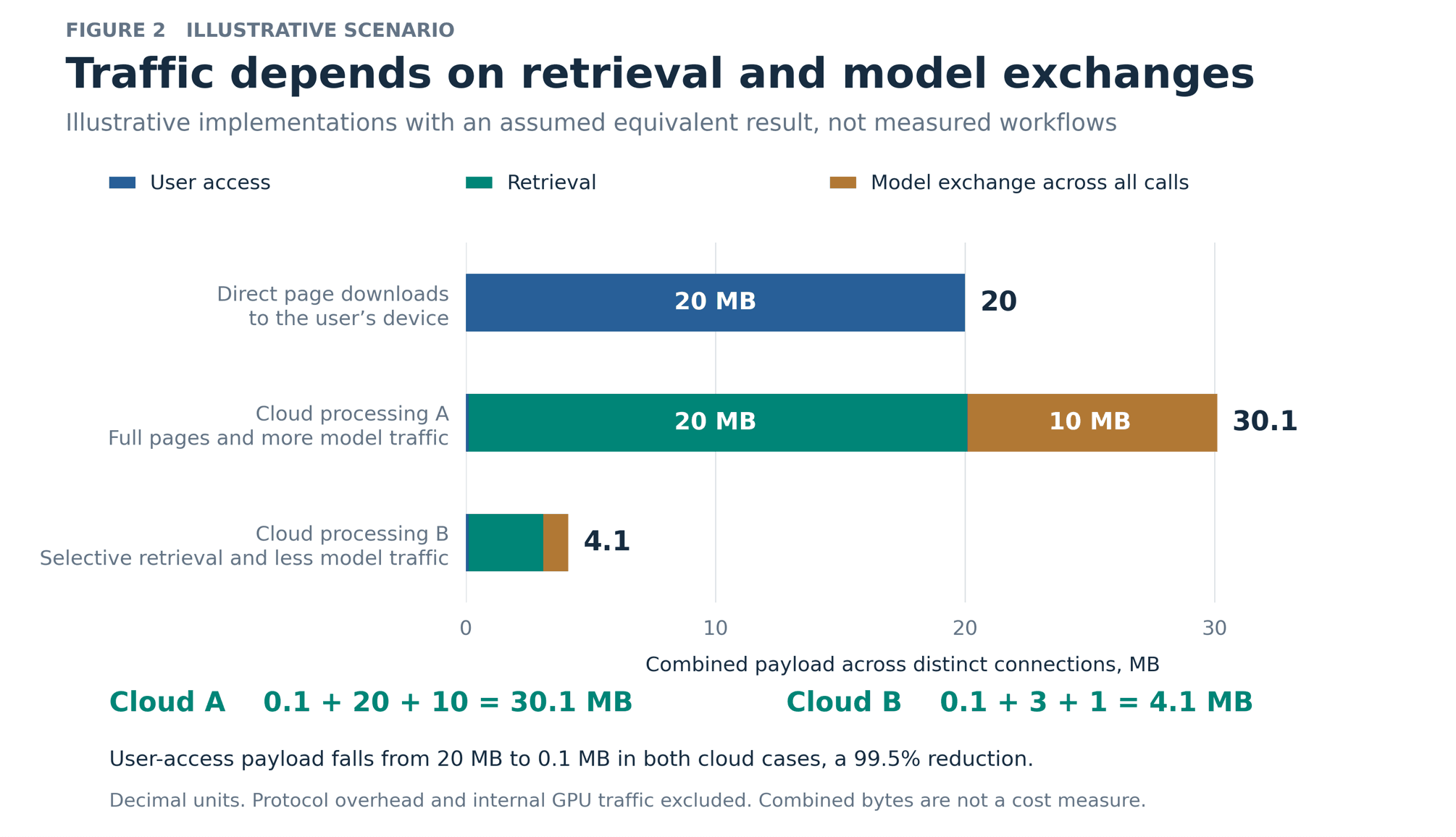
Historically, internet investment had a causal relationship with access traffic. In the AI era, household broadband measurements cover only part of this activity. A person downloading ten webpages of 2 MB each receives 20 MB. In an illustrative alternative, cloud software retrieves the same pages, exchanges another 10 MB with a model and returns a 0.1 MB answer. Combined payload rises to 30.1 MB while access payload falls 99.5%. Application programming interfaces, or APIs, can return selected information and reduce the total. A smaller download can result from more work between computing facilities.
We are pulling from our old bag of tricks to manage the new AI demand. Cloudflare already offers caching of complete answers for identical requests, avoiding another call to the model provider. Prompt caching saves part of the work by reusing computation for unchanged input. Producing a new answer still requires processing. Operators can also combine equivalent requests into one calculation. Reuse depends on freshness and permissions, so a cached product recommendation must still be current and available to that user. Repeated purchase requests still require checks against duplicate execution.
Where these results are stored affects where subsequent work should run. Sending a request to an idle GPU elsewhere may require transferring saved intermediate results or computing them again. Keeping related requests together avoids that expense, until a longer queue outweighs the saving. Operators need to compare the time to finish the whole task, including queues and tool calls. Operators must also consider available power when choosing new sites.
A customer who can accept a report tomorrow morning allows more scheduling flexibility than someone waiting for a reply. Anthropic already sells batch processing at half its standard API prices. With Meta’s Muse, cloud processing continues after the app closes. This is a key enabler for lower serving costs. Work can be deferred where deadlines permit. This applies to inference primarily. Moving a running training job requires handling saved state and data dependencies. It gets ugly.
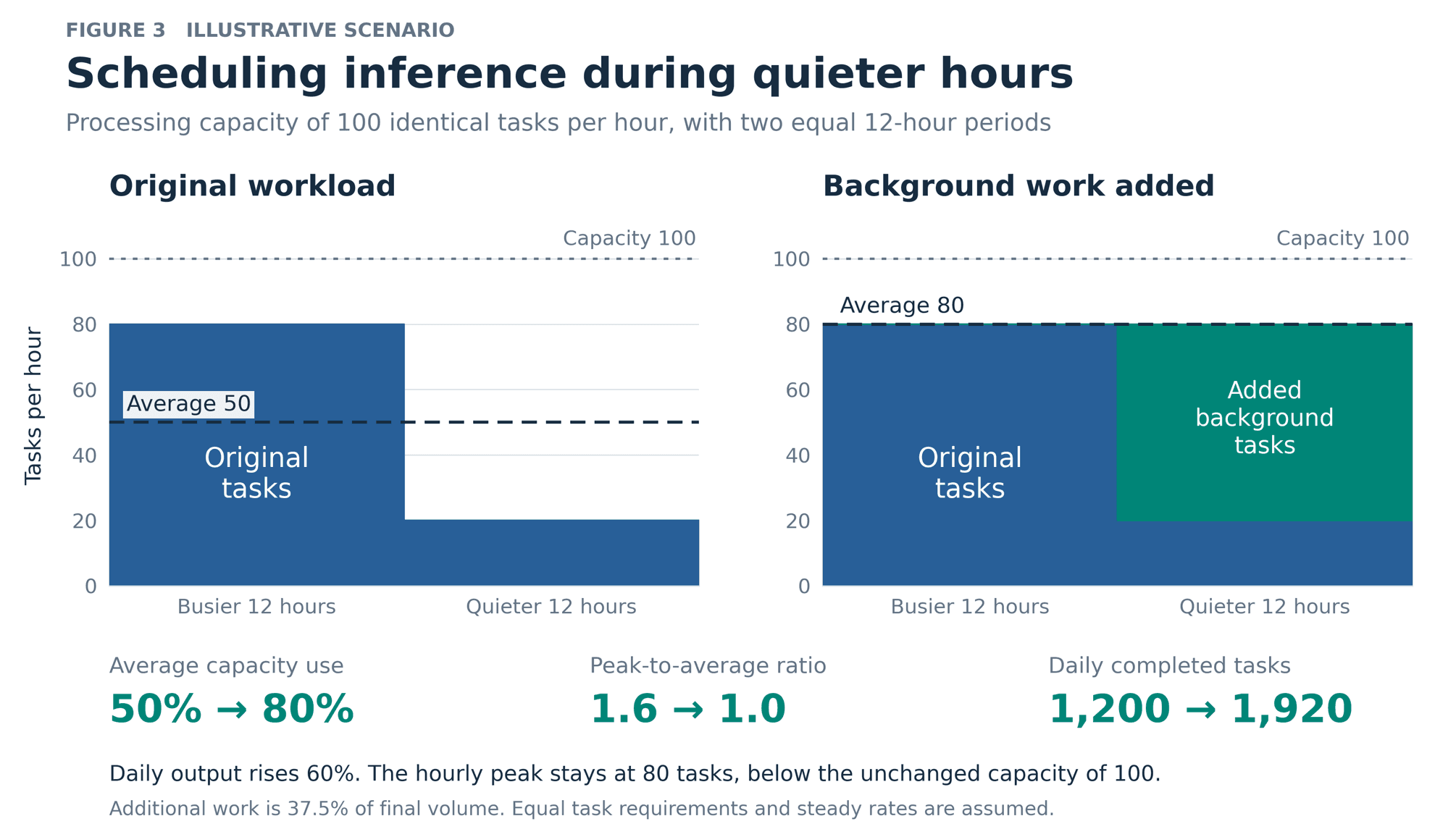
An illustrative inference installation can complete 100 identical tasks an hour. Processing 80 an hour for 12 hours and 20 for the other 12 gives 1,200 daily completions. Adding 60 tasks in each off-peak hour raises output to 1,920 without increasing the hourly peak. Average use rises from 50% to 80%, and fixed cost per completed task falls 37.5%. Electricity use rises. The saving comes from spreading fixed expenditure over more useful work.
Meta’s Muse traffic strategy reminds me of electricity entrepreneur Samuel Insull who served customers with different demand peaks, spreading generating costs over more sales. Applying that principle here requires 720 additional tasks that can wait. Global demand may already smooth daily peaks, leaving fewer opportunities. Where the example holds, unchanged bytes and routes per task mean 60% more daily traffic without a higher hourly peak. Operators could serve that additional demand before expanding their equipment and links.
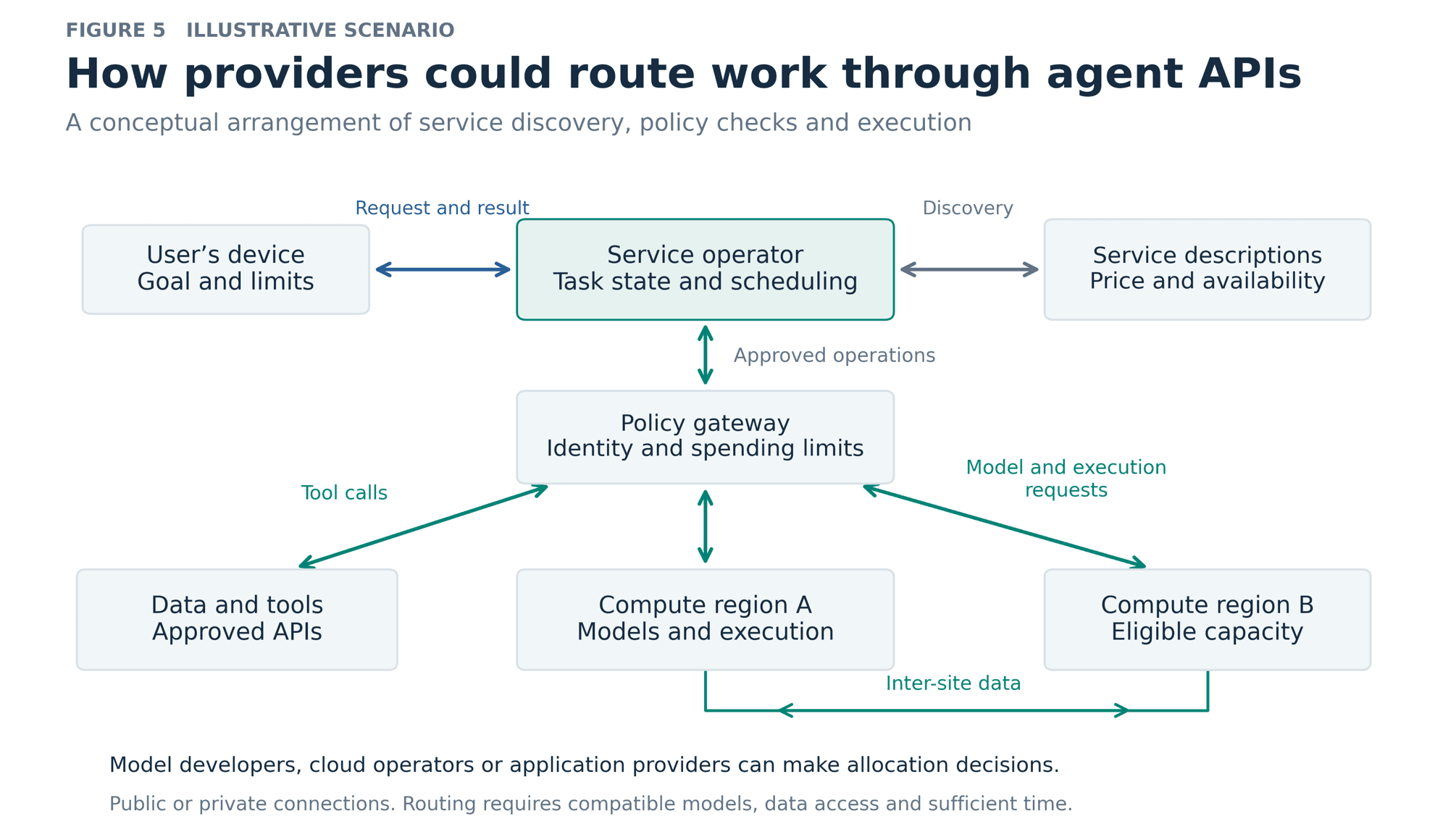
A provider controlling task histories and deadlines can offer suppliers work during off-peak periods and choose among compatible sites. Where capacity is spare, that flexibility strengthens its negotiating position. Agent APIs make automated procurement possible, although moving histories and permissions remains difficult. This means that companies directing the work can influence which facilities are busy without owning the buildings. Suppliers must assess how easily these customers could move elsewhere.
Anthropic has already commissioned Lumen to expand its North American fibre network, within nearly $13 billion of private connectivity contracts Lumen reported in February. Lumen’s filings show that customer advances help fund network expansion. Contracts determine how much demand risk the carrier accepts, while construction and delivery risks remain. A model developer’s purchasing decisions can therefore influence both network geography and how construction is financed.
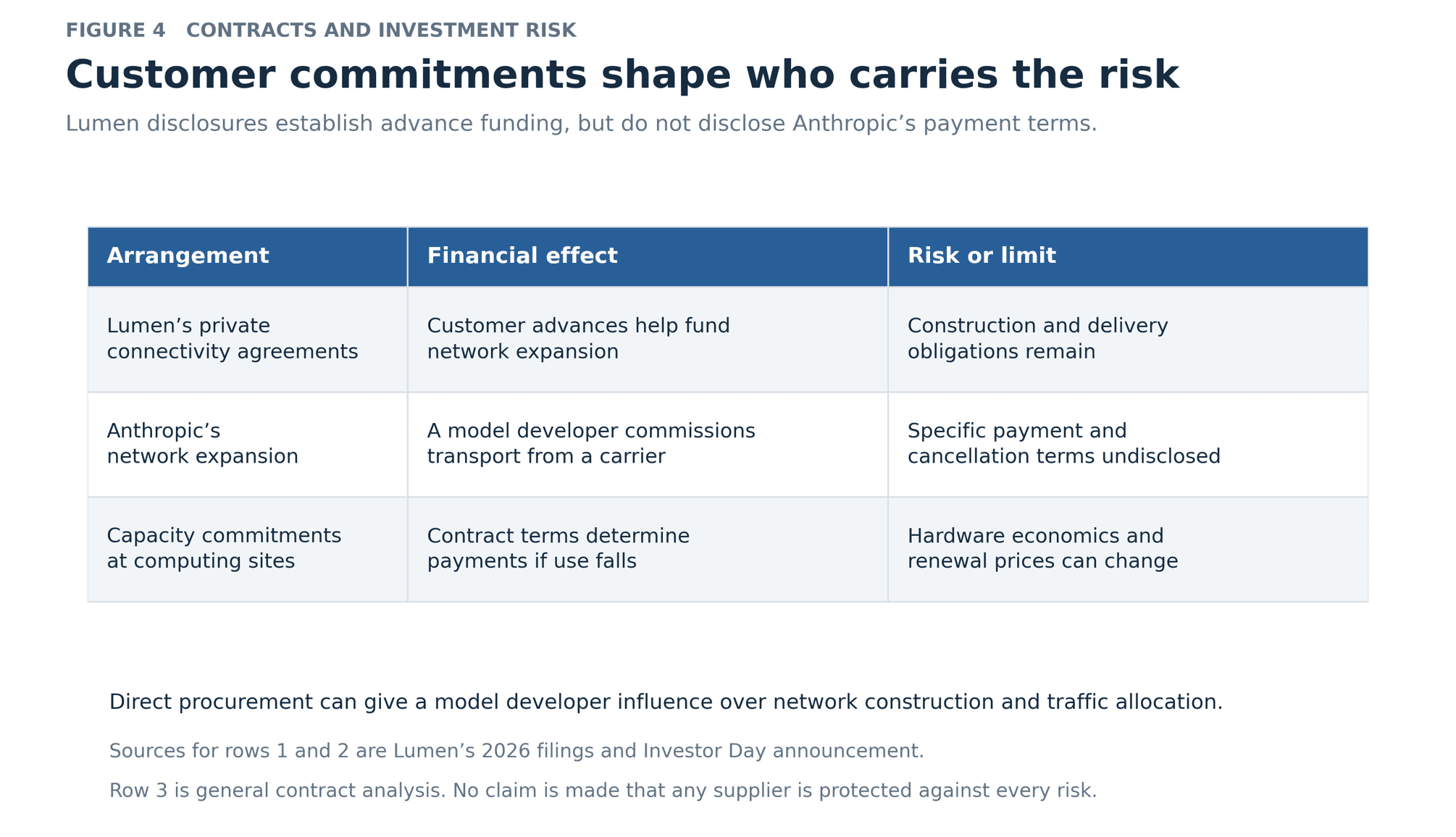
So, how will the AI Internet infrastructure evolve? I expect private connections, shared caches and scheduling software to attract more investment because they can increase useful output before operators buy additional accelerators. More traffic will run between facilities, with its timing influenced by deadlines and capacity prices. Lower prices could encourage enough additional demand to require further construction. Before funding that capacity, investors should establish how much computation can be reused and how much work can wait, at the quality customers require. They should also establish who controls access to those customers and their task records. That company will likely become a first-class citizen in the new internet infrastructure.