The next bank heist will sound like someone you trust

Reuters reported that fraudsters used an apparent WhatsApp message and an AI-replicated voice to impersonate trusted senior figures and induce Fideuram, the private-banking arm of Intesa Sanpaolo, to transfer €95 million. About €53 million was recovered; roughly €36 million remained missing at the time of reporting. There was no disclosed malware, no network intrusion. The attack succeeded because the request appeared to come from people the recipient already trusted. AML Intelligence has since reported Italian authorities investigating similar AI impersonation scams at two more banks. This is becoming a repeatable pattern, not an isolated case.
Historically, attackers compromised systems and stole the credentials that controlled them. AI now lets them target the trusted identities behind those systems instead — voices, messages, even autonomous agents acting on an organisation’s behalf. The pattern is the same whether the impersonated party is a human executive or an AI agent:
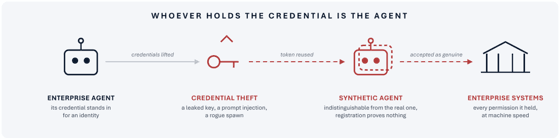
Figure 1: Whoever holds the credential is the agent
Most security architectures treat possession of a credential as proof of legitimacy. But a credential can be copied, an account compromised, a voice cloned. It proves control of something issued once. It does not prove continuity — that this is still the same trusted party the relationship was built with. Identity needs to be a continuously verifiable history, not a token presented at the door.
A second assumption compounds the problem: once authenticated, an identity often keeps its authority across an entire session or role, long after the purpose that justified it has passed. An AI agent, in particular, can reuse that standing authority to act again and again, at machine speed, with nobody watching. Identity should remain continuous. Authority should not — it should be computed fresh for each action, granted at the point of need, and removed the moment the task is done.
That is the model we have built into CaveroCTX™:
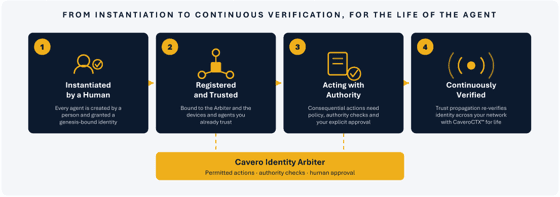
Figure 2: From instantiation to continuous verification, for the life of the agent
Every identity is bound at the moment it is created and re-verified for its entire life. A clone may copy an agent’s state, but not its history, so it exposes itself the first time it tries to act. Consequential actions still need explicit policy checks and human approval. And if an identity’s history ever fails to verify, authority can be withdrawn from that one entity — not from the whole system.
The question for any leader deploying agentic AI, or simply trusting a voice on the phone, is no longer whether it can be imitated. It’s whether your systems can tell imitation from continuity before they grant authority.
To discuss a CaveroCTX™ pilot, visit caverosecure.com.
Cavero Secure Ltd · Nexus, University of Leeds · caverosecure.com