Rise of " Micro GCCs" in India - Driving the Global Expansion of SMEs

For decades, India has been a magnet for global businesses seeking talent, efficiency, and innovation. The country’s journey in the global business landscape has been nothing short of remarkable.
In the 1980s, India became the resourcing capital of the world, offering a massive pool of skilled professionals. By the 1990s, it transformed into the outsourcing capital, with large corporations offshoring their IT, customer service, and back-office functions.
Today, India is emerging as the insourcing capital of the world, where companies no longer just outsource but set up their own teams to drive core business functions.
What’s exciting is that this trend is no longer only limited to large enterprises.
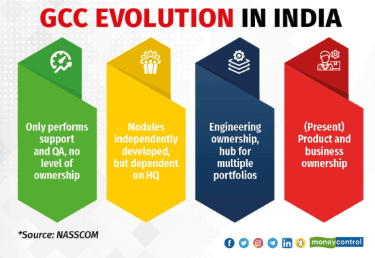
Source: Nasscom and moneycontrol
Small and mid-sized companies (SMEs) across the world are increasingly setting up their own "Micro GCCs" (Small Global Capability Centres) in India.
These smaller, more agile centres - typically with teams of 5 to 50 employees - are enabling businesses of all sizes to tap into India’s talent pool and boost their global competitiveness – and also take initial steps into India’s 1.4 billion people strong consumer market
The current state of GCCs in India:
India is already home to over 1,600+ GCCs, employing more than 1.7 million people.
For years, these centres were predominantly established by Fortune 500 companies with the financial muscle to build large-scale operations. However, this model is evolving.
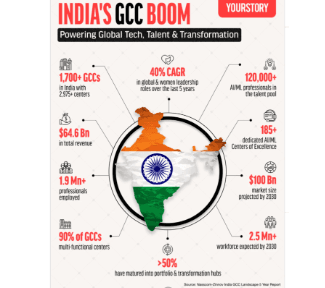
Source: Yourstory
Thanks to remote work models, flexible infrastructure, and digital transformation, even smaller companies are now able to set up "Micro GCCs" in India without massive upfront investments.
This shift is giving SMEs the same access to India’s talent and cost advantages that were once exclusive to industry giants.
What are "Micro GCCs" in India?
Imagine you run a tech startup in London or a mid-sized marketing agency in New York or an advisory firm in Copenhagen. You want to scale but face rising costs and limited local talent. Instead of outsourcing, you decide to set up a small, dedicated team in India - with 5 to 50 team members - you get direct control over your operations, maintain your company culture, and build a seamless extension of your core team.
"Micro GCCs" offer the perfect blend of cost efficiency, scalability, and flexibility. They allow SMEs to operate in India just like the big players, without the need for massive infrastructure or investments.
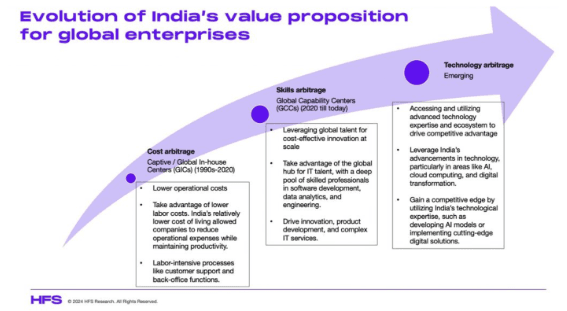
Source: House for Sources
Why "Micro GCCs" are a Game-Changer for SMEs?
There’s a reason why companies of all sizes are flocking to India:
World-Class Talent: India produces over 1 million engineers and 300,000 management graduates every year, making it a global talent powerhouse. By leveraging India’s talent and cost benefits, you can compete with larger players on a global scale.
Cost Efficiency: Setting up a "Micro GCC" can cut operational costs by 40% to 70%, helping SMEs remain competitive without compromising on quality.
Agility and Flexibility: With co-working spaces, remote work options, and plug-and-play offices, SMEs can quickly establish operations with minimal overheads.
Direct Control and Quality: Unlike traditional outsourcing, "Micro GCCs" give you full control over your remote team, ensuring alignment with your goals and quality standards.

Praveen Kumar DK at "TNA10" Copenhagen by Tech Nordic Advocates
I recently joined Tech India Advocates-led delegation in Denmark where I highlighted the the rising opportunity of "Micro GCCs" in India and why it is the right time for Nordic tech companies to consider India as a strategic growth partner, and the work we are doing through InsourceIndia to make India accessible for SMEs – not just as a talent hub, but as a launchpad for global scale.
“India Welcomes Everyone” - Why do I say that?
Doing business in India can be as complex as it is rewarding. The country isn’t a single, uniform market – it’s more like a continent, made up of 28 diverse states, each with its own language, culture, policies, and regulatory quirks.
For global SMEs, this diversity can be daunting. Navigating compliance, legal processes, and local market dynamics requires patience, persistence – and the right partners. But the landscape is changing fast.
India is now more accessible than ever, thanks to better digital infrastructure, business-friendly reforms, and a thriving startup scene. Built on decades of global trust, talent, and delivery excellence, "Micro GCCs" are now giving SMEs the same access to India that was once reserved for Fortune 500s.
India is no longer just a destination for corporate giants - it’s a land of opportunity for businesses of all sizes.
As an SME looking to scale smartly, if India is not on your business plan - you may be missing a big opportunity.
Have you thought about it?
Let’s discuss.