Is your software up to scratch?

Wouldn’t the world of public services be a better place if we were able to share intelligence easily to provide better services?
But there is hope.
The use of unique identifiers in any dataset can help link together the information to create vital intelligence and insights. This can be achieved by including the UPRN or USRN whenever property or street information is used.
However, having these identifiers present within your datasets is only one part of the challenge. A critical step in order to get to this point is that it needs to be partnered with the capability of software systems being able to consume, update, expose and export the UPRN and USRN.
Inclusion of these unique identifiers can generate millions of pounds of efficiency savings for individual local authorities as explored in a recent TechUK webinar with Nottingham City Council, and at a Local Government Association event in December 2023 on ‘How to derive efficiencies and insight from the data you didn’t know you had’.
How does the procurement of software play a part?
56% of the software being used in local authorities does not fully mandate the use of the UPRN.
This means the software either does not use the UPRN, or partially uses it but allows the inclusion of free text addresses which reduces the integrity of the address data.
The following points derive from engagement with local authority officers. These are some of the key factors hindering good procurement of UPRN and USRN capable software.
|
|
|
|
|
|
How can we achieve better procurement of systems?
Procuring in the right way can create value. The value is it can drive is in terms of better linked data and intelligence, through a single version of the truth. Capture once, store once but share many. All against agreed and tested data standards and practices. This reduces multiple versions of the data that can lead to confusions and errors.
For example:
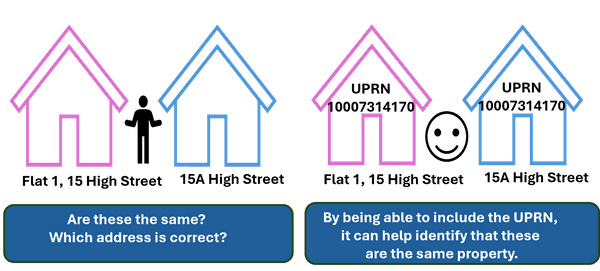
The UPRN can cut out that initial confusion and time taken to clarify, with more time for the officers to focus on delivering services.
The value is also realised in the sharing of the intelligence to improve services and developing new services for residents both locally and nationally.
But what do you need to think about when procuring new software that will enable the use of a UPRN or USRN?
The following are a few tips that may help when embarking on the journey to procure better enabled.
|
|
|
|
|
|
|
|
|
|
|
|
|
|
Ask what you can you do better? One of the key parts in the above is engaging and talking with others who can help.
How are GeoPlace helping?
GeoPlace helps manage UPRNs and USRNs at a national level and we provided support and guidance on procuring systems that supports the inclusion of these key identifiers.
This includes the Procurement Criteria Suggestion tools which can be used for use in buying gazetteer management systems. They set out questions and considerations in the procurement process, for address gazetteer software and street gazetteers.
Alongside this is our Generate Procurement Criteria tool. This creates technical defining criteria for address data requirements to help commission and purchase of new local authority systems’ software which utilise address data
We engage with local authorities and software suppliers to help integrate address and street data within existing system so that the intelligence can be shared more easily to help plan and shape better resident focused services.
We must all embrace this together
But to enable better procurement of systems that can help drive better services through enabled shared intelligence we need to take a collaborative approach.
This must include every part of public sector organisations, including local authorities through to software suppliers. We all play a part.
We need to be working together to be actively enabling the mandating of the inclusion of the UPRN/USRN key identifiers in the software capabilities. This can be done with better engagement, education and understanding of the why these are important and the benefits that they can bring. A lot of work has already been undertaken in this area but more still needs to be done.
To supply and procure better enabled systems we all must act together.