Implementing Secure-By-Design Frameworks in OT Environments


David Stebbings
Senior Associate – Europe Cyber Account Lead, Booz Allen Hamilton
Whether modernizing an existing industrial site or building a new plant from the ground up, integrating OT cybersecurity throughout the development lifecycle is critically important to ensure future resilient operations. True OT ‘security-by-design’ requires cybersecurity principles to be injected beginning at the earliest stages of the development lifecycle; from Conceptual Design and Procurement, to Commissioning and Handover, and into ongoing Sustainment.
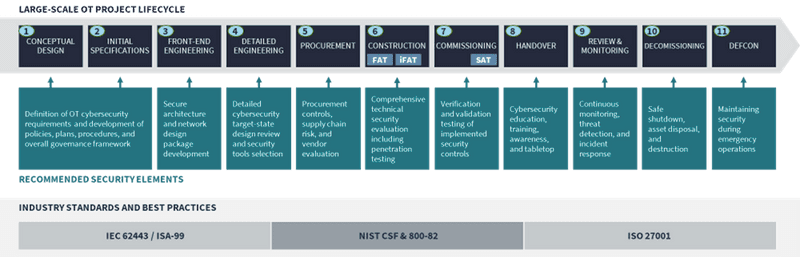
The Secure by Design OT framework encompasses both security elements and industry best practices in stages that align to the OT system development lifecycle to create a framework process flow. To ensure a sustainable and repeatable process output that embodies security principles, security elements must be injected throughout each phase as below:
Conceptual Design & Initial Specifications: Key security considerations include defining OT cybersecurity requirements, legal & regulatory requirements, organization risk tolerance, and relevant standards (i.e. NIST SP 800-82), to support the development of OT governance, policies, plans, and procedures.
Front-End & Detailed Engineering: Key security considerations include secure architecture and network design including the delineation of OT network zones criticality & business impact, network segmentation, configuration design, and change management practices.
Procurement: Key security considerations in addressing escalating Supply Chain risk include country-of-origin analysis, vendor security practice evaluation or attestation, supplier redundancy, export/import control compliance, and inclusion of security provisions within procurement contracts.
Construction: Key security considerations include comprehensive technical security evaluation including assessments, penetration testing, and product evaluation FAT (factory acceptance testing) and iFAT (integrated factory acceptance test).
Commissioning: Key security considerations include a similar comprehensive security evaluation by site personnel including assessments, penetration testing, and product evaluation for the purpose of SAT (site acceptance testing).
Handover: Key security considerations include socializing OT cybersecurity initiatives across stakeholder groups, comprehensive cybersecurity education, training, and awareness programs including hands-on workshops, structured learning modules, and tabletop exercises (TTXs) tailored to the unique needs of OT environments.
Review & Monitoring (In-Service): Key security considerations include implementing continuous monitoring solutions with anomaly-based monitoring and threat intelligence integration, establishing a centralized Security Operations Center (SOC) for OT or integrating OT-specific monitoring within an existing SOC, and developing a well-defined incident response & recovery framework tailored for OT systems.
Decommissioning: Key security considerations are validating asset dependencies, implementing controlled shutdown procedures, ensuring that all security controls remain intact during decommissioning, and performing secure asset disposal and data destruction.
DEFCON/Emergency Operations: Key security considerations are pre-defined incident response protocols, hardened network segmentation, rapid threat containment strategies that prioritize real-time threat monitoring, a strong institutional understanding of the interplay between the Safety Instrumented System (SIS) and the OT system, and secure failover mechanisms to sustain critical operations while minimizing the attack surface.
These insights and our underlying approach are grounded in robust global experience in OT Cybersecurity implementation and assessment projects across critical industries such as critical manufacturing, electric/hydroelectric, oil & gas, nuclear, pharmaceutical manufacturing, automotive manufacturing, transport & logistics, maritime, retail manufacturing, water & wastewater, and more.
While the security dimensions described only represent a sample of the necessary OT security program considerations, initiating these conversations early in the system lifecycle with intentionality and care can have a significant impact on the resulting OT security posture of the site and avoid costly program overhauls or security incidents down the line.