A network blueprint for local government reorganisation


Helen Kirkpatrick
Public Sector Network Specialist, Cloud Gateway
Why reform needs digital foundations
Across the public sector, structural reform is accelerating. Recent local government sector reports highlight the risks: legacy infrastructure, inconsistent security controls, siloed data, and limited visibility across organisational boundaries. Local Government Reorganisation (LGR) is facing a digital challenge: how to converge fragmented IT estates without disrupting frontline services.
This use case sets out a practical best-practice framework for network devolution, showing how network architecture can act as a strategic enabler for LGR-led devolution.
A step-by-step blueprint for LGR
Phase 0: the starting point
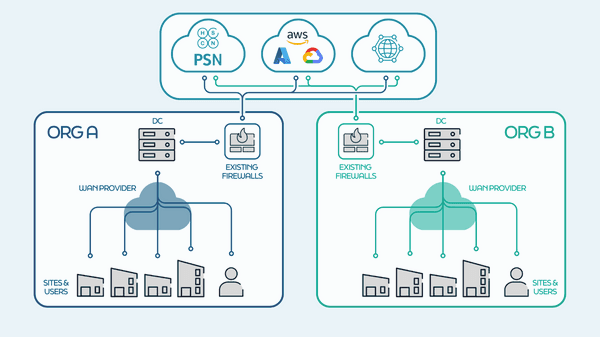
Before embarking on LGR, authorities typically operate entirely separate network infrastructures. As shown in the diagram, ORG A and ORG B each maintain their own WAN provider contracts, independent firewall estates, separate data centres, and distinct security policies.
This duplication creates significant cost overhead, management complexity, and makes service integration nearly impossible. Connectivity to shared resources like PSN, HSCN, cloud platforms, and the Internet is managed independently, with no common security framework or visibility.
Phase 1: establish the bridge

Deploy a cloud-native network platform that sits between the two organisational infrastructures. This creates a secure interconnection point without requiring immediate changes to legacy systems - both organisations maintain their existing WAN providers and firewall estates, allowing contracts to run their course.
However, the bridge immediately enables shared access to cloud resources: teams can begin consolidating duplicate AWS or Azure tenancies, share SaaS applications, and eliminate redundant cloud connectivity costs while the underlying infrastructure remains separate.
Phase 2: consolidate security
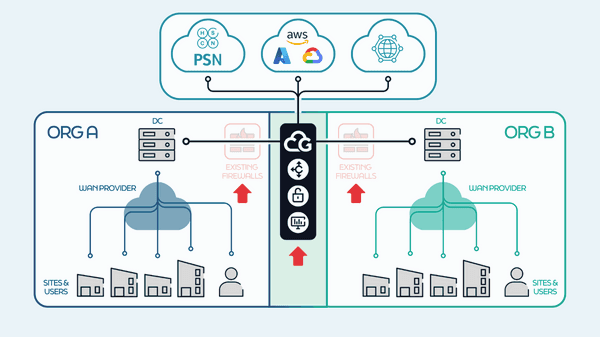
Replace disparate firewall estates with unified next-generation security delivered through the bridging platform. This harmonises security policies across the merged organisation while eliminating duplicate licensing costs and reducing management overhead.
With a common security posture now in place, teams can begin consolidating security tooling, incident response processes, and compliance frameworks - moving from two separate security operations to a unified approach that protects the entire estate.
Phase 3: integrate connectivity
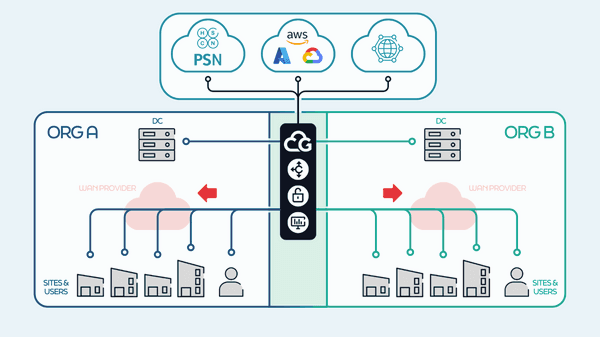
Transition from multiple WAN contracts to a unified Software-Defined WAN architecture by incrementally migrating sites and users onto the shared platform. This integrates remote users, consolidates data centre connectivity, and optimises access to cloud services and government networks (PSN/HSCN) without service disruption.
The unified WAN fabric now enables strategic decisions about the physical estate: consolidate offices sharing the same town, rationalise branch footprints, share buildings between formerly separate organisations, and right-size connectivity based on actual usage patterns rather than legacy contracts.
Phase 4: optimise and scale
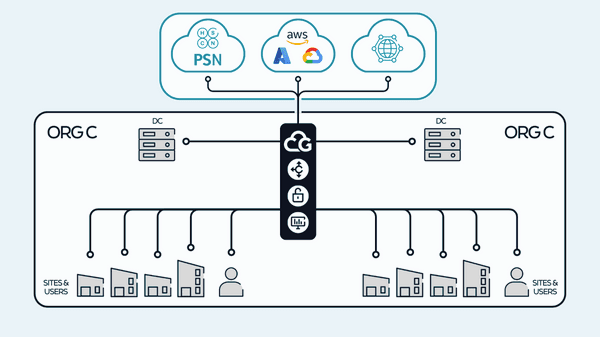
With unified infrastructure in place, the diagram shows the final optimised state: a single merged organisation (ORG C) with common networking, security, and connectivity. But this is where deeper consolidation accelerates.
The platform now enables:
Decommissioning redundant data centres and migrating workloads to the optimal location
Consolidating duplicate on-premise tools, applications, and services onto shared platforms
Rationalising cloud tenancies - moving from multiple AWS accounts or Azure subscriptions to a unified, cost-optimised cloud strategy
Right-sizing the entire estate based on real-time visibility into traffic patterns, application usage, and security events
Implementing consumption-based billing that flexes with actual demand rather than overprovisioned legacy capacity
Rapidly provisioning new services without approval bottlenecks
What this means for local government
Whether enabling new unitary authorities or supporting shared services across councils, LGR timelines are tight and risk tolerance is low. By treating network infrastructure as a strategic asset rather than a technical dependency, the public sector can turn reorganisation from a disruptive event into a controlled, continuous process.
Visit cloudgateway.co.uk to learn more about our approach to devolution-ready network architecture.