Power is being devolved: why reinvent the know-how?

Devolving power, multiplying complexity
England is undergoing a significant redistribution of power. Greater Manchester, under Andy Burnham, has become a leading model for the latest phase of English devolution, with successive agreements giving the region greater control over transport, skills, housing and other areas.
The direction is now national. The Government’s English Devolution White Paper describes a “permanent shift of power away from the centre”[i]
Bringing decisions closer to communities creates significant opportunities. But greater local responsibility also brings greater operational complexity.
Three words we have learned to confuse
Policies, processes and procedures are often grouped together and sometimes used interchangeably. Yet they perform fundamentally different roles.
Policies establish the principles and boundaries of governance. Processes organise work. Procedures guide decisions and actions.
That distinction matters far more than it might first appear, because procedures are where operational know-how is documented.
What automation has left behind
Many procedures have already been digitised or automated. But more and more complex procedures are being left behind by advances in automation.
Conventional automation is data-driven. For much of this complex procedural know-how, the structured data needed to automate it simply does not exist.
It is this largely overlooked body of complex procedural know-how that we explore here.
Complex rules, fragile procedures
Complex procedures aggregate knowledge from legislation, regulation, standards, professional expertise and operational experience. As these bodies of knowledge grow, so too can the permutations of rules — multiplying the possible user decision journeys and outcomes.
Yet our research suggests that the underlying procedural structures have not evolved at the same pace. Decision algorithms are often weak and fragmented, while procedures are rarely systematically tested for usability, understandability or algorithmic strength.[ii]
Much of the growing volume of rules addresses exceptions, but these are rarely used to strengthen the underlying algorithm.[iii] Procedures also frequently reference other procedures and source materials, leaving users to synthesise the knowledge needed to decide and act.
Strong controls, weak assurance
Across our research in both public and private sector organisations, we have repeatedly found procedural documents to be well controlled. They have owners, version histories, review cycles, approval processes and formal sign-off.
But control of the document is not the same as assurance of the procedure. A procedure can be approved without evidence that its usability, understandability or underlying algorithm has been tested.
Internal and external audits can reinforce this gap by confirming that procedures are controlled and followed, without necessarily testing the strength of the procedural logic itself.[iv]
At the governance level, everything can look good — while the procedure underneath remains untested.
The competency gap
Our research also identified a significant competency gap in the design and maintenance of complex procedures. Effective procedures require both strong decision logic and clear narrative, yet these combined skills are rarely treated as a specialist discipline.[v]
The shadow layer
Our research found that where formal procedures are incomplete, the missing operational know-how does not simply disappear — it moves into a shadow layer.
We found it embedded in training materials, individual experience, supervision, workarounds and local custom and practice.[vi]
As procedural complexity increases, there can simply be too much for people to learn and remember.
Supervision then fills the gaps, often embedding local custom and practice rather than strengthening the formal procedure.
Our research found that gaps in procedural knowledge create latent operational risks.
Without evidence of the decisions and actions taken during execution, those risks can remain largely invisible to governance.
Spiralling duplication, cost and operational risk
Devolution risks multiplying these challenges by requiring more organisations to translate the same national rules into local procedural know-how.
Build once, reuse everywhere
A national strategy should enable critical procedural know-how to be developed once and reused across organisations.
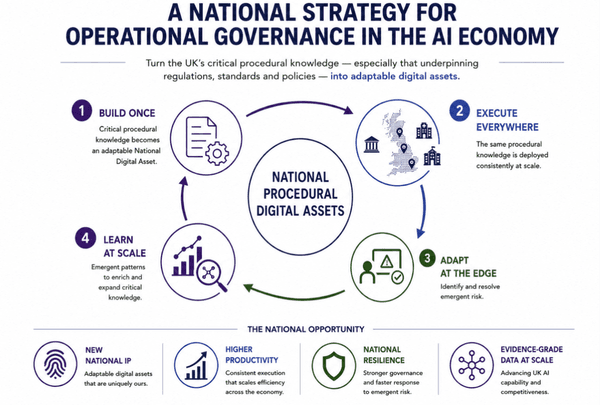
Our infographic illustrates how shared procedural knowledge could continuously learn from exceptions and expand — an increasingly important capability as AI accelerates the pace of change.
Local execution should strengthen national knowledge, not fragment it.
Unlocking new value from national intellectual property
The NHS National Standards of Healthcare Cleanliness 2025[vii] provide a practical example of how a common national standard could support shared procedural know-how.
In England alone, this valuable national intellectual property has potential relevance across tens of thousands of healthcare and care locations[viii], each needing to translate national requirements into operational know-how.
Our work shows how this national intellectual property can be translated into procedural know-how and executed consistently across organisations and locations.
From procedures to national knowledge assets
The opportunity is to treat critical national procedures as knowledge assets — capable not only of being reused and shared at scale, but of generating evidence-grade data to drive productivity, continuous learning, risk intelligence and better governance.
Footnotes
[i] English Devolution White Paper - GOV.UK
[ii] Grenfell Tower Inquiry Phase 2 Report: Government Response, 2025, Chapter 7, paragraph 90. Grenfell Tower Inquiry Phase 2 Report: Government response (HTML) - GOV.UK
[iii] Mendoza et al., The realities of procedure deviance: A qualitative examination of divergent work-as-done and work-as-imagined perspectives, International Journal of Industrial Ergonomics, Vol. 100, 2024. The study found significant differences between procedures as designed and work as actually performed, with users reporting more procedural deviations than administrators perceived and identifying task-related reasons for those deviations. The realities of procedure deviance: A qualitative examination of divergent work-as-done and work-as-imagined perspectives - ScienceDirect
[iv] FCA/FSA reviews of financial-services mis-selling found weaknesses in firms’ ability to identify and control mis-selling risk, including over-reliance on routine monitoring and insufficient information about how sales incentives operated in practice. The PPI scandal ultimately resulted in more than 32 million complaints and over £38 billion in redress. Risks to customers from financial incentives | FCA Payment protection insurance complaints deadline Final Report | FCA
[v] Chartered Institute of Ergonomics & Human Factors, Guidance on Design of Effective Work Procedures, 2020. Guidance on design of effective work procedures | CIEHF
[vi] Debono et al., Nurses' workarounds in acute healthcare settings: a scoping review, BMC Health Services Research, 2013. Review of 58 studies examining the development, proliferation and impact of workarounds in acute healthcare. Nurses' workarounds in acute healthcare settings: a scoping review - PubMed
[vii] NHS England » National Standards of Healthcare Cleanliness 2025
[viii] Df2020 estimate based on published NHS and sector data for healthcare and care settings in England, including approximately 6,100 GP practices, 10,400 community pharmacies, 14,500 care homes, together with NHS and independent hospitals and clinics, dental practices, hospices and other regulated healthcare locations. The combined estate exceeds 40,000 locations; figures are approximate because published datasets use different definitions and reporting periods.