Getting workplace monitoring technology right

Workplace monitoring technologies (WMT) are not simply good or bad for workers and outcomes depend on how and why they are implemented. As government considers its next steps following the Department for Business, Innovation, Science and Trade's consultation on WMT, getting the definition and approach right will determine whether policy supports businesses and workers without holding back responsible adoption.
Policy must define monitoring in a way that fits
Within the consultation, WMT is defined broadly – as ‘digital tools used by employers to collect, track, analyse or make decisions based on information about workers and their activities’. This captures routine operational tools and applications such as running payroll, scheduling, workforce planning, or secure and compliant service operations. Most employers using these tools are running their business, not surveilling their workforce.
Policy must be sure not to capture a vast array of standard workplace technologies, nor conflate markedly different tools and applications. There must be a clear definitional distinction between genuinely intrusive or high-risk systems, systems that merely process worker data in the course of normal operations, and systems used for essential security or compliance purposes. In areas like cybersecurity, where monitoring is focused solely on detecting threats and anomalies in systems, accounts and devices, and transparency expectations would help adversaries evade controls, there must be clear carve-outs from any future regime.
Without these distinctions, any interventions risk a chilling effect on technology investment and adoption. This would affect a broad range of workplace technologies, and smaller employers in particular, with negative consequences for resilience, productivity and growth.
Monitoring can benefit businesses and workers
Used well, WMT can bring distinct benefits for businesses and workers across a range of areas, from boosting productivity and service efficiency, to enabling targeted training, to protecting security and health and safety. Workplace data on productivity, for example, can ensure resource and workloads are appropriately distributed, avoiding undue pressures on workers while boosting output and efficiency. In health and safety, monitoring typically exists to protect the worker. Check-in systems and location data enable a rapid response when a lone worker is in trouble, while 97% of UK HGV and van drivers said technological advancements made them feel safer when carrying out their work.
Monitoring can also pose some risks in particular circumstances or a narrower set of applications, such as where it informs performance decisions without the right oversight and safeguards, many of which data protection law already requires. Good management and responsible adoption practices, including effective communication and AI assurance mechanisms, are key to mitigating those risks and building trust.
Policy should build on existing legal frameworks
Employers already operate under a comprehensive legal framework: data protection regulation, the Equality Act, employment law, health and safety legislation, Human Rights Act case law and ICO guidance, with a further ICO code forthcoming on AI and automated decision-making. Data protection law and ICO guidance already require transparency, proportionality and fairness, as well as impact assessments for high-risk processing. Covert monitoring is generally unlawful outside exceptional circumstances. And where significant decisions are made through automated processing, regulation also provides for human intervention and rights to contest.
Proposed legislative requirements to consult and negotiate, or new statutory obligations on adopting WMT, would therefore risk parallel, overlapping or conflicting frameworks. They would introduce significant friction to technology deployment and deter adoption, rather than encouraging it in line with best practice, and cut against government's ambition to support businesses to adopt productivity and growth-enhancing technologies with confidence.
While engaging workers can help employers deploy technology for maximum benefit, and businesses should seek to do it where possible, they also need freedom to choose how. The right form of engagement varies by organisation and workplace. Adoption also tends to happen through iterative updates and new features, not one-off or big bang implementations, so repeated rounds of engagement at every stage are not always workable.
In addition, any intervention must be sufficiently dynamic to accommodate rapidly emerging use cases, including developments in AI and the changing nature of work. When considering specific statutory or legislative interventions, there is a clear risk of creating a framework that is overly broad, overly complex, or quickly outdated – undermining the effectiveness and credibility of the regime over time.
Businesses need practical, proportionate guidance
What is missing in this space is not law, but consolidation and associated support, and techUK believes government should create non-statutory guidance to encourage adoption in line with best practice. This should explain what WMT is and isn’t, set out what good looks like for adoption and ongoing use, and bring together the obligations employers already have.
Guidance must be flexible, built upon existing law, regulation and guidance, and supported by practical advice, toolkits and case studies for businesses of different shapes and sizes looking to implement this technology. It should distinguish clearly between routine or lower risk changes and those that may have a significant impact on businesses or the workforce, and avoid a one-size-fits-all approach that would fail to reflect the different contexts in which WMT is deployed.
Further dialogue between government and industry representing a variety of employment relationships would ensure guidance is evidence-based, co-designed with a range of employers, and informed by how WMT is developed, procured and used.
Engaging with government
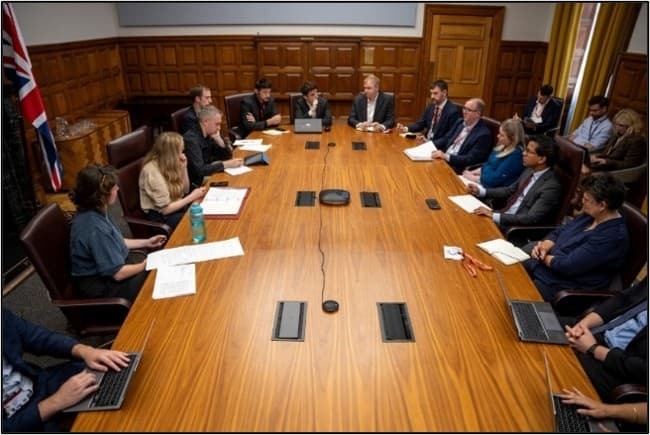
techUK has worked closely with members and government to help shape a proportionate approach to workplace monitoring technology – one that supports responsible adoption while recognising the benefits these technologies can deliver for businesses and workers. Alongside providing briefings to officials, we attended a roundtable with Ministers Kate Dearden MP and Kanishka Narayan MP, to bring the tech sector’s view to bear on government thinking and proposals related to WMT.
As the government considers its response to the consultation, we will continue to make the case for a practical, proportionate approach that builds on the regulation and protections already in place. If you are interested in this work or would like to read our full response, please get in touch.