Unlocking Photonics Potential in Northern Ireland
From quantum computing breakthroughs to next-generation optical communications, photonics technologies are transforming how the world connects, computes, and innovates. The UK is uniquely positioned to lead this transformation. But realising this leadership requires more than world-class research: it demands that we close the commercialisation gap and bring photonics from lab to fab, at scale.

Why Photonics Matters
Photonics the science of light underpins a wide range of critical technologies, from high-speed internet and AI acceleration to precision medicine and quantum encryption. It is also a cornerstone of the emerging quantum technology stack, where precise control of individual photons is enabling transformative breakthroughs with far-reaching implications across industries. To fully capitalise on this technological shift, it is essential to take a UK-wide perspective recognising and leveraging the unique strengths that exist across the regions. In particular, Northern Ireland offers specialised capabilities in photonics and advanced manufacturing that policymakers must consider as part of any coordinated national or cross-border innovation strategy.

Seagate uses advanced photonics in its data storage technologies to achieve ultra-precise laser writing at higher data densities a critical enabler for the future of cloud and edge infrastructure.
Northern Ireland already has a robust photonics ecosystem that’s primed to scale.
Smart Nano NI was awarded £42.3m from UK Research and Innovation’s Strength in Places Fund. It shares capabilities around nano-manufacturing and world-leading knowledge in photonics and is pushing the boundaries of photonics, smart manufacturing and nano technology innovation across Northern Ireland.
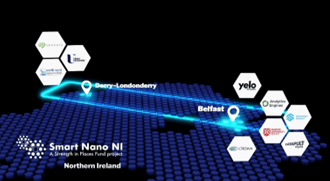
Strengthening the region’s photonics ecosystem, this Seagate-led consortium includes members from industry, education and innovation partners. The Consortium goal is to create a self-sustaining local ecosystem through research and innovation with opportunities for new technololgy applications across multiple sectors including analytics, healthcare, diagnostics and data storage.
⚙️ From Lab to Fab: Northern Ireland’s Opportunity

Seagate water fab in Derry, Nothern Ireland
Seagate’s wafer fabrication facility in , Northern Ireland produces advanced thin-film recording head wafers used in around 25% of the world’s hard drives. The site has become a key R&D hub, particularly in nanophotonics developing cutting-edge technologies that support next-generation data storage.
The challenge?
Despite the clear potential, most photonics and quantum innovations remain stuck at Technology Readiness Levels (TRL) 3–6 strong in theory but far from deployment. The next step? Investing in later-stage R&D and shared infrastructure that allows ideas to scale:
1. Shared Infrastructure for Scaling Innovation
The “valley of death” between university breakthroughs and real-world deployment is still a major barrier. Access to scalable fabrication, packaging, and test infrastructure is essential.
Seagate is exploring shared capital models through Smart Nano NI, helping start-ups and researchers gain access to tools without duplicating high-cost facilities.
2. Targeted R&D Investment
Northern Ireland would benefit from:
Co-investment in scalable photonic modules
Support for hybrid technologies like AI + photonics
Cross-Border and International Collaboration
Photonics doesn’t stop at national borders. Innovation relies on global knowledge exchange and frictionless R&D mobility.
Northern Ireland holds a unique economic advantage under the Windsor Framework, with privileged access to both UK and EU markets.
Seagate’s operations benefit from cross-border research ties with Ulster University, Tyndall, and ATU a foundation now strengthened by SPEAR, which brings together institutions and stakeholders across Northern Ireland and the Republic.
We support
Joint UK-Ireland innovation programmes
Expanding re-engagement with Horizon Europe and similar collaborations
Global standards leadership for photonics and quantum
Fast-tracking visas and mobility for high-skilled photonics professionals
Skills and Mobility: Building the Workforce of Tomorrow
Photonics growth depends on a flexible, mobile workforce. The region is already laying strong foundations:
Programmes through Smart Nano NI and Digital Catapult NI
Talent development via Ulster University, QUB, ATU, and Tyndall
Support for industry-academia secondments, upskilling in fab design, AI integration, and secure communication
It’s Time to Act
Northern Ireland has:
The research base
The industrial footprint
The cross-border advantage
Now we need:
Continued support for innovation clusters like Smart Nano NI
Formal recognition at the UK and EU levels of Northern Ireland’s strengths and growth potential in advanced technologies, specifically photonics
Targeted investment in infrastructure, including energy access, equipment, and funding, to scale and strengthen the cluster
International collaboration focused on attracting talent and investment to the region
Let’s Lead in Photonics
Photonics isn’t a side story it’s a platform technology for the 21st century. From quantum communications to net-zero data infrastructure, its potential is vast.
With the right support, Northern Ireland can propel the UK and Europe to global photonics leadership.
Let’s invest, collaborate, and build the future in light.
techUK – Unleashing UK Tech and Innovation
The UK is home to emerging technologies that have the power to revolutionise entire industries. From quantum to semiconductors; from gaming to the New Space Economy, they all have the unique opportunity to help prepare for what comes next.
techUK members lead the development of these technologies. Together we are working with Government and other stakeholders to address tech innovation priorities and build an innovation ecosystem that will benefit people, society, economy and the planet - and unleash the UK as a global leader in tech and innovation.
For more information, or to get in touch, please visit our Innovation Hub and click ‘contact us’.