Frontier Compute Needs Missions, Not More Silos

The UK has no shortage of breakthrough technology.
Across universities, research institutions, start-ups and established companies, remarkable progress is being made in quantum, photonics, neuromorphic and biological computing, advanced semiconductors and AI.
But scientific leadership does not automatically create industrial leadership.
The harder question is: How do we turn Frontier Compute breakthroughs into capabilities that industry actually needs?
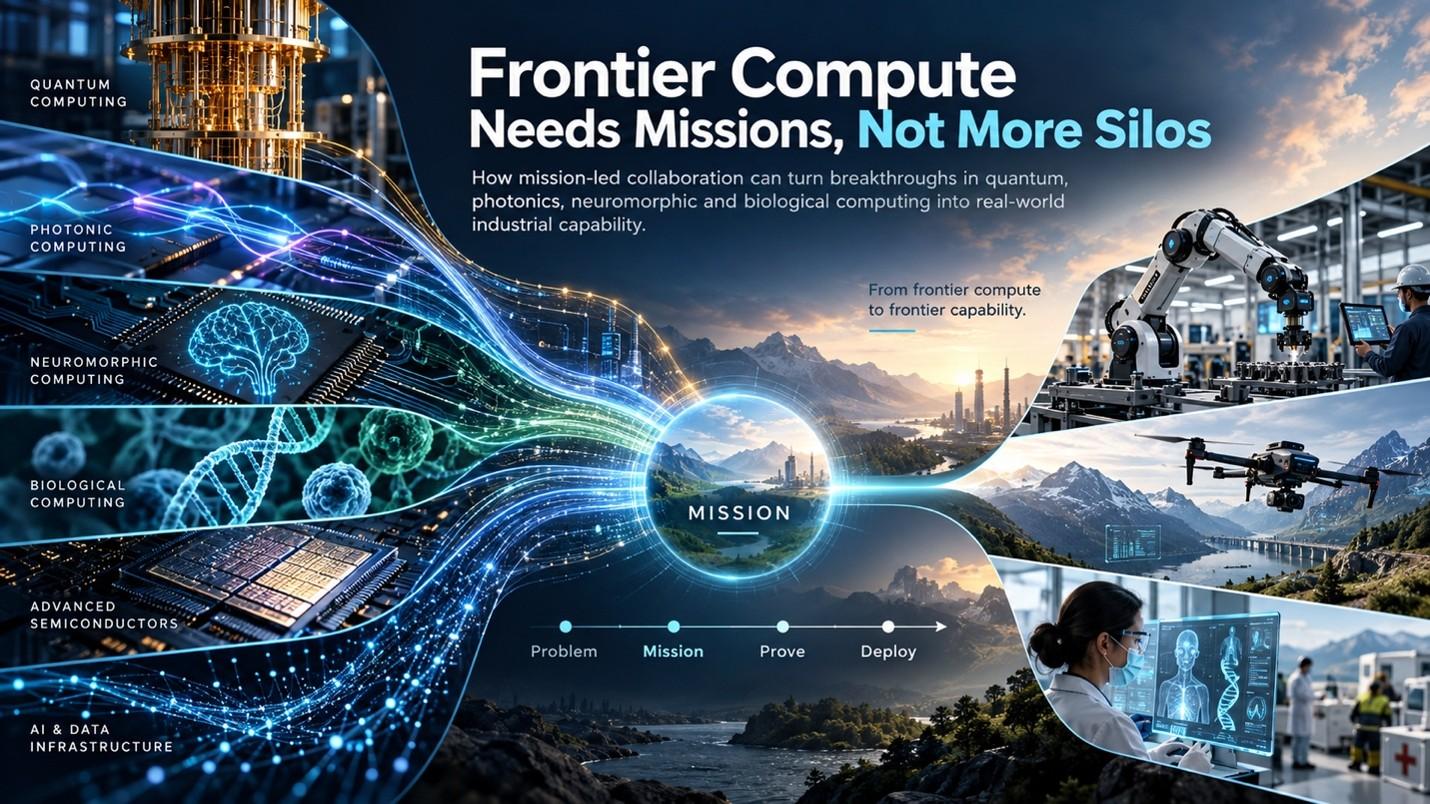
Industrial problems don’t respect technology boundaries
Industrial customers rarely start by asking for a particular technology.
A robotics manufacturer doesn’t necessarily want neuromorphic computing. It might want a robot capable of adapting to new manufacturing tasks faster, using less energy and at lower cost.
A defence organisation doesn’t necessarily want quantum technology. It might need an autonomous system capable of navigating reliably when GNSS or communications are unavailable.
A healthcare organisation may not be looking specifically for photonics or biological computing. It may want earlier identification of a biological threat with greater confidence.
Solving these problems could require combinations of advanced semiconductors, AI, photonics, quantum technologies, sensors and new computing architectures.
The customer shouldn’t have to determine which technologies provide the answer. They should bring the problem.
From technology-led to Mission-Led innovation
Much of deep-tech innovation naturally starts with a technology:
Technology → Find an application → Find a customer → Attempt deployment
What happens if we reverse that?
Problem → Mission → Assemble technologies → Prove the system → Deploy
Consider a robotics company whose customers need robots capable of adapting economically to changing products, tasks or manufacturing environments.
Instead of deciding whether the answer is a new processor, better sensing, AI, neuromorphic computing or photonics, start with the required industrial outcome.
An open ecosystem can then test alternatives.
Could a new compute architecture reduce power consumption? Could neuromorphic approaches enable more efficient perception? Could photonic sensing improve environmental awareness? Could AI improve adaptability? Could quantum optimisation improve factory operations?
Or could conventional technology still provide the best solution?
That last question matters.
Mission-Led innovation shouldn’t exist to find applications for Frontier Compute. It should find the best technologies for applications that matter.
Prove the technology. Then prove the system.
One of the biggest barriers to Frontier Compute adoption is moving from an impressive technical benchmark to evidence of industrial value.
A semiconductor architecture might demonstrate exceptional performance in isolation. But what happens when it becomes part of a robot, autonomous vehicle or industrial system?
Does it reduce power consumption? Can the system respond faster? Does it enable a previously impractical capability? Ultimately, does somebody value that improvement enough to pay for it?
This is where digital engineering and digital twins could play an important role.
Rather than immediately building expensive physical prototypes, emerging technologies can progressively be evaluated within increasingly complete digital representations:
PROVE THE TECHNOLOGY → PROVE THE SUBSYSTEM → PROVE THE SYSTEM → PROVE THE INDUSTRIAL VALUE → DEPLOY
Digital validation won’t replace physical testing. But it can expose problems earlier, compare alternatives and reduce the cost of discovering that something doesn’t work.
For Frontier Compute companies, it could also provide something extremely valuable: evidence that technical differentiation creates value beyond the laboratory.
Connecting technology, customers and capital
The UK already has significant strengths in research, innovation funding, technology entrepreneurship and industrial capability.
But those strengths don’t always connect easily.
Start-ups need access to customers with meaningful problems. Industrial companies need practical ways to evaluate emerging technologies without assuming excessive technical risk. Investors need evidence that differentiation can translate into demand. Government wants research investment to generate economic growth, sovereign capability and resilient supply chains.
These aren’t separate challenges.
They are different parts of the same commercialisation journey.
What we’re exploring through Siemens Cre8Ventures
This is one of the ideas we’re exploring through Siemens Cre8Ventures.
We’re evolving towards an open, partner-led Mission-Led Platform, bringing industrial customers, technology companies, researchers, investors and policymakers together around specific problems.
Our emerging Factory-One robotics campaign provides one example.
The proposition is deliberately simple:
Bring us a robot — but more importantly, bring us a problem.
Something customers want that is difficult, expensive or perhaps impossible with today’s technology.
We can then explore whether Siemens and a wider ecosystem can assemble and digitally validate the capabilities required to address it.
The answer might involve semiconductors, AI, photonics, quantum, advanced sensing or new computing architectures. It might involve several of them. Or the evidence might show that existing technologies already provide the best answer.
The mission determines the technology — not the other way around.
Could the UK create Frontier Compute Missions?
There may be a broader opportunity to apply this principle nationally.
Alongside programmes supporting individual technology domains, the UK could create a small number of industry-led Frontier Compute Missions, each grounded in a measurable industrial challenge and a credible route to deployment.
For example:
Adaptive Manufacturing — how can robots and factories adapt economically to increasingly flexible production?
Resilient Autonomous Systems — how can autonomous platforms continue operating when navigation, communications or compute resources are constrained?
Sustainable Compute — how can emerging architectures materially reduce the energy required for AI and data processing?
Advanced Biosecurity — how can new approaches to sensing, computing and AI identify emerging biological threats earlier?
Each mission could connect:
Customers + Problems + Frontier Technologies + Digital Validation + Capital + Routes to Market
Government doesn’t need to predict which technology will win. Industry doesn’t need to understand every emerging architecture. Start-ups don’t need to build complete systems themselves.
Instead, we create environments where technologies can be combined, compared and proven against problems that matter.
From Frontier Compute to frontier capability
The UK’s opportunity isn’t simply to invent the next generation of computing.
It is to become one of the best places in the world to turn those inventions into deployable industrial capabilities.
That means continuing to invest in fundamental science while connecting industrial customers with emerging technologies earlier and creating clearer routes from experimentation to deployment.