Similar facades, different fates: Exploring climate risks in two cities

In today’s data-driven world, it’s often said that numbers don’t lie. However, the way data and statistics are presented can significantly shape the narrative. It is also the case that similarities can be taken to support the claim that businesses in a vertical sector may demonstrate similar risks. This is true when it comes to supply chains, where the same core components or raw materials are needed. But this is not true when you start to look at climate.
Our recent findings highlight how climate risks vary dramatically, even between seemingly similar entities. This case study compares manufacturing businesses in two U.S. cities, Miami and New Orleans. They’re not a million miles away from each other (in fact, under a 900 miles) and both in the southern states of the US.
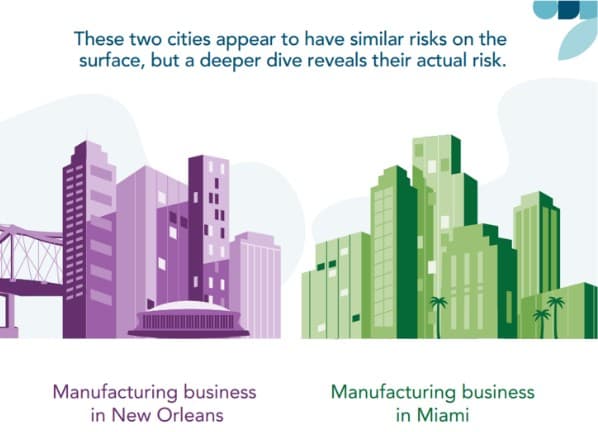
On the surface, the two manufacturing businesses looked at for the case study had very similar financial performance, size, and operated in a sector that appeared to carry low risks. But, as you start to lift the hood, the image quickly changed shape. This is where data science can really help, for example, reviewing specific data attributes to support supply chain decisions particularly when companies are planning to work with new suppliers or assessing supply chain health.
For instance, in our manufacturing case study, we utilised advanced data science techniques to assess site-specific factors, including family tree data (business hierarchy) and branch locations. This analysis revealed how physical site locations significantly influence climate vulnerability, reshaping the risk landscape for businesses. This proactive approach is crucial as climate risks increasingly intersect with operational, financial, and reputational concerns.
Once these factors were added into the wider map of the supply chain, the following could be seen:
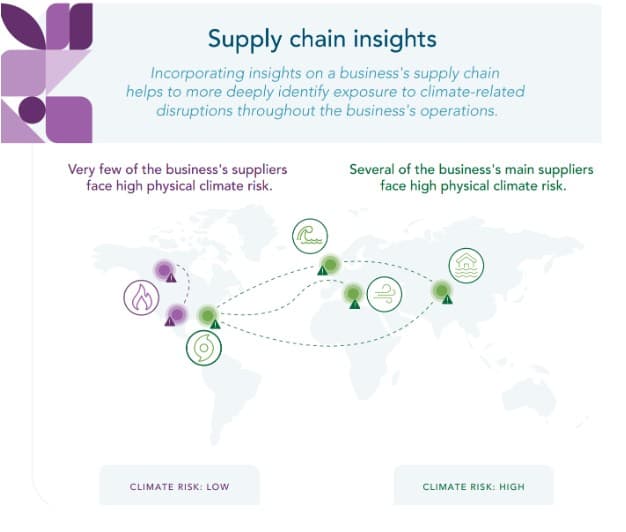
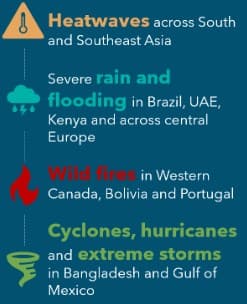
We all know that climate events are becoming more and more prevalent, for example, major events from last year continued into this year, such as the Los Angeles wildfires. However, we also know that climate change preparedness is not currently at the top of the list. One reason for this is the inability to quickly pivot; supply chains are complex and mapping a full supply chain end-to- end is still being done manually, in many sectors.
Another interesting point is that this month sees the launch of the delayed Public Sector Procurement Act, which comes into force in February. In public procurement risk assessment, detailed Economic and Financial Standing checks are carried out, but climate risk is not thoroughly assessed due to the limited maturity of assessment frameworks and the lack of widely available data. However, tools like our Climate Risk Insights are paving the way for more comprehensive approaches, ensuring that environmental considerations become a core part of public and private sector decision-making.
Unfortunately, climate risks span physical assets, supply chains, and financial systems. Businesses need to develop strategies to adapt their supply chains, such as investing in renewable energy and diversification.
On a positive note, data drives insight, which allows businesses to plan for disruptions and proactively adapt their operations with a view to strengthening their supply chains, protecting assets and ensuring stability.
By leveraging smart data, businesses can reinforce supply chain decisions, build resilience, identify supplier vulnerabilities, diversify sourcing strategies, and plan alternative routes - essentially becoming more proactive around climate risk.
Case study results
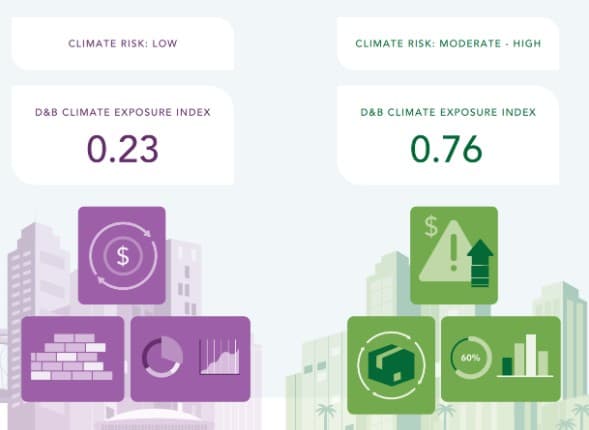
Below is a diagram of what it looks like when combining a company’s’ physical climate risk, financial risk, supply chain locations and property characteristics.
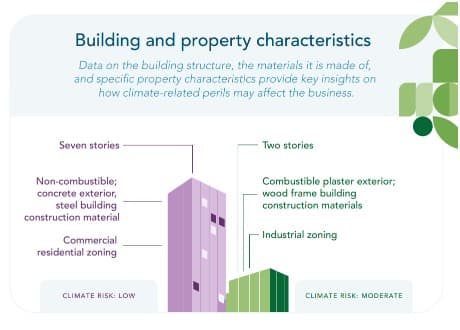
An index can be returned providing visibility into an entity’s exposure to climate related disasters.

For businesses still believing they can afford to wait, now is the time to reassess. With 2026 just around the corner, the issues and statistics highlighted in the CDP Global Supply Chain Report 2020 show that climate risks are no longer a distant concern – they’re an imminent challenge that businesses must address today.
By integrating advanced data analytics into decision-making processes, businesses can safeguard their operations, protect their assets, and ensure long-term stability in an increasingly volatile world. Climate resilience and preparedness are no longer optional—they are essential for sustainable growth and competitiveness.
For details on the Climate Risk Index please go to https://www.dnb.com/en-us/products/dnb-climate-risk-insights.html or contact 0800 001234