Determining Business Readiness for AI Integration

In 2026, AI evolves from pilot testing into a full-scale driver of business efficiency and cost reduction. Companies now leverage AI integrations as a competitive advantage, offering personal AI assistants to automate routine tasks.
State of the AI Industry in 2026
The defining trend is surging AI agent adoption, driven primarily by large enterprises with over $1B in annual revenue. While 27% of enterprise respondents reported scaling AI last year, that figure rose to 40% in 2026. By contrast, adoption in smaller companies remains flat at 22%. According to the Stanford Institute for Human-Centered AI (HAI), artificial intelligence will be the most transformative technology of the 21st century. However, its benefits remain unevenly distributed across companies and demographics.
The US leads globally in AI data centers with 5,427 facilities, yet it relies heavily on a single Taiwanese supplier for most of its hardware chips. China ranks second, having traded the lead with the US periodically since early 2025. As of March 2026, the US Anthropic model leads China's DeepSeek-R1 by only 2.7%.
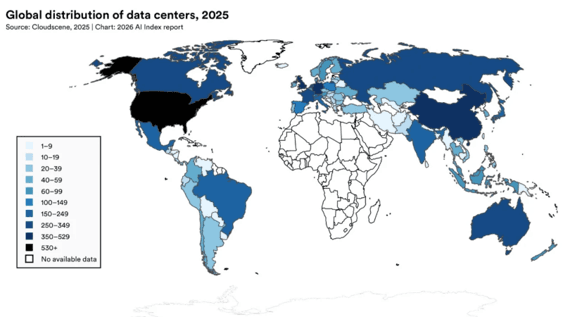
Global distribution of data centers (based on data presented in the article “The 2026 AI Index Report”)
Key priorities in the AI landscape remain:
Despite rising revenues for AI developers, compute power and data center costs are growing significantly faster.
While AI models excel at complex math and programming, they still exhibit unexpected blind spots on intuitive tasks, such as reading an analog clock.
Cybersecurity has gained a powerful tool for threat monitoring and tracking, but it has also exposed new vulnerabilities and attack vectors.
Ethical AI deployment faces critical legal challenges around copyright ownership and IP compliance.
How Businesses Successfully Use New Technologies
AI-driven automation optimizes time spent on repetitive processes — such as data entry, email triage, scheduling, and report generation. This lets organizations reduce routine workload and reallocate resources to high-value strategic tasks. Industry research shows that AI-driven automation cuts task completion time by 30-70%.
While task execution still requires human expertise, artificial intelligence significantly optimizes operational working hours:
AI can transcribe meetings and automatically extract key insights and action items. For example, a healthcare company integrated AI with Microsoft Teams to generate automated meeting summaries, enabling managers to track initiatives and execute tasks seamlessly.
AI enhances CRM capabilities through predictive analytics. It transforms historical customer data into precise sales forecasts, behavioral insights, and optimized demographic targeting.
Marketing teams deploy AI across key functions: audience segmentation, messaging validation, strategy optimization, and creative campaign ideation.
Artificial intelligence enables predictive market scenario modeling, allowing enterprises to simulate variable impacts on supply chain inventory, anticipate demand fluctuations, and build resilient strategies.
While these represent only a fraction of AI's capabilities, domain experts across industries continue to unlock new applications.
How to Avoid Mistakes with AI Implementation
Despite widespread business adoption, AI integration requires a pragmatic approach to avoid adopting technology merely to follow trends. To guarantee sustainable ROI, organizations should avoid these common AI deployment mistakes:
Confusing a polished demo with production readiness is a major trap. Beyond the tech stack, organizations must validate process alignment, cybersecurity posture, and team readiness in real-world conditions before rollout.
AI is only as intelligent as the data it accesses. Despite driving faster decision-making and automation, AI fails when operating on siloed or inconsistent data. Organizations must standardize and centralize internal data sources before deploying AI solutions.
Not every AI recommendation should be executed automatically. Despite rapid advancements, AI models remain susceptible to hallucinations and errors. Unchecked automation can harm client relationships and the enterprise's brand authority. AI should serve as a decision-support tool, with a human in the loop for final validation and oversight.
Establish clear AI ownership by designating a dedicated leader responsible for data governance, output validation, and risk management. Defining accountability prevents shadow AI, ensures compliance with data privacy regulations, and supports controlled enterprise adoption.
Deploying AI without re-evaluating existing workflows rarely yields results. AI cannot inherently fix flawed processes and may amplify operational friction. Rather than attempting an immediate, full-scale replacement, organizations should first audit core processes, then deploy AI incrementally to optimize specific, modular tasks.
Beyond implementation errors, organizations must account for AI's total cost. Amid the ongoing "memory crisis," infrastructure and maintenance costs keep rising. Before deployment, enterprises should weigh net cost reductions against the long-term OPEX required to maintain AI models.
Sources referenced
The state of AI in 2026: On the road to ROI. Available at: https://www.mckinsey.com/capabilities/quantumblack/our-insights/the-state-of-ai
The 2026 AI Index Report. Available at: https://hai.stanford.edu/ai-index/2026-ai-index-report
How Artificial Intelligence Is Transforming Data Science: Market Trends and Career Outlook. Available at: https://bit.ly/4yDwBz9
How Companies Are Using AI Today: 9 Examples and Guardrails. Available at: https://www.certified-nets.com/how-businesses-use-ai/
What is Customer Relationship Management (CRM)? Available at: https://www.ibm.com/think/topics/crm
What is AI inventory management? Available at: https://www.ibm.com/think/topics/ai-inventory-management