AI, regulation and emerging technologies: why the foundations matter

Alan Blanchard
TSO Business Development Director
Artificial intelligence is increasingly positioned as the technologies that will shape the UK’s future economy. But while much of the discussion focuses on the technologies themselves, far less attention is paid to the information ecosystems these technologies rely upon.
This is becoming a critical issue.
Across both the public and private sectors, many organisations’ content and information are simply not fit for purpose. Important information often remains locked inside PDFs, fragmented across disconnected systems, inconsistent in structure and difficult to interrogate or reuse effectively.
How can the UK seize the opportunities created by AI and emerging technologies? The answer lies in improving the quality, structure and interoperability of the information these technologies depend upon.
This means:
unlocking information
structuring it as data
improving accessibility
enabling interoperability
maintaining human oversight
modernising regulatory and information ecosystems.
At a recent industry event discussing the practical application of AI in regulation and official information, TSO explored how these principles are already moving from theory into practice.
The circle of AI as both producer and user of information
One of the most important shifts taking place is that AI is no longer simply a tool organisations use. Increasingly, AI itself is being used to help create the information it previously only consumed.
Large language models, intelligent search systems, robotics platforms and emerging automation technologies all rely on information that is:
structured
machine-readable
semantically connected
accessible across systems.
Without this, AI systems struggle to interpret information accurately and consistently.
Many organisations are currently attempting to jump directly to AI-enabled outcomes while still operating on information foundations built for manual, document-centric processes. The reality is that innovation happens in stages. Organisations starting with static publishing and disconnected systems must implement the steps required to move towards structured, interoperable and AI-ready information ecosystems before advanced technologies can operate effectively at scale.
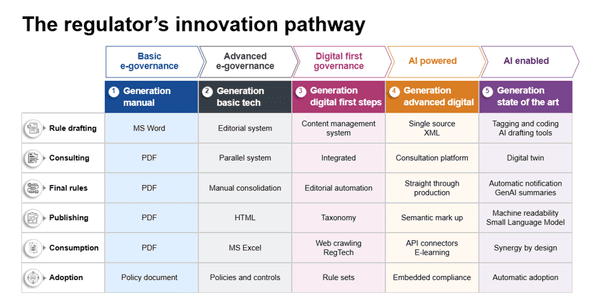
The organisations most likely to benefit from AI and emerging technologies will not necessarily be those investing in the largest number of AI tools. They will be those modernising the underlying information ecosystem first.
Making legislation more accessible, connected and AI-ready
One example of this transformation is UK legislation.
TSO publishes UK legislation and has been at the forefront of using AI to improve how legislation is structured, enriched and reused. One of the most significant developments has been the use of AI to semantically mark up legislation data, transforming dense legal text into linked, structured information.
Working with The National Archives and the Department for Business and Trade, AI is now being used to analyse UK legislation data and identify where duties have been delegated to regulatory bodies. By using enriched metadata and semantic relationships, obligations can be connected across primary and secondary legislation, helping build towards a more joined-up view of the regulatory landscape.
This supports the wider shift towards machine-readable regulation and rules-as-code approaches, where regulation can be more easily interpreted by both people and AI systems.
AI is also helping improve access to historic legislation and regulation. Much older material exists only as scanned PDFs or image-based documents, limiting searchability and reuse. AI tools can recognise document structures such as headings, tables, references and footnotes, while also identifying and reconstructing text obscured through damaged scans, folds, marks or poor print quality.
Combined with careful human validation and reconciliation processes, these documents can be transformed into high-quality structured data aligned to schema and metadata with 100% accuracy. The result is legislation that is easier to search, understand, connect and apply.
Enhancing trust and usability in The Gazette
Another example is The Gazette, the UK’s official public record.
Gazette notices have legal standing and are relied upon by courts, professionals and researchers, making trust and data quality essential. TSO is using AI to enhance notice data submitted through multiple ingestion routes including online forms, APIs and email submissions. The API route allows for many notices to submitted at once, and the AI used here allows for the correct ingestion and enrichment of those notices accurately at scale.
Importantly, AI does not create notices. Legal and editorial controls remain precise and governed by human oversight. Instead, AI is used to enrich and connect information by identifying key entities, relationships and semantic links that improve discoverability and usability.
At TSO, we are exploring how AI can further support:
improved search across complex Gazette datasets
unlocking a 350-year-old archive through AI-powered OCR with human validation
augmented live chat services to improve response times and handle routine queries more efficiently.
These examples demonstrate an important principle: AI delivers the greatest value when combined with structured information, interoperability and expert oversight.
The importance of accessibility, interoperability and human oversight
As technologies such as AI, robotics and quantum-enabled analysis continue to evolve, accessibility and interoperability become increasingly important strategic enablers rather than purely technical considerations.
Information that is:
clearly structured
consistently labelled
semantically connected
accessible across systems
is significantly easier to reuse across AI systems, automation platforms, analytics environments and digital public services.
The same principles that improve accessibility and usability for people also improve usability for machines.
Human oversight also remains essential. AI can accelerate processing and support information transformation, but organisations still need expert judgement to ensure:
accuracy
context
ethics
proportionality
trust.
The organisations likely to gain the greatest value from AI and emerging technologies will not be those seeking to remove humans from the process entirely. They will be those successfully combining advanced technologies with AI-ready information ecosystems and expert human oversight.
Looking ahead
The UK has significant opportunities at the intersection of AI, quantum computing, robotics, photonics and semiconductors. But technological capability alone will not determine success.
The organisations and economies most likely to benefit will be those that focus on the quality, usability and interoperability of the information underpinning these technologies.
Innovation depends not only on the technologies themselves, but on the information ecosystems they operate within.