Keeping up with AI: Event recap

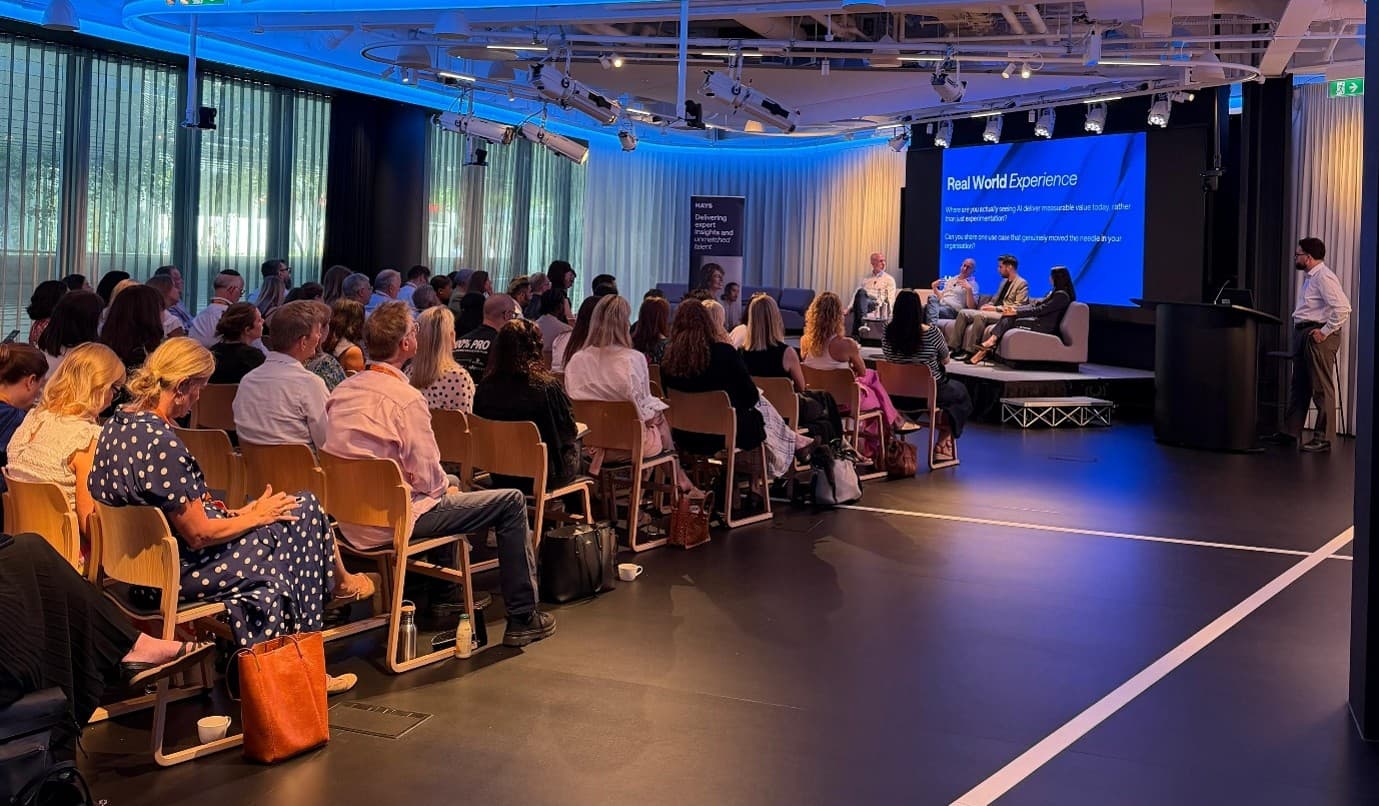
Jacob Bartoli, Business Manager at Hays, recently hosted an AI leadership event at Norton Rose Fulbright in collaboration with BossUp, bringing together industry experts Paul Orchard, Matt Hobby, Rahan Arif and Anu Doll to discuss how organisations can move from AI adoption to genuine AI readiness.
The AI conversation is changing
For the last two years, most conversations about AI have focused on adoption. Organisations have been exploring use cases, investing in new tools and encouraging employees to experiment with emerging technologies.
However, a recent discussion I hosted with leaders from technology, professional services, HR and transformation highlighted a shift in thinking. The organisations seeing the greatest value from AI are no longer focused on adoption alone. Instead, they are focusing on readiness.
This might sound like a subtle distinction, but it has significant implications for businesses planning their next phase of AI investment.
Adoption is not the same as transformation
Many organisations can confidently say they are using AI. Employees have access to tools, pilot programmes are underway and innovation teams are testing new ideas.
The challenge is that AI is often being layered onto existing ways of working rather than fundamentally changing them.
The organisations making meaningful progress are stepping back and asking different questions:
Where does AI create genuine value?
How should work be redesigned around AI?
Which skills will become more important?
How do we prepare our workforce for change?
In other words, they are focusing less on the technology and more on the operating model that sits around it.
Human skills are becoming more valuable
One of the more surprising themes to emerge from the discussion was the growing importance of human capability.
Whilst AI continues to improve at executing tasks, skills such as communication, critical thinking, decision-making and judgement are becoming increasingly valuable.
Rather than replacing people, AI is changing the role people play.
Many professionals are moving away from purely executing work and towards directing, reviewing and improving outputs generated by AI. The ability to ask the right questions, challenge assumptions and make informed decisions is becoming a key differentiator.
For employers, this presents an important challenge. Technical skills remain important, but organisations also need to invest in the softer skills that enable effective collaboration between humans and AI.
The workforce must come along on the journey
Technology is rarely the biggest barrier to AI transformation. More often, it is confidence, capability and culture.
Employees understandably have questions about how AI will affect their roles and future career paths. Organisations that address those concerns openly and invest in workforce development are likely to be better positioned than those focused purely on technology deployment.
AI readiness should not be viewed as a one-off training exercise. It requires ongoing development, curiosity and a willingness to continuously learn as the technology evolves.
Looking ahead
AI is rapidly becoming accessible to every organisation. As access to technology becomes more widespread, competitive advantage is less likely to come from the tools themselves.
Instead, the organisations that stand out will be those that successfully prepare their people, redesign their processes and create environments where humans and AI can work together effectively.
The next phase of AI adoption will not be defined by who adopts the fastest. It will be defined by who becomes ready first.