techUK’s 2030 Vision Report: Reflections on Building a World-Leading Digital Assets Economy

On 16 October 2025, techUK gathered industry leaders, policymakers and innovators in London to launch techUK’s 2030 Vision: A Roadmap for Building a Digital Assets Economy. The event and accompanying report set out a bold agenda for how the UK can become a global leader in digital asset technologies by 2030. Read and download the full report here.
Setting the scene
The morning opened with a welcome from James Challinor, Head of Financial Services at techUK, who emphasised that the architecture of the UK’s future digital economy—and the competitiveness of financial services—relies on the successful implementation of digital asset technologies. With other jurisdictions moving quickly, the UK must match and surpass that pace of delivery.

Industry perspectives
Matt Green, Chair of techUK’s Digital Assets Group, outlined where the UK stands today and what must happen next to lead the coming wave of innovation. That wave will be powered by distributed ledger technologies (DLT), tokenisation, programmable finance and enhanced fraud-prevention tools. The question, he noted, is no longer “if” but “how quickly—and how well—the UK can build the frameworks for digital assets to scale.”
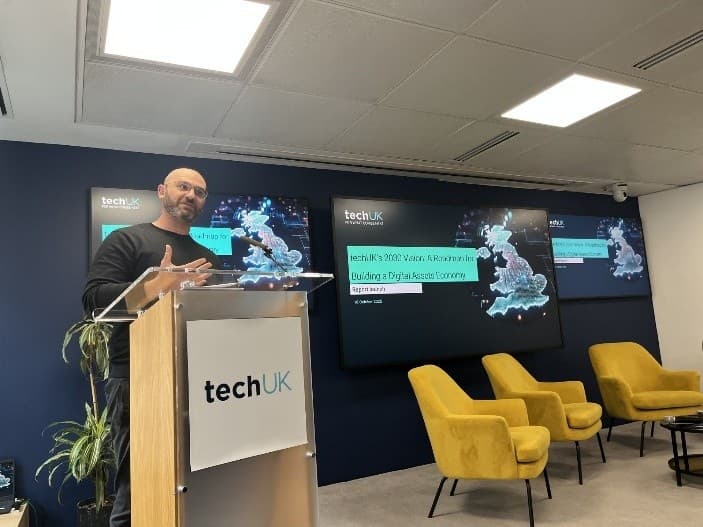
Panel discussion: opportunities, risks and the role of regulation
Following Matt’s remarks, a panel of distinguished industry voices explored current use cases and the policy pathway to 2030. The panel featured:
Matt Green, Partner & Head of Blockchain & Digital Assets, Lawrence Stephens
Cindy van Niekerk, Founder & CEO, Umazi
Robert Gaskell, Founder & Partner, Appold
Dr Christina Yan Zhang, CEO, The Metaverse Institute
The discussion also focused on the report’s proposed roadmap for policymakers and regulators to secure UK leadership by 2030:

Building foundations – Establish a comprehensive national strategy, expand the Digital Securities Sandbox, and prepare for quantum risks.
Strategic scaling – Introduce a UK-native stablecoin framework, develop a national strategy for tokenisation, and invest in digital-asset talent and education.
Shaping global standards – Use the UK’s reputation and influence to lead on standards for digital assets, programmable finance and fraud prevention, and forge strategic global partnerships to create trusted cross-border corridors.
An audience Q&A surfaced pointed questions: What does tokenisation mean in practice for real-world assets? How do regulators keep pace without stifling innovation? What role do skills and education play in preparing the workforce? Panellists addressed these candidly, returning to a central point: policy, regulation and market readiness must move in unison.
What this means for the UK
A recurring theme throughout the morning was urgency. To lead rather than follow, the UK must act now. The report stresses that digital assets are not a niche, but critical infrastructure for the UK’s future digital economy.
The event underscored the role of multiple stakeholders—industry, regulators, standards bodies, talent-builders and government. Fragmentation, unclear regulation or skills gaps pose real risks. Conversely, a coordinated approach could unlock new asset classes, liquidity, efficiencies and growth in the creative industries.
Looking ahead
As the report recommends, the next 12–18 months will be crucial. Key areas to watch include:
The speed and quality of UK regulatory frameworks for stablecoins, DLT and tokenised assets.
Growth of industry-led sandboxes and pilot programmes moving into scaled deployment.
Investment in talent and skills—programmes to train and upskill the workforce in asset tokenisation, DLT architecture and programmable finance.
UK engagement in global standard-setting—interoperability, cross-border corridors and fraud-prevention frameworks.
Tangible roll-out of real-world-asset and creative-economy applications using digital ledgers and tokens.
Final thoughts
The launch of 2030 Vision: A Roadmap for Building a Digital Assets Economy marks a significant moment with a clear ambition: to move the UK from adaptation to global leadership. What remains is for policy, regulation, industry and talent to converge and deliver at pace over the coming 12-18 months. Read the report in full here. If you have views on this topic and would like to discuss in more detail - or to learn more about techUK’s areas of focus - please contact james.challinor@techuk.org.