Innovation Nation: from breakthrough to breakout – Tech and Innovation Summit 2026 round-up

On 3 November, techUK brought together founders, investors, researchers, policymakers and technologists for our fourth annual Tech and Innovation Summit. This year's theme, Innovation Nation: from breakthrough to breakout, tackled a familiar UK problem: while we’re excellent at inventing world-class technology, we too often let other countries build, scale and profit from it. The day followed the innovation journey in order: getting ideas out of the lab, building and scaling companies, financing and buying innovation, regulating it, and deploying it beyond the pilot. Across keynotes, panels and fireside chats spanning AI, quantum, semiconductors, photonics and robotics, discissions explored where the UK captures the value of its ideas, where it loses that value and what it would take to turn this around.
The Summit was opened by Chris McDonald MP, Minister of State for Science, Innovation and Investment, with a later keynote from Peter Fortune MP, Shadow Parliamentary Under Secretary of State at the Department for Business, Innovation, Science and Trade. Across the day, attendees heard from speakers across government, Catapults and national research centres, universities and university spin-outs, deep-tech founders, high-growth SMEs and scale-ups, and skills providers. Together they offered a view of the innovation journey from every angle: those creating new technologies, those building and scaling them, and those shaping the policy, funding and regulatory conditions they depend on.
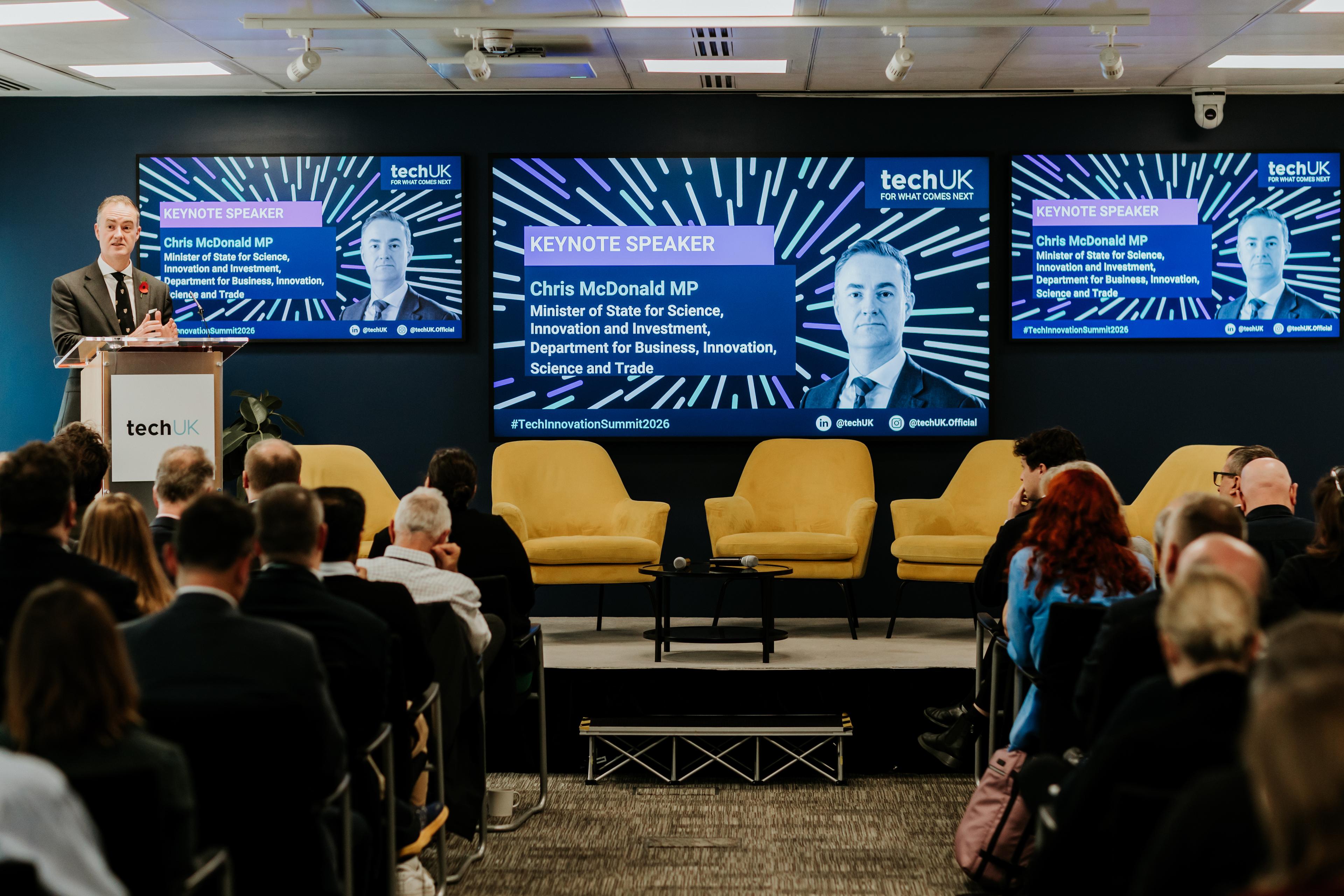
The day followed the innovation journey in order: getting ideas out of the lab, building and scaling companies, financing and buying innovation, regulating it, and deploying it beyond the pilot. Across keynotes, panels and fireside chats spanning AI, quantum, semiconductors, photonics and robotics, discissions explored where the UK captures the value of its ideas, where it loses that value and what it would take to turn this around.
Below is a summary of the key takeaways from across the day:
From lab to company
The UK's research base remains one of its greatest strengths. It has four of the world's top 10 universities, a disproportionate share of highly cited research, and leading quantum, semiconductor and AI clusters. Speakers agreed that the culture around commercialising that research has changed markedly. Not long ago, spinning out a company was seen as a distraction from "real" research. Today it is widely seen as a route to impact, encouraged by funding that rewards it.
New sources of capital have also made a difference. University-linked venture funds have drawn in billions of pounds of co-investment and are being replicated outside Oxford, Cambridge and London. But speakers stressed that success starts long before a company is formed: with curious people, an entrepreneurial environment from day one, and sustained investment in fundamental research. Today's quantum strength rests on research funded decades ago. There was a strong plea to keep funding blue-sky science alongside translational work, and to bring business challenges into the lab early so researchers make better assumptions as they move up the technology readiness levels.
The question of university equity stakes divided opinion. Some panellists noted that equity stakes are still often the first thing investors ask about, and that the stakes UK universities typically take remain higher than those at some leading international institutions. Others argued that the most extreme examples of universities demanding large stakes are now out of date, thanks to recent guidance and the national spin-out review. Panellists did come to a consensus that the focus should move away from disputes over equity splits and towards collaboration that increases the overall value of spin-outs.
Pairing researchers with experienced commercial talent, access to lab and incubator space, and visibility matters as much as Mone. Speakers highlighted three other areas that matter:
Commercial talent alongside researchers. Founders described learning on the job what a technology transfer office does, what an accelerator programme involves, and how to explain their technology to industry partners who didn't understand the technical language. Speakers called for commercial talent to be deliberately brought into research centres and matched with scientific founders from the start. They described "venture building" as a craft in its own right, which the UK is still early in learning, and as companies mature, people experienced in turning a working technology into a reliable product are scarce.
Space to build. Deep tech, and hardware in particular, needs physical infrastructure: labs, cleanrooms, and incubator space where young companies can keep developing outside the university. Hardware spin-outs typically draw more heavily on university labs and equipment than software companies do, which is one reason spin-out terms differ between them. Speakers made the case for the right property and facilities portfolio around research centres as part of any successful ecosystem.
Visibility and connections. Spin-outs from outside the 'golden triangle' described having to prove themselves first, with international investors sometimes unfamiliar with their university or region. Better connections between regional ecosystems and the established clusters would mean more collaboration, more investment and stronger reputations. International programmes that take early-stage companies overseas and arrange meetings with manufacturers and partners were praised for opening doors a small company could not open alone. Universities' own international research partnerships can also become a spin-out's first customer and route to market.
Scaling here, not elsewhere There was broad agreement that the UK is now good at starting companies, with UK tech start-ups raising more in the first half of the year than France, Germany and Sweden combined. But later-stage rounds in the US can be more than two and a half times larger than herre in the UK. That gap is where many promising British companies decide to sell, move or list elsewhere, and with them go supply chains, tax revenue, the next generation of founders, and the decisions made at headquarters.
Recent government measures were welcomed as steps in the right direction: an expanded British Business Bank, additional capital for the National Wealth Fund, a new founders' relief, and listing reforms. Several speakers said seed to Series B funding is now largely working. The harder problem is the larger tickets needed by capital-intensive deep tech, where public institutions can act as a catalyst with an outsised effect.
Speakers were clear that capital is only part of the picture, especially for physical technologies. A robot, autonomous vehicle or quantum computer must work fully before it can be sold; you can't ship it 90% finished and patch it later. Sales cycles with large customers are long, corporate sponsors move on, and revenue can be lumpy. Founders' advice included:
Understand what each investor is worried about.
Build human relationships rather than relying on pitch decks.
Raise a proper round early rather than bootstrapping for too long.
Avoid depending on a single partner's product strategy.
International partnerships and joint ventures were described as valuable export routes, provided core IP and growth stay anchored in the UK. Speakers described how a first UK customer, often in government, built the credibility that led to international sales. Export finance, trade missions, technology partnerships with allies, and programmes that arrange meetings with overseas manufacturers and partners were praised for opening doors small companies could not open alone. The underlying message was that the UK should aim to be an indispensable partner in global supply chains, not self-sufficient. If ownership and decision-making move abroad, the UK risks keeping the research but losing the headquarters, jobs and tax revenue, with speakers agreeing that going global was seen as a route to keeping value in the UK, not a threat to it, as long as companies grow out from a strong UK base rather than leave in order to grow.
Building at home
Modern re-industrialisation: framed not as recreating the industries of the past but as applying advanced technology to the places and sectors that make, power and move things. Every part of a modern industrial base, from design and simulation to process control and predictive maintenance, depends on digital technology. That makes re-industrialisation fundamentally a technology adoption agenda. The UK's manufacturing strengths in high-value, complex, low-volume production align well with its strengths in software and AI.
The UK cannot build everything and should not try to do so. Supply chain shocks during the pandemic, and the growing strategic importance of technologies like AI, semiconductors and quantum, have put sovereignty firmly on the agenda. But speakers were equally clear that the UK is an open, trading economy that relies on global supply chains. In semiconductors, for example, the supply chain is so international that the focus should be on where the UK already has an edge, such as compound semiconductors and photonics. In robotics, the UK is strong in software but imports most hardware components, often unaware that UK suppliers exist. Simple steps like a national registry of UK robotics companies were seen as quick wins.
Barriers raised included:
High industrial electricity costs and growing difficulty securing grid connections.
Difficulty accessing later-stage patient capital.
Slow negotiations caused by every university and company bringing its own IP and collaboration model. Standard frameworks could help.
Academic-led research consortia that drift away from commercial outcomes, where industry- or government-led consortia might do better.
Cyber resilience. Recent incidents showed that the cost of an attack falls heavily on suppliers and local economies, not just the company hit, making a case for collective action.
Several examples showed how old industrial sites can be given a new purpose. Aircraft wings built where a steelworks once stood, nuclear technology developed in a former Spitfire factory, and drones made on the site of a closed car plant. In each case, a combination of factors anchored new industry to the place: a long-term anchor customer, often public sector; a skilled workforce developed with local colleges; an active local authority; and nearby research facilities and Catapults. Some summarised the recipe as customer, capital, capability, cost base and connections, plus strong institutions
Financing innovation The UK offers a wide range of R&D support: grants, R&D tax relief, the patent box, and national programmes. But speakers described a landscape that feels fragmented, with separate applications where "no one is talking to anyone else".Making support easier to navigate, and joining it up so that one award eases access to another, was a common ask.
R&D tax relief has been through a turbulent few years. A crackdown on poor-quality claims succeeded, but it also deterred legitimate claimants: new claimants fell from around 17,000 in 2019 to around 4,000 in 2025. Speakers welcomed recent simplifications and a period of relative stability, while noting that processing delays remain a real frustration. Moving some innovation decisions to a local level was seen as the right direction, but with a warning against adding another layer of complexity in places without clear local structures.
Public procurement emerged as one of the most powerful tools available. Companies that won an early government contract described how it forced them to define requirements, negotiate contracts and deliver to deadline, discipline that grant-funded R&D rarely instils. It also gave them credibility that led to repeat international sales. The challenge is making that experience the norm rather than the result of finding the right fast-moving team in government.
Public funding does more than provide money: it sends a signal to private investors. By the time public funding has invested time and money in a company, they have assessed both the technology and the strength of the business behind it. That gives private investors and public buyers confidence. Funders are increasingly taking a more investor-like view, forming judgements on whether a company has "the right stuff" rather than only scoring individual projects.
Public innovation funding is also becoming more targeted. Open competitions are giving way to themes aligned with the industrial strategy's priority sectors. That brings focus to areas like quantum, but companies outside those themes may find much less support beyond general R&D tax relief.
Speakers also noted that funding needs to evolve with a company. As a product matures, the emphasis shifts from novelty to reliability, and the team shifts from researchers to experienced engineers and managers. Yet many funding instruments, and some procurement, still reward novelty over maturity. The debate over routes to growth was healthy: VC, government contracts, or enterprise customers. Each has trade-offs, and founders favoured winning real customers as early as possible.
Compute and hardware were flagged as part of the financing picture. Some UK AI start-ups are funded by US investors and rent US compute, so much of the value flows straight back across the Atlantic. Speakers called for shared UK compute capacity and incentives to train models here. They also saw a short window, ahead of the next spending review, for the UK to do much more AI hardware manufacturing.
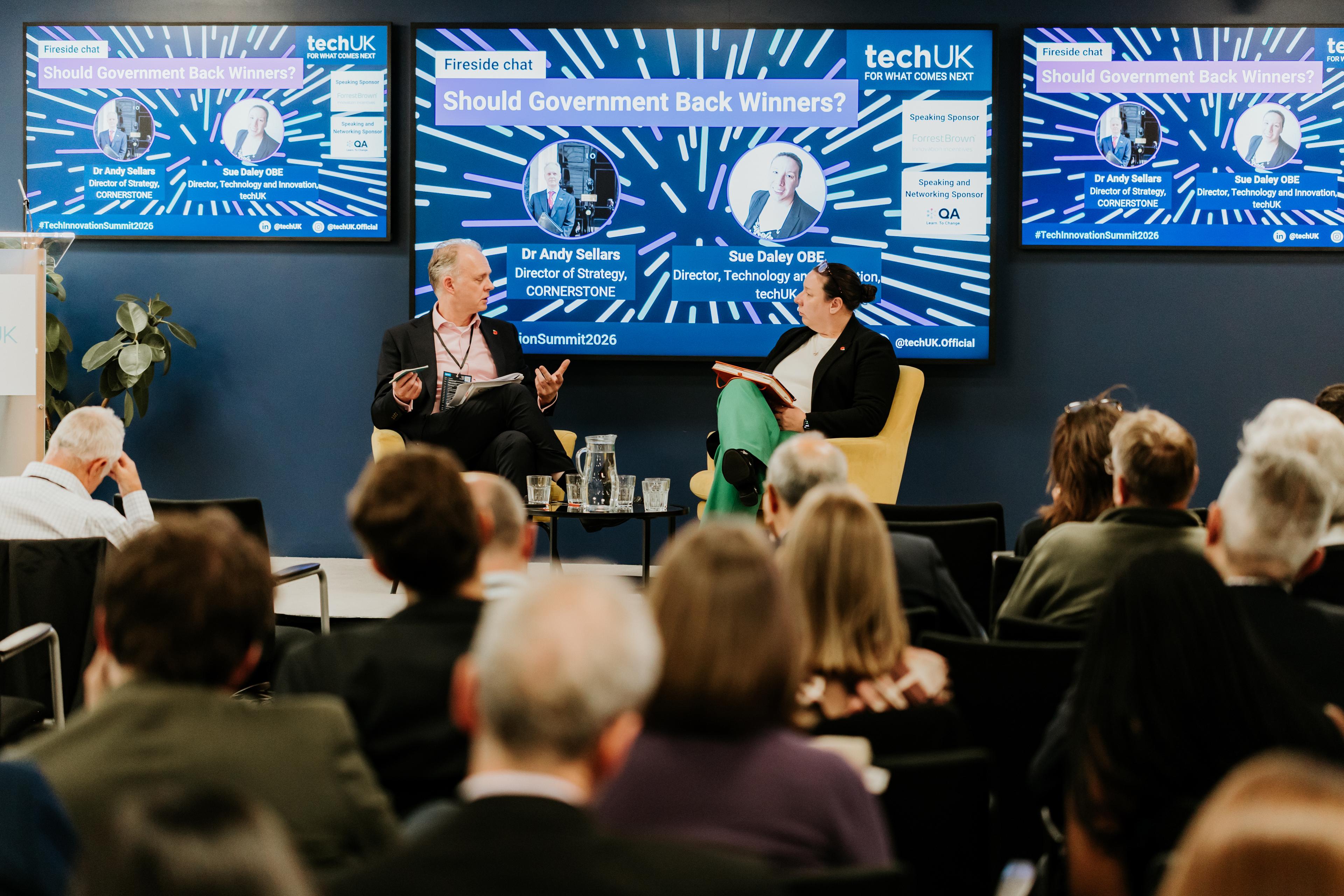
Should government back winners? Speakers traced UK policy from direct state intervention in the 1970s, through the free-market 1980s, to today's consensus. That consensus holds that markets work well in general, but deep tech faces specific market failures: long times to market, high capital intensity, and resistance from incumbents.
Globalisation has also brought specialisation and lower costs, but also fragile supply chains, exposed during the pandemic when cars couldn't be finished for want of a single inexpensive chip. That shock, and the rise of AI and quantum, has pushed governments everywhere towards a more active role. Rather than a yes-or-no question, "picking winners" was framed as a sliding scale. It runs from picking challenges and capabilities, through sectors and technologies, to backing individual companies. The UK is now increasingly backing specific technologies such as semiconductors and quantum. Suggested criteria were strategic importance for the economy and national security, and genuine competitive advantage.
History offered lessons on both sides. An ambitious 1970s state semiconductor venture left a lasting legacy, including a fab still operating in South Wales and a chip design community in Bristol. But stepping away from its pioneering work arguably cost the UK a much bigger prize. A decade ago, UK solar cell manufacturers collapsed in the face of sustained overseas subsidies. The consistent message was that long-term commitment across changes of government matters more than any single intervention. Some economies have succeeded by backing an industry consistently for 40 years.
Regulation as a competitive edge Regulation was described as an under-appreciated reason why companies choose to test or scale abroad. The problem is rarely the rules themselves, and several speakers defended the UK's flexible, outcomes-based approach. The real issues are threefold: regulators' natural caution when evidence is thin, gaps in understanding of new technologies, and technologies that cut across several regulators at once. A single product might touch health, data, safety and communications regulation, with none clearly in the lead.
Practical progress was highlighted:
Regulators working together on cross-cutting issues, such as spraying crops by drone, which spans aviation and health and safety rules.
New guidance clarifying which aviation regulator applies to dual-use drones.
Work towards the first health and safety guidance on collaborative robots working alongside people.
A sandbox to explore how AI can support drug development.
Local regulatory experiments, such as a licensing approach for pavement delivery robots in Milton Keynes.
Forthcoming sandboxing powers could allow regulations to be temporarily set aside for controlled trials, then changed permanently where they work. The biggest frustration was approvals that must be repeated area by area. Examples included a proven pilot with one NHS trust having to start again with the next, and delivery robots needing separate permissions from each council. Speakers contrasted this with countries that have legislated nationally and seen deployment grow rapidly, attracting investment as a result. Approvals recognised across the country, and regulators willing to engage early while technology is still developing, were seen as the way to turn regulation into an advantage. Businesses were encouraged to bring specific examples of regulatory blockers to government, which is actively asking for them.
Beyond the pilot
The "pilot production gap": the point where a technology works in a trial but never reaches full deployment. This can be caused by a variety of factors including regulatory uncertainty, procurement, customer hesitancy, and practicalities like where to store robots in a hospital. The costs are two-fold. Start-ups go where scaling is easier, taking IP, jobs and tax revenue with them, and UK businesses that don't adopt lose productivity.
Speakers agreed that uncertainty, rather than the rules themselves, is the main brake. Industry estimates suggest 15–25% of enquiries to adopt robotics in industrial settings stall on safety uncertainty alone. New health and safety guidance, co-developed with industry, could lift adoption by up to 20% within a year. Where views amongst panellists diverged was on speed. From the industry side, the frustration was clear. Every extra month spent on another council's slightly different paperwork eats into a start-up's runway, and progress towards a national approach has been slow. The counter perspective acknowledged the frustration but argued the direction is right. Regulators are increasingly willing to engage before a technology is ready, co-designing rules through sandboxes and innovation accelerators. Speakers also cautioned against "throwing the baby out with the bathwater": the UK's outcomes-based regulation is more flexible than tick-box systems elsewhere, and what it needs is clearer guidance, not wholesale change. Others added that decades-old rules in areas such as electricity networks are already getting in the way of AI, and argued for built-in mechanisms to review and set aside outdated regulation.
Skills are a hidden barrier to adoption. Organisations typically build a technology strategy first, investing heavily in what to buy or build, and only think about skills once the technology has landed, creating a lag before the investment pays off. Many also assume staff already have the skills they need, or that a short training session will do. The alternative is to treat workforce capability as infrastructure, planned alongside technology. In practice that means:
Training for the near term, not "for a rainy day" and not generic, one-size-fits-all courses.
Shorter planning cycles, of 6–12 months rather than five-year workforce plans. Skills now "live in beta", with roles like forward-deployed engineers going from almost unknown to in high demand within 18 months.
Skills-based rather than job-title-based planning, so people can be redeployed as technology changes. The alternative is the costly cycle of letting staff go in one area while hiring scarce talent at a premium in another.
Can working across multiple sectors helps companies scale faster? Some argued companies should lean into it. Technologies like AI and engineering biology naturally apply across sectors and often face the same underlying questions, such as how to show something is safe. Regulators and government can help by treating these as common challenges. But for other technologies, there was a consensus that innovators should explore widely to find the right market, then focus on making one thing exceptionally well. Every extra product variant multiplies testing, prototypes and supply chain costs. Customers want outcomes, not robots for their own sake. The early car industry started with one model, not a range. Broaden again once you have scaled.
How the UK diagnoses its scale-up problem. Much of the debate focuses on the supply side: more investment, pension reform, talent visas. Less attention goes to demand, but panellises argues that innovation needs a first customer, and companies scale where their customers are. The UK's fastest-growing AI companies tend to serve financial, professional and legal services because that is where large UK customers exist. Building demand in sectors such as manufacturing, through government strategy and procurement, would help supply follow. Speakers also suggested publishing what is learned from publicly funded deployments. One programme pairing start-ups with organisations deploying AI plans to share anonymised lessons on assurance and compliance, so others can see what has worked and adoption feels less risky.
Confidence and culture
If one message ran through the whole day, it was that the UK has the ingredients for success: world-class research, brilliant founders, strong regional clusters, industrial sites with proud heritage and new purpose, and real capability in the technologies of the future. What it hasn't always had is a joined-up approach, policy stability across governments, and the confidence to back itself.
Speakers urged the community to drop the "we can't do it" mindset, stop assuming success means exiting to the US, and adopt a "go, go, go" attitude. A closing keynote from the creative technology sector showed how UK craft spans Hollywood film, the automotive industry and AI. It reminded us that the UK is full of success stories at the intersection of sectors, and that we need to join the dots and tell those stories more loudly.
The day in pictures
A selection of moments from across the day, from the opening keynote to the closing panels.







What's next
The Tech and Innovation Summit is part of techUK's Emerging Technology programme. The programme brings together industry, government and researchers to accelerate innovation and commercialisation, helping turn emerging technologies from early-stage research into real-world deployment . It spans AI innovation, quantum, semiconductors, robotics, photonics, digital twins, frontier compute and more through a regular drumbeat of activity. Click the links above to find out how you and your organisation can get involved.
Get involved in next year's summit. Planning for the 2027 Tech and Innovation Summit is already under way. If you are a techUK member interested in sponsoring or speaking at next year's event, and in helping to shape the discussion, please get in touch with Ella Shuter at ella.shuter@techuk.org.
Thank you to everyone who spoke, chaired and attended, and to our sponsors QA and ForrestBrown for making the day possible.
Sponsors
QA

QA is the largest tech training company in the UK and Europe’s leading AI technology and digital training partner. We teach the critical AI, technology, digital and human skills needed to transform and succeed in a changing world. For over 40 years, organisations have trusted us to transform the capabilities of their people. Our tailored learning solutions include apprenticeships, instructor-led, and self-paced modalities for individuals and cohorts. Discover why over 4000 organisations trust QA to apply skills back to their business. Learn. To Change. For more information, visit us at QA.com.
ForrestBrown

ForrestBrown is an award-winning incentives and reliefs specialist. We help technology businesses unlock opportunity by securing innovation incentives and reliefs that support growth, investment and product development. Combining deep tax expertise with industry insight, we take an adviser-led, technology-enabled approach that helps forward-thinking businesses shape what's next with confidence.