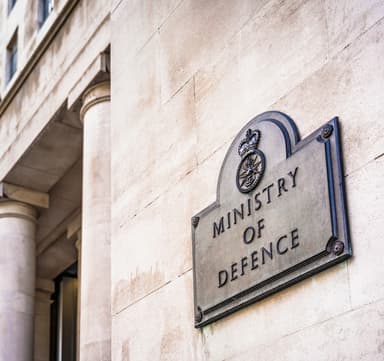
The issues in not adopting AI in Defence

The pressures on MOD personnel are ever increasing
With war in Europe, conflict in the Middle East and rising tensions in the Far East, the pressures from overseas are real and obvious. The UK no longer has the luxury of time.
And at home, with a new government progressing the Strategic Defence Review and defence spending still stuck at 2.3% of GDP, there is huge pressure on MOD personnel to save money. Or specifically, to do more with less, to increase competitiveness, manage ever increasing volumes of data and do so on modern terms of equality and social value.
Currently, decision making is expensive, time consuming and flawed
We all make thousands of decisions a day, with the average human making 34,000 according to the Harvard Business Review, or a decision every 2 seconds.
Albert Einstein used to wear the same colour clothes each day to reduce his decision making, later copied by Steve Jobs and Barack Obama.
For the more difficult decisions, the data needed to make the best decision is out there, and often in reach. But this has been mirrored by the decreasing availability of suitably skilled people to sift through this data.
Typically, we spend 1.8 hours a day, or nearly 10 hours a week, searching for the right information according to McKinsey. For analysts, and the UK government employs approximately 17,000 analysts, this rises to 60% of their time spent making sense of data.
Data rates are increasing by approximately 23% per annum or doubling every 3-4 years. Highly regulated sectors such as defence, security and finance are inundated with diverse, complex data from a multitude of sources. MOD and government teams simply are not scaling at the same rate and are more often being reduced in size. And the infrastructure to understand and distribute information in a time-sensitive manner is often sub-optimal.
The result is that many MOD and government personnel are now suffering from cognitive overload, unable to find the information they need to allow proper thinking time to make optimal strategic decisions. This can lead to one or more of three outcomes:
Information being missed, not being seen in time, ignored, or incorrectly understood. Often leading to no decision at all.
Decisions being based on instinct rather than information. Our subconscious brain is programmed to make a “gut reaction” decision and then search for the information using our logical brain to back up this decision. This can often lead to cognitive bias, particularly given the echo chambers we often create for ourselves.
Stress, anxiety and time off work, with 1 in 6 employees now reporting a mental health condition (UK government)
Additionally, people will often resort to using Shadow IT to find the information they are looking for, risking cyber breaches and hallucinations from ChatGPT.
In a perfect world, we would have more time to make the best decisions
In a perfect world, we would all have the time to carefully consider important decisions. We would have summaries of the documents that contained the information we needed readily available, whether they came from text, images or other types of data, and that could be relied upon without worry. Whether in the office, the command centre or the battlefield, we would have the capacity to think through all the options, weight them according to the support they had and reference our evidence. We would always be able to make the best decision using the right information with the speed that the situation required.
Enabling MOD to do more with less
Many people in government believe that AI just means ChatGPT and that the benefits can’t yet be fully realised for MOD and government. However, the tools are available to make decisions faster, reducing cognitive burden, essentially freeing up humans to do what matters with confidence.
UK deep-tech company Oxford Dynamics has worked with Dstl and Commercial-X to bring AI tools to MOD and wider government. Generative AI search, comparison and summarisation tools for Defence that can be trained on MOD data, can now be deployed on ICE (Internet Connected Environment) but also deployable on air-gapped systems at higher classifications.
By using a combination of proprietary AI Modules, together with multiple large language models in parallel, the chance of hallucinations can be significantly reduced. And these tools can also provide comprehensive referencing back to the source material used such that a user can readily verify the accuracy of an answer should they wish. MOD users can be confident in justifying and explaining decision being made, with the full power of the source materials readily referenced.
These AI tools are enabling strategic decision making within government, and have had the support of MOD Commercial, who have put in place an Enterprise Lite framework agreement contract so anyone within MOD can start using them this year.
Our vision is that all MOD personnel make use of such AI tools so they have the time to make important decisions, being able to rely upon the information used, supporting – not replacing – the human.
And our estimate of how much could be saved by the efficient use of AI tools within government is £1 billion on analysis alone, with some 17,000 analysts in government currently spending up to 60% of the time making sense of data. Greater estimates put the potential saving across government with the appropriate use of AI tools as high as £200 billion.
Have you planned how you can take advantage of AI in your work this year?
And what would you do with the spare time it would give you?
We would be pleased to discuss further via rob@oxdynamics.com or lets_talk@oxdynamics.com .