Photonics: the catalyst for tech convergence

There have been many competing technologies, including compound semiconductors and photonics, to rival silicon chips over the years, but manufacturing advances have ensured that silicon has maintained its lead.
To quote Sean Redmond of Silicon Catalyst, “if it can be done in silicon, it will be done in silicon”.
So what’s different this time?
To answer that question, consider the emerging trends illustrated below, in which blue represents microelectronics and red represents photonics.
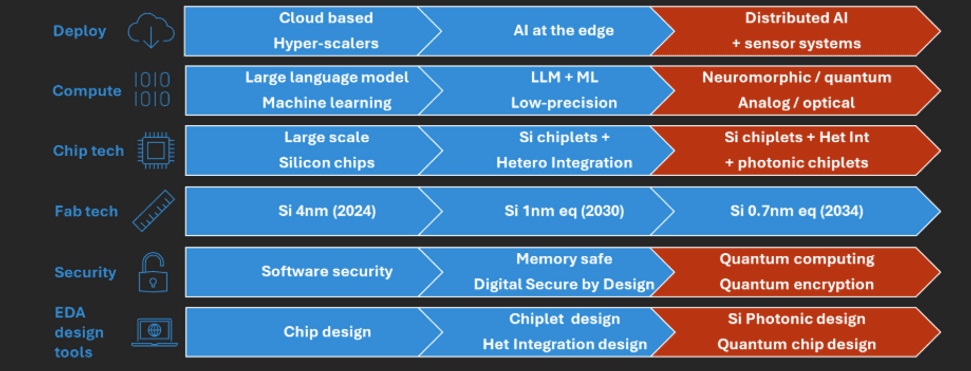
These trends indicate a progressive transition from pure microelectronic systems, based on silicon chips, to hybrid systems that combine microelectronics with photonics – as described below.
While cloud-based AI benefits from scale for training and inference models, it suffers from latency and high energy consumption. In contrast, AI at the edge will be more responsive and energy efficient, creating opportunities for distributed AI sensor systems, which will interpret the environment and respond accordingly.
Recent research has demonstrated AI’s tolerance to low-precision compute – opening up the possibility of new microprocessor designs based on 16bit or even 8bit architectures optimised for edge AI. The advantages of low-precision compute include: reduced memory bottlenecks, faster processing and lower energy. In addition to low-precision compute, AI will also benefit from new paradigms including neuromorphic, analog and optical compute, which is being developed by Microsoft.
As chip nodes have shrunk, the cost to design and verify a new chip has risen by a factor of x18 since 2006, with the cost of designing a 2nm chip forecast to exceed $725m. This trend is accelerating the adoption chiplets, which subdivide VLSI (very large-scale integrated) circuits into smaller reusable IP blocks, thereby reducing cost and speeding time to market. Chiplets are packaged using a process known as heterogeneous integration, which is set to revolutionise the OSAT (Outsource Semiconductor Assembly and Test) industry.
Along with heterogeneous integration, innovations in hybrid integration enable silicon chiplets to be packaged with non-silicon devices, such as photonic integrated circuits (PICs) – combining digital, analog and optical compute in the same package.
Recent data breaches have highlighted the importance of data security, with cyber vulnerabilities costing $9.2tr in 2024. As 70% of cyber vulnerabilities are caused by memory access, new memory safe architectures are being developed, including the Morello CHERI architecture developed by ARM, which prevents unwarranted memory access in 70% of cases.
The emerging technology with the greatest potential to transform data processing is quantum, with quantum computers promising to solve complex computational analytics. However, there are over 80 companies developing quantum computers, with multiple quantum platforms competing for investment. The main quantum platforms are listed below, along with their attributes.
|
|
|
|
|
|
|
|
|
|
|
|
|
|
|
|
|
|
|
|
|
|
|
|
|
|
|
|
|
|
|
|
|
|
|
|
|
|
|
|
|
|
As investors evaluate the relative merits of each platform, it’s clear that some technologies are foundational to more than one platform – these include photon sources, photon detectors, atomic clocks and cryogenic systems. In the case of photonic systems, they are scalable using mature processes developed for silicon photonics; they operate at room temperature; and they offer low decoherence, as photons interact weakly.
The above trends offer considerable opportunities for economic growth, with the UK’s design capability being central to capitalising on the opportunity. The UK has around 130 semiconductor design companies, with established clusters in Bristol, Cambridge, Edinburgh and Oxford, offering the design capabilities outlined below.
|
|
|
|
|
|
|
|
|
|
|
|
|
|
|
|
|
|
Interestingly, 25% of UK design companies design photonics and quantum chips, ensuring the UK is well-positioned to benefit from the transition from microelectronic to hybrid microelectronic-photonic systems.
Recognising the need to operate at the forefront of technology, the UK has recently invested £50m in four Innovation Knowledge Centres (IKCs), researching the following complementary semiconductor technologies:
CHIMES (led by Sheffield University): chip design and heterogeneous integration
CORNERSTONE (led by Southampton University): integrated photonics
NEUROWARE (led by UCL): neuromorphic computing
REWIRE (led by Bristol University): compound semiconductors
IKCs follow a similar business model to Catapults, working with academia and industry to translate early-stage research into commercial applications.
To fully realise the UK’s potential, several reports have recommended investments in pilot line facilities that provide the operational environment to scale-up prototypes. For example, the UK Telecom Innovation Network (UKTIN) Future Telecoms Report recommends a silicon photonics pilot line, while SAIBRE Capital call for sandboxes to integrate technologies for security and defence applications – to build sovereign capability for national resilience and security.
CORNERSTONE has recently launched an open source process design kit (PDK) for PICs, allowing researchers and industry to develop new optical components, which are ready for scale-up and commercialisation in a suitable a pilot line – supporting the above recommendation.