National security: What should governments do now to secure the next generation of technology supply chains?


Nataliia Chornohub
CEO, YC World
Transparency as the foundation of national security
In the context of accelerating digitalisation, technology supply chains have emerged as a critical vulnerability within the broader national security architecture. Heightened geopolitical instability and ongoing acts of aggression are compelling both governments and private-sector actors to fundamentally reassess their approaches to counterparty due diligence. The focus has shifted beyond mere financial reliability to a more comprehensive evaluation of whether counterparties may be linked to entities that support terrorism or are subject to international sanctions.
A key contemporary challenge lies in the existence of “opaque” or non-transparent affiliations. Conventional audit mechanisms are increasingly inadequate for addressing scenarios in which hostile actors leverage complex, multi-layered ownership structures and intermediaries operating across third-country jurisdictions to circumvent regulatory and sanctions frameworks.
Why is the identification of connections critical?
To safeguard next-generation technological supply chains, governments and enterprises must prioritise the detection of concealed affiliations. A clear understanding of ultimate beneficial ownership (UBO) structures, as well as inter-company relationships, enables organisations to:
Mitigate the risk of indirectly financing hostile activities by excluding engagement with entities associated with military aggression or terrorist regimes.
Safeguard intellectual property by preventing the transfer of sensitive or strategic technologies to adversarial actors through intermediary or shell entities.
Maintain robust sanctions compliance by systematically identifying exposure to politically exposed persons (PEPs) and sanctioned entities.
Real threats: the case of transit through third countries
Risks in this domain are not hypothetical – they represent an ongoing operational reality. A recent cross-border investigation by Trap Aggressor exposed a scheme to supply high-precision machinery manufactured in Poland to the Russian Federation via intermediaries based in Turkey. In accordance with international classification standards, such equipment is categorised as High Priority Items due to its substantial dual-use potential, particularly in the context of weapons manufacturing. This case exemplifies how dual-use technologies can be diverted to an aggressor through deficiencies in supply chain oversight. Similar vulnerabilities may arise in any jurisdiction where due diligence processes are confined to direct counterparties.
Technological solutions for complex challenges
Addressing such schemes effectively requires advanced tools capable of mapping complex networks to a depth beyond immediate contractual relationships. One such solution is the automated connection-mapping functionality in the YC World platform, which enables rapid extraction and analysis of counterparty data and their associated networks. In addition, an AI-powered extraction module transforms structured and unstructured open-source data into visual network representations.
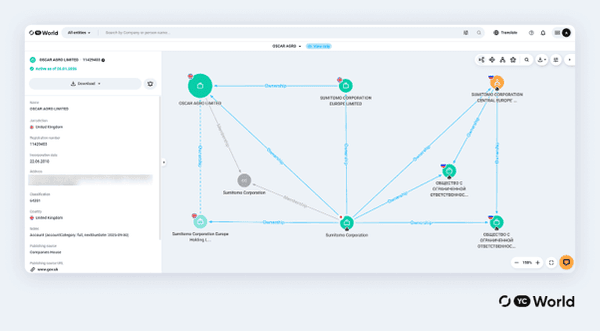
Example: Connection visualisation within the YC World platform
This functionality converts fragmented, unstructured data into coherent risk maps, enabling compliance professionals and government bodies to promptly identify hidden affiliations. The automation of this analytical process is, in practice, indispensable for keeping pace with the speed and sophistication of emerging sanctions evasion mechanisms.
What actions should governments undertake without delay?
Implement a data-driven approach: Deploy advanced analytical platforms that aggregate and consolidate verified data from registries across multiple jurisdictions.
Enhance UBO due diligence: Prioritise identifying and analysing ultimate beneficial owners, rather than relying solely on nominal directors or formal corporate representatives.
Foster business transparency: Establish regulatory and operational frameworks that mandate comprehensive supply chain due diligence for all public procurement and government contracts.
The resilience of future security frameworks depends on the ability to penetrate opaque corporate structures. Only through the coordinated efforts of accountable governments, supported by robust analytical tools, can the global technology and defence sectors be effectively safeguarded against the adverse influence of hostile actors.