From the lab to everyday life

Read this guest blog by Richard Barron as part of Tech and Innovation Focus Week 2026.
Quantum technology is a broad umbrella term, with many potential benefits to a huge array of fields. By relying on quantum effects, such as superposition and wave/particle duality, quantum technologies offer a technological leap forward over even the most advanced classical systems.
Current application
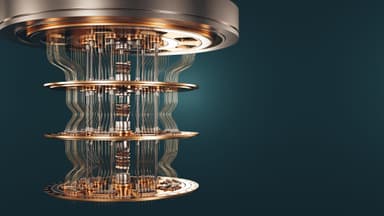
Perhaps the most obvious field where these effects can be used to great effect is in computing, where quantum computers using qubits (rather than the classical bit) promise step changes in computing power and speed – with potential applications in drug discovery, physical modelling, and AI.
However, quantum computing is not the only quantum technology worthy of our attention. Another key application is quantum metrology, which exploits the sensitivity of quantum effects to take measurements of the world around us. Sensors exploiting quantum effects can measure tiny variations in electromagnetic and gravitational fields, detect the presence of gas molecules, and measure time to unprecedented degrees of accuracy.
These technologies not only facilitate highly exciting progress in investigating the physical laws of the universe, but also have practical applications as well. For example, by measuring the tiny electrical and magnetic fields produced by the human body, a quantum magnetometer can measure brain and heart health. By providing a stable and accurate time signal, a quantum clock can provide critical capability in navigational networks, reducing reliance on satellites. Through determining the tiniest variations in gravitational fields, quantum gravimeters can “see” through the ground to locate lost infrastructure such as pipes or mineshafts.
Within many of the fields of quantum technology, due to its cutting-edge nature, there is currently no “default” approach, and companies exploring these technologies may be taking vastly different approaches. Taking the example of quantum computers, while any quantum computer will require qubits to function, the way to generate and control these qubits can be fundamentally different. For example, quantum computing architectures can use photons, superconductors, ions, and neutral atoms to make qubits, each with their own benefits and drawbacks. It may well be that for different quantum computing use cases, different architectures using different qubits will be required.
UK approach to quantum
In recent years, extraordinary progress has been made on these technologies globally. Supported by advances in semiconductor and laser fabrication, quantum technologies are beginning to make the jump from large scale, lab-locked, experimental prototypes to deployable systems capable of operating in the real world.
The UK is well placed to capitalise on the growth of quantum technologies. Through the National Quantum Technologies Programme, the UK has already fostered strong links between academic and industry partners with more than £1 billion invested since 2014. This program focuses around quantum “hubs” based in UK universities, with the current third phase supporting QEPNT (navigation), Q-Biomed (biomedical), QuSIT (sensing, imaging, and timing), QCi3 (computing), and IQN (integrated quantum networks). This approach gives the UK a broad view of the field, and enables research across multiple avenues of quantum technologies.
This overall support and the quantum hubs have already produced a number of spin-out companies such as MoniRail and Delta.g, which are seeking to demonstrate quantum technologies in real-world applications – namely rail navigation and measurement of gravitational fields. The recent announcement of more than £1 billion over the next four years to support scaling quantum technologies in the UK, is a further and welcome demonstration of the government’s recognition of the importance and potential of quantum technologies.
What next?
While the UK is well positioned to make the leap to demonstrate the real-world application of quantum technologies, there is inevitably more that can be done. The key priorities that the UK should focus on are two-fold.
First, for a healthy sovereign quantum ecosystem, the continued long-term support of spin-out companies, enabling them to scale and grow effectively, is key. This support should go beyond the demonstration of technologies, and the translation of them into real-world use cases, helping companies into a profit-making position and enabling competitiveness in the global quantum marketplace.
The second priority should be recognising that quantum technologies do not exist in a vacuum. Supporting technologies such as lasers, optics, and semiconductors – critical for quantum technologies – must be readily available from within the UK supply chain.
Through commitment to innovation incentives and reliefs such as R&D tax relief and targeted grants and loans aimed at each level of the quantum supply chain, the UK can build on its already strong academic and industry collaborations, to become the leading quantum-enabled economy globally.