CHERI: Turning UK Cybersecurity Research into Industrial Advantage

Cybersecurity has become an economic and strategic issue for the UK. Critical infrastructure, businesses, public services and emerging AI systems all depend on increasingly complex software, while attackers are becoming faster and more sophisticated.
Yet much of our response remains reactive: find vulnerabilities, patch them, and repeat. The UK has an opportunity to change that model.
The challenge: preventing vulnerabilities, not just finding them
A large proportion of serious software vulnerabilities arise when software written in languages such as C and C++ handles computer memory incorrectly. These are known as memory-safety errors. UK Government analysis cites research from Google and Microsoft indicating that around 70% of ongoing cyber vulnerabilities are memory-safety bugs. [1] [2]
These languages remain essential to operating systems, embedded devices, telecommunications equipment, vehicles and other high-performance systems. Rewriting decades of existing software is neither quick nor economically realistic.
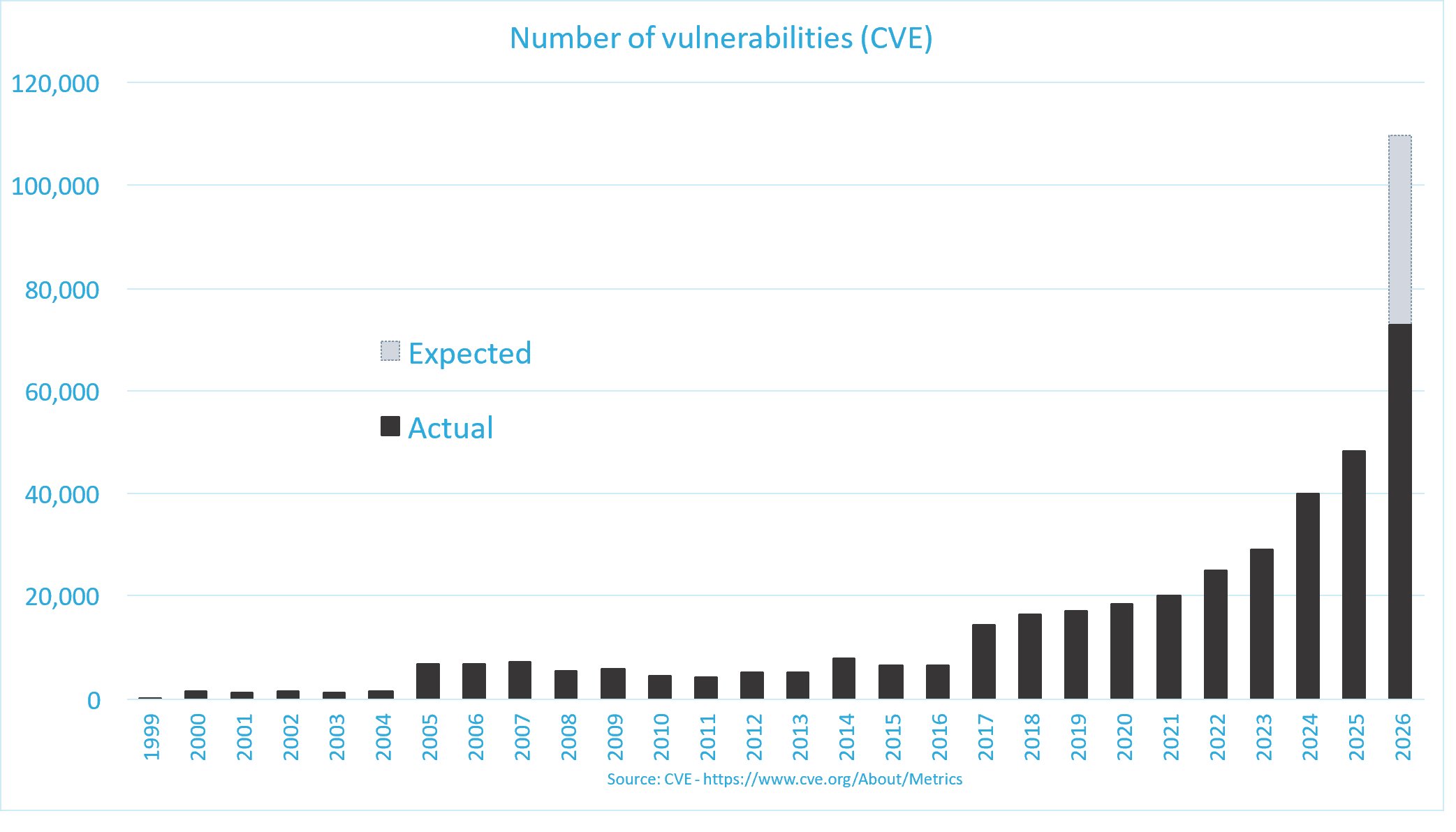
Meanwhile, software supply chains are becoming more complex and AI is accelerating both software development and attackers' ability to identify and exploit weaknesses. Faced with a surge in attacks, organisations are under pressure to fix vulnerabilities quickly.
[Chart: Number of vulnerabilities (CVE), 1999–2026, Expected vs Actual. Source: CVE – https://www.cve.org/About/Metrics]
A strategy built on finding and patching vulnerabilities is a battle we cannot win: by design, the fix always comes after the flaw. Detecting vulnerabilities faster does not change that underlying model. We need computing platforms that can prevent entire classes of vulnerabilities from being exploited.
The solution: security built into the processor
CHERI, or Capability Hardware Enhanced RISC Instructions, takes that approach. It is an open technology, supported by publicly available architectural specifications and open-source software. [3] [4]
CHERI builds protection into the processor itself, controlling which areas of memory software can access and helping isolate software components from one another. These protections are known as fine-grained memory protection and compartmentalisation. Developed mostly by the University of Cambridge, CHERI helps stop memory errors from becoming weaknesses that attackers can exploit. Organisations can keep using existing software and benefit from memory protection and gradually upgrade to strong compartmentalisation.
The UK's National Cyber Security Centre has highlighted CHERI, alongside memory-safe languages such as Rust, as an example of technology that could eliminate classes of memory-corruption vulnerabilities. [5]
CHERI is now mature and ready for industrial adoption after 16 years of research, proof and prototyping. This work has been supported by more than £80 million from the UK Government, alongside £200 million of industrial co-investment.
The Government's stated next step is to encourage the adoption of CHERI in commercial products, working with the CHERI Alliance, the University of Cambridge and industry.
The barrier: moving from innovation to adoption
The challenge now is commercial adoption.
For a new processor architecture to succeed, it needs more than chips. It needs an ecosystem spanning reusable processor designs, chips, operating systems, compilers and other development tools, and software, standards, products and skills.
Companies and design centres across the UK were early adopters of CHERI and are now leading efforts to develop technology components for integration into products. This gives the UK a strong starting position as the focus shifts to commercial adoption.
But technical capability alone is not enough. Businesses also need commercially available components, clear migration paths, trusted implementations and confidence that CHERI will become part of a sustainable global ecosystem.
The CHERI Alliance was created to bring this ecosystem together and coordinate efforts to accelerate industrial adoption of CHERI. It is an independent, non-profit organisation supported by the UK government. [6]
The impact: a UK opportunity beyond cybersecurity
CHERI presents an opportunity not only to make systems more secure, but also to turn decades of UK research leadership into economic value.
The UK has already helped create the technology, and a UK company has been the first to release a complete CHERI product. The next step is to build on that milestone: develop the ecosystem that brings CHERI into more processors and products used around the world. [7]
That can strengthen the resilience of UK digital infrastructure while creating opportunities for British semiconductor companies, software developers, cybersecurity specialists and technology suppliers.
Cybersecurity has spent decades getting better at finding vulnerabilities. The bigger opportunity now is to build systems that prevent entire classes of vulnerabilities from being exploited.
For the UK, CHERI offers a chance to lead that transition.