2025 is the International Year of Quantum and it could just change all our lives
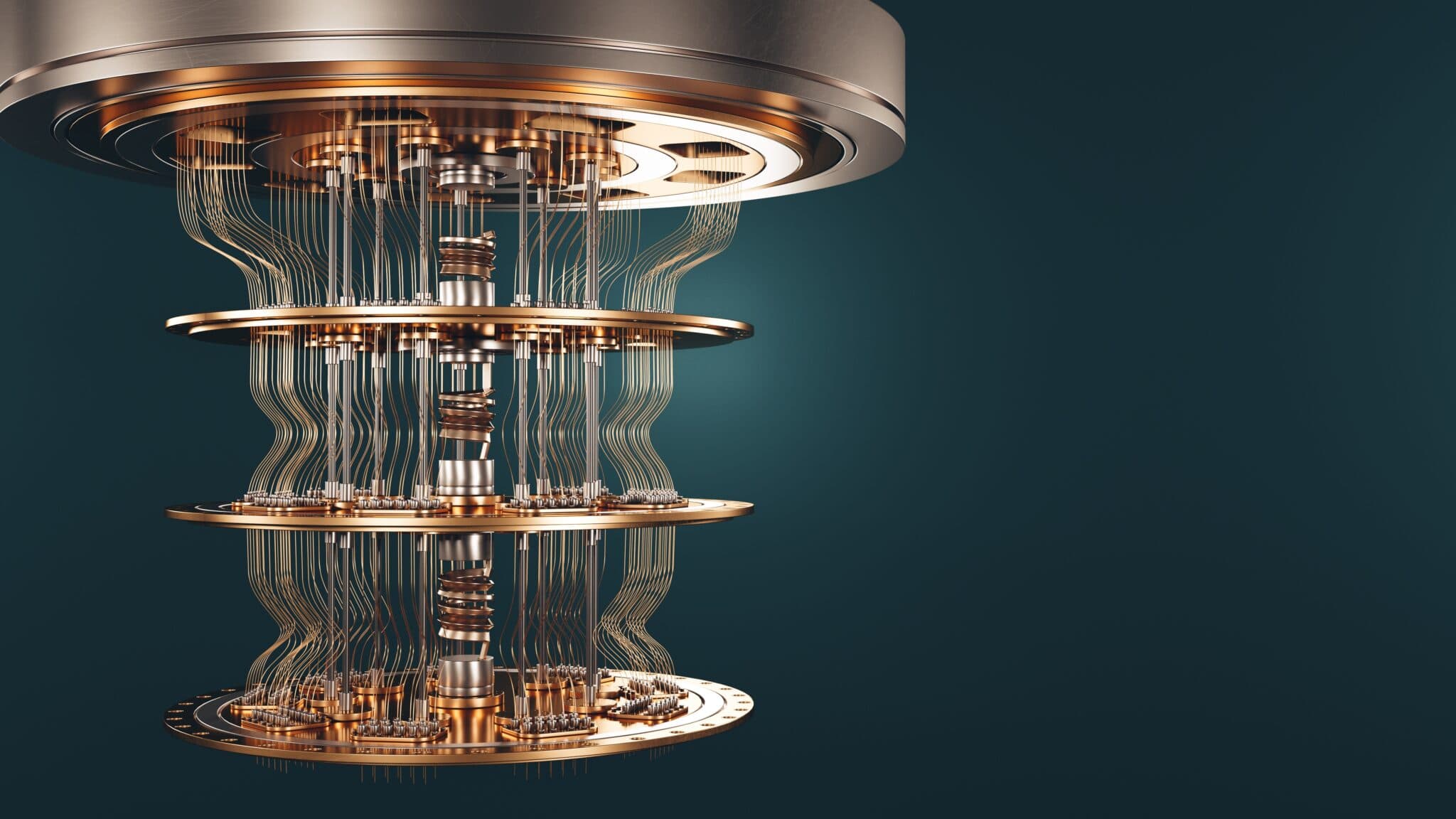
The science we now call Quantum mechanics was kick started in 1925 on the wind-swept island of Heligoland by the youthful German physicist Werner Heisenburg.
This year UNESCO is marking the anniversary of Heisenburg’s breakthrough by holding the International Year of Quantum Science and Technology and the Institute of Physics is delighted to be coordinating contributions on behalf of the UK and Ireland quantum community.
Heisenberg's seminal paper, "Quantum theoretical re-interpretation of kinematic and mechanical relations" also called the Umdeutung (reinterpretation) paper, described the “strangely beautiful interior” of an atom’s mathematical structure.
At a stroke it overturned many of the certainties of classical physics, informed his famous ‘uncertainty principle’ and began the development of matrix mechanics – something new to physics at the time.
Its publication redefined how we understand the most elemental forces in the universe, gave birth to a whole new field of research and investigation and won Heisenberg a Nobel Prize.
The momentum begun by the 23-year-old Heisenburg, who was only on Heligoland initially to help treat a bout of hayfever, was picked up by scientists across Europe in general and the UK in particular, where a series of quantum breakthroughs and insights followed.
Vital contributions from the UK came from scientists like David Thouless, the theoretical physicist who won the Nobel Prize in Physics in 2016 for his work on topological phases of matter and Peter Higgs, who predicted the existence of the eponymous Higgs Boson, detected finally in 2012 at CERN.
And from Sir Michael Berry, one of the pioneers in the field of quantum mechanics, particularly known for his work on quantum chaos and the Berry phase, an essential concept in quantum mechanics.
A field of science with profoundly important practical implications in technologies as diverse as medical scanning, encryption and computing had been launched. And it is poised to transform our lives and economies in a myriad of different ways.
Quantum diagnostics, for instance, mean we can, for the first time, scan the brains of young children who cannot undergo MRIs - to save lives and learn more about early development.
Advances in Quantum encryption mean current online privacy protections are about to become obsolete and international finance giants are already finding ways to make billions using quantum computing to gamble on global currencies.
But for all its transformational opportunities, the majority of which are still to be even imagined, Quantum has a problem. Its tough to explain, hard to understand and sometimes seems to defy anything approaching what most of us would consider a rational explanation.
Its world of entanglements, bosons, field theories and thought experiments is one which most of us would admit to having only the haziest sense of. After all, it was no less a figure than the American physicist Richard Feynman who conceded that “nobody understands quantum mechanics”.
The problem with this of course is that no science cannot survive for long simply on the work of fine minds cloistered away in academia. Sooner or later funding needs to be secured for research, investors found for commercial applications, public and politicians engaged and educated about why this field is worthy of their attention and money.
That’s part of the reason, along with the 100-year-anniversary, that the UN decided to have an International Year of Quantum Science and Technology. A UN ‘year’ might not always be everyone’s cup of Quantum tea but it can give a focus to public engagement and help to break down some of the barriers to understanding.
That’s certainly the hope in any case. The UK is a genuine leader in this industry of the future: we have more quantum companies, and attract more private investment into quantum technologies, than any other country except the US.
We also have an excellent UK National Quantum Strategy. Published in 2022, with the support of the IOP, which provides a roadmap for the next decade of development for this crucial science.
The UK has already made significant progress in the quantum sector, including quantum research hubs and world-leading companies in areas like quantum computing, quantum cryptography, and quantum sensors.
If we want to build on that strong start, we need an informed and excited public which understands why Quantum matters and what Quantum means.
At the Institute of Physics we are helping with that work this year, co-ordinating the UK’s activity and leading on much of the story telling.
We will be hosting and supporting events, generating our own content and supporting our partners in government, business and civil society in telling the story as well.
And we are also listening to businesses in the sector, trying to understand what they need and working to help government understand how we can make the most of the investments we are making in Quantum. Our recent project working with the venture capital community looked at how they could be helped to find opportunities in physics deep tech and how science-driven innovators can market themselves to unlock the capital they need.
We believe quantum could solve some of biggest challenges facing societies and humanity; from climate change to preventing terrorism. And we understand the opportunity which it presents to our economy.
But we also know we’ll only get the benefits from this kind of global revolution – if it is understood, supported and debated by society, governments and communities. That’s the mission we have set ourselves for the International Year of Quantum and we are proud to be playing our part.
Find out more about the year of Quantum at the IYQ page, Also please visit our Vision for Quantum and VC report pages.
techUK – Unleashing UK Tech and Innovation
The UK is home to emerging technologies that have the power to revolutionise entire industries. From quantum to semiconductors; from gaming to the New Space Economy, they all have the unique opportunity to help prepare for what comes next.
techUK members lead the development of these technologies. Together we are working with Government and other stakeholders to address tech innovation priorities and build an innovation ecosystem that will benefit people, society, economy and the planet - and unleash the UK as a global leader in tech and innovation.
For more information, or to get in touch, please visit our Innovation Hub and click ‘contact us’.